7 best Profound AI alternatives in 2026 (after its pricing change)

The best alternatives to Profound AI, which dropped its self-serve brand plans in September 2026, depend on the job. For self-serve tracking, compare Quotable, Peec AI, AIclicks, and Promptwatch. Evertune suits brand research and AI advertising, AirOps content operations, and Bluefish AI enterprise brand governance.
If you were about to buy Profound’s Starter or Growth plan this autumn, you’ve probably noticed they’re gone. Sometime between September 14 and September 21, 2026, Profound’s pricing page stopped listing the two self-serve brand subscriptions, and a brand now gets a seven-day free trial or a custom Enterprise quote. That’s a reasonable move for a company that raised $180 million in October to build an AI platform for marketing, but it leaves a team that wanted to start tracking AI visibility without a sales call looking for an alternative to Profound AI.
None of this means Profound got worse. Changes to a public pricing page don’t rewrite existing contracts, and its agency pricing runs on a separate track. It does mean the comparison you’re making has changed, from “which Profound plan?” to “which product does the job I actually need?”
Profound alternatives by use case
- For the lowest cost per tracked prompt in this comparison, start with Quotable.
- For focused AI visibility monitoring with clean source data, start with Peec AI.
- For tracking plus the work that follows (articles, page rewrites, crawler checks, an agent that acts on your data), compare Quotable and AIclicks.
- For brand research with repeated sampling and AI advertising, look at Evertune.
- For content production at scale, AirOps is the closer comparison.
- For monitoring plus article drafts and crawler logs in one self-serve plan, compare Promptwatch.
- For brand accuracy and governance at enterprise scale, look at Bluefish AI.
Full disclosure: this comparison is published by Quotable, one of the products on the list, so we’re biased. We ran a free trial on every platform that offers one and tested them hands-on, then went through each vendor’s live pricing page, help docs, and public reviews on G2, and checked prices on November 3, 2026. Where a product is sold only through sales, as with Bluefish AI and Profound Enterprise, the descriptions come from its public documentation.
The best Profound AI alternatives at a glance
| Alternative | Best reason to choose it | Starting at | Entry-plan tracking | Entry-plan cost per prompt/mo | What to watch |
|---|---|---|---|---|---|
| Quotable | Tracking, sources, crawler analytics, and an agent that does the follow-up work, at the lowest cost per prompt here | $99/mo | 100 prompts per model, 3 models | $0.99 | Newer platform with little public review evidence |
| Peec AI | Focused prompt tracking and source intelligence | $95/mo | 50 prompts, 3 selected models | $1.90 | Prompts are shared across projects |
| AIclicks | Lower entry price with content and outreach actions | $59/mo | 30 prompts, 3 engines | $1.97 | API only from Pro |
| Evertune | Brand research, repeated sampling, and AI advertising | $60/mo | 5,000 prompt credits, up to 5 models | Credit-based | 100-sample measurement only on Pro |
| AirOps | Turning AI search findings into content operations | About $199/mo (not published) | 100 prompts, ChatGPT only, on Solo | Not published | More engines need Pro, at about $1,999/mo |
| Bluefish AI | Enterprise brand accuracy and governance | Custom quote | Custom | Not published | Not a budget substitute for Profound |
| Promptwatch | Monitoring plus content agents and crawler logs | $95/mo, 7-day trial | 50 prompts, 4 models | $1.90 | Articles and crawler logs start on Professional |
Prices are month-equivalent figures from each vendor’s pricing page, with two exceptions: Quotable’s come from its own pricing, and AirOps doesn’t publish prices, so its figures are the widely reported ones. The per-prompt figure divides the entry price by the tracked-prompt allowance, so it doesn’t account for how many engines each prompt runs on. Prompts, prompt credits, and AI responses are different units, which is why three rows can’t be reduced to one number.
What you can actually do in each product
A line that says “AI visibility tracking: yes” tells you very little, because almost every platform here can show brand mentions. The differences show up when you try to investigate a missed recommendation, coordinate a fix, or report on what happened.
| Platform | Where most of the work happens | What you can investigate or execute | The limitation to check |
|---|---|---|---|
| Quotable | Prompt analytics, sources, crawler views, Quotable Agent, and Tables | Review a missing recommendation, inspect cited evidence, check crawler access, then have the agent draft the article, rewrite the page, or build the workflow | Engine coverage and credit use on your plan |
| Peec AI | Performance dashboards, prompt and topic filters, source and recent-chat views, Actions, and Peec Agent | Compare visibility across engines, inspect answers and sources, and work through ranked recommendations | Selected models and prompt allocation |
| AIclicks | Prompt tracking, Sources and Citations, Recommendations, and content tools | Filter sources by model, page type, or missing mentions, then turn a gap into outreach or content | Starter’s prompt limit; integrations from Pro |
| Evertune | AI Brand Index, Consumer Preferences, and Content Analytics | Study unaided awareness, attribute associations, and influential sources, then connect them to ads and content agents | Repeated sampling and advanced research sit on Pro |
| AirOps | Insights and Page360, spreadsheet-like Grids, and the workflow builder | Move a content gap into a bulk refresh, human review, and CMS publication | More moving parts; Solo insights are ChatGPT-only |
| Bluefish AI | Audience-level monitoring, source influence, and AI Accuracy | Find which persona receives a wrong claim, trace the source, and coordinate the correction | Sales-led scope and included integrations |
| Promptwatch | Prompt tracking, citations, query fan-outs, Agent Analytics, and content agents | Track answers collected from each engine’s interface, see the ad attached to ChatGPT answers, and draft AEO articles from a gap | Four models per plan; seats and websites scale by tier |
Features that sound interchangeable but aren’t
A prompt dashboard isn’t the same as an answer archive. Ask whether you can open the exact response behind a percentage, with its source URLs, engine, date, locale, and repeat runs, because a polished chart is no substitute for the raw evidence.
Citation data isn’t a retrieval trace either. A cited URL is visible, while a document an engine considered and then didn’t cite usually isn’t observable at all, so check what each vendor means when it says “source,” “used,” or “retrieved.”
Recommendations and execution are different again. A to-do suggestion is one thing, and an agent that drafts the revision, routes it for approval, and publishes it to your CMS is another, so ask who reviews the output before it goes anywhere.
Crawler analytics needs server or CDN evidence, since a GA4 referral describes a human session and tells you nothing about whether a bot reached your pricing page. And more engines doesn’t automatically mean comparable measurement: ChatGPT reached one way and Google AI Overviews reached another can differ in location, search context, and sampling, so buy the engines and markets you need instead of ranking tools by model count.
What Profound offers now
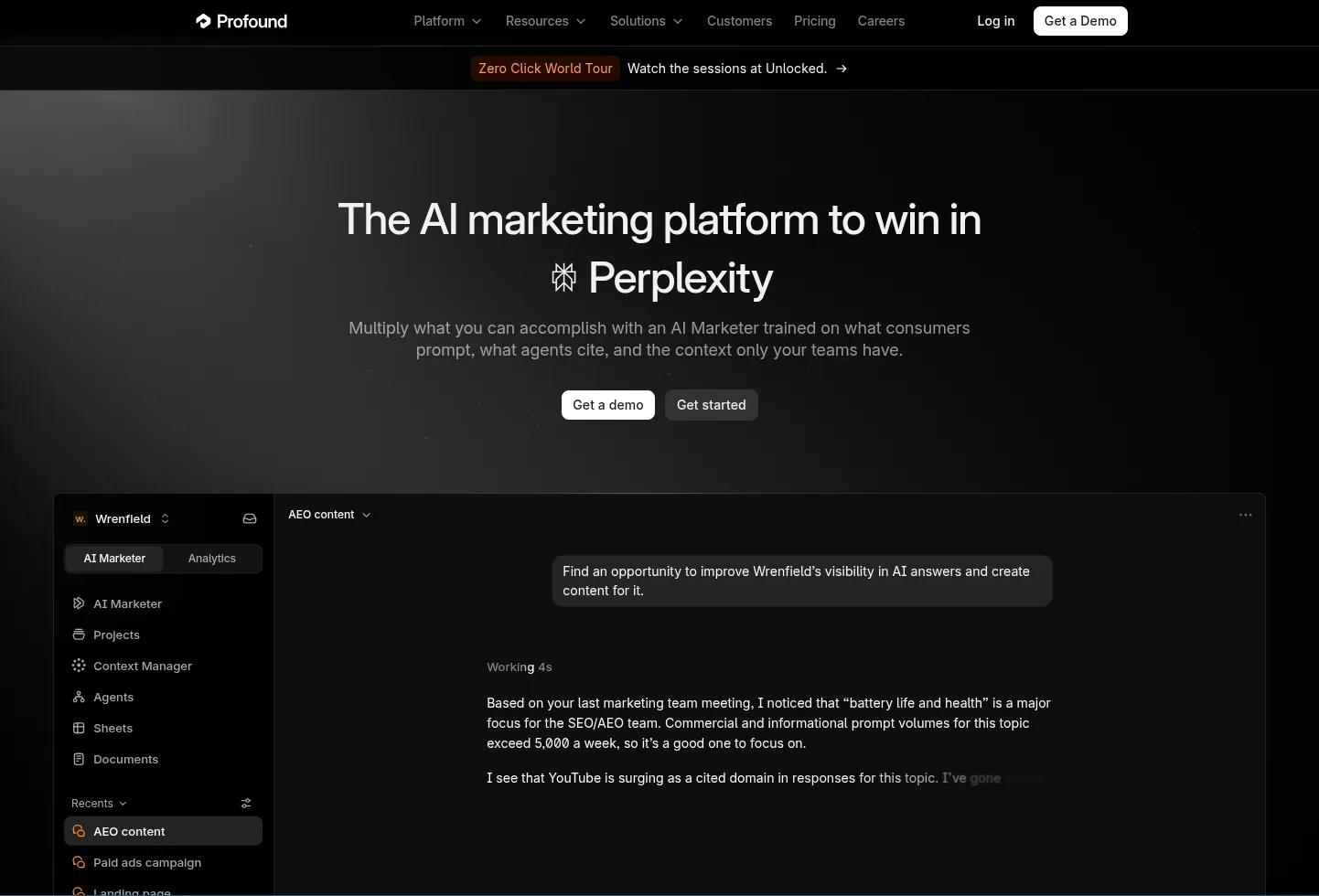
Profound’s free trial tracks 50 prompts daily for seven days on ChatGPT, Gemini, and Google AI Overviews. The prompts are suggested for your industry and can’t be customized, and the trial comes with one language and region, no history, no exports or API, and limited AI Marketer credits. Enterprise is quoted individually and adds custom prompt sets, up to nine answer engines, historical reporting, exports, API access, SSO, and the broader agent workflows.
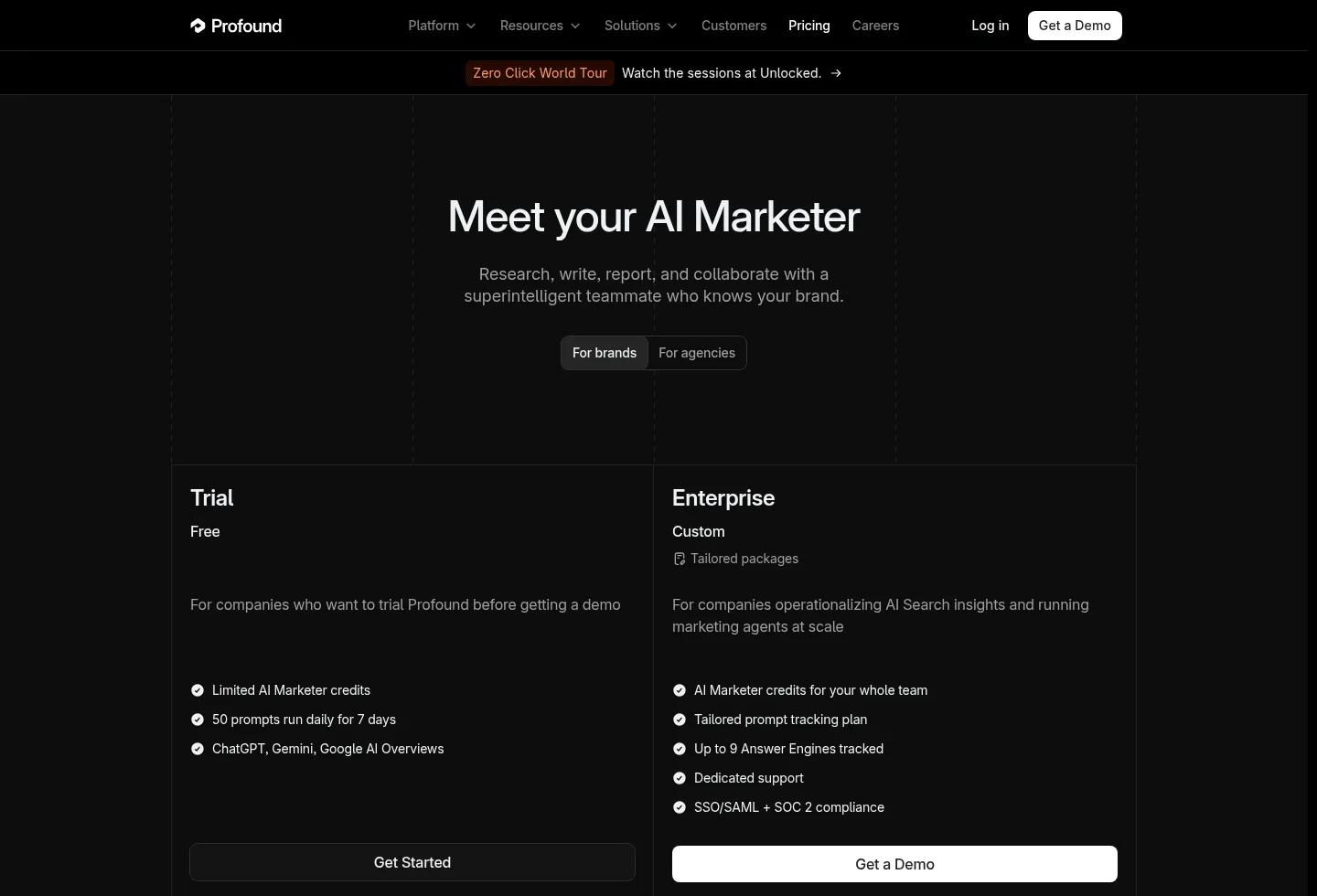
That broader layer is the part a cheap tracker won’t replace. Answer Engine Insights covers brands and citations, Prompt Volumes estimates demand, Agent Analytics measures AI crawler and referral activity, and Shopping covers product discovery. On top sits the AI Marketer, Aim, which in October alone got conversational Agents, redesigned Projects with proactive suggestions, and Search Visibility in Pages built on Moz data. Profound holds a 4.5 out of 5 rating on G2 across more than a thousand reviews, and reviewers tend to value the insights, reporting, and agents while flagging the learning curve and the cost.
So the honest framing is this: replacing Profound’s monitoring charts with a self-serve tracker is a very different decision from replacing an enterprise team’s reporting, bot analysis, and content workflows. On the trial, test the response detail and the three-engine coverage. For Enterprise, ask for a live walkthrough of a source gap and an agent task using your own category.
The best alternatives to Profound AI
Quotable: best for a self-serve GEO workflow
Full disclosure: Quotable is the product I build, so read this section with that in mind.
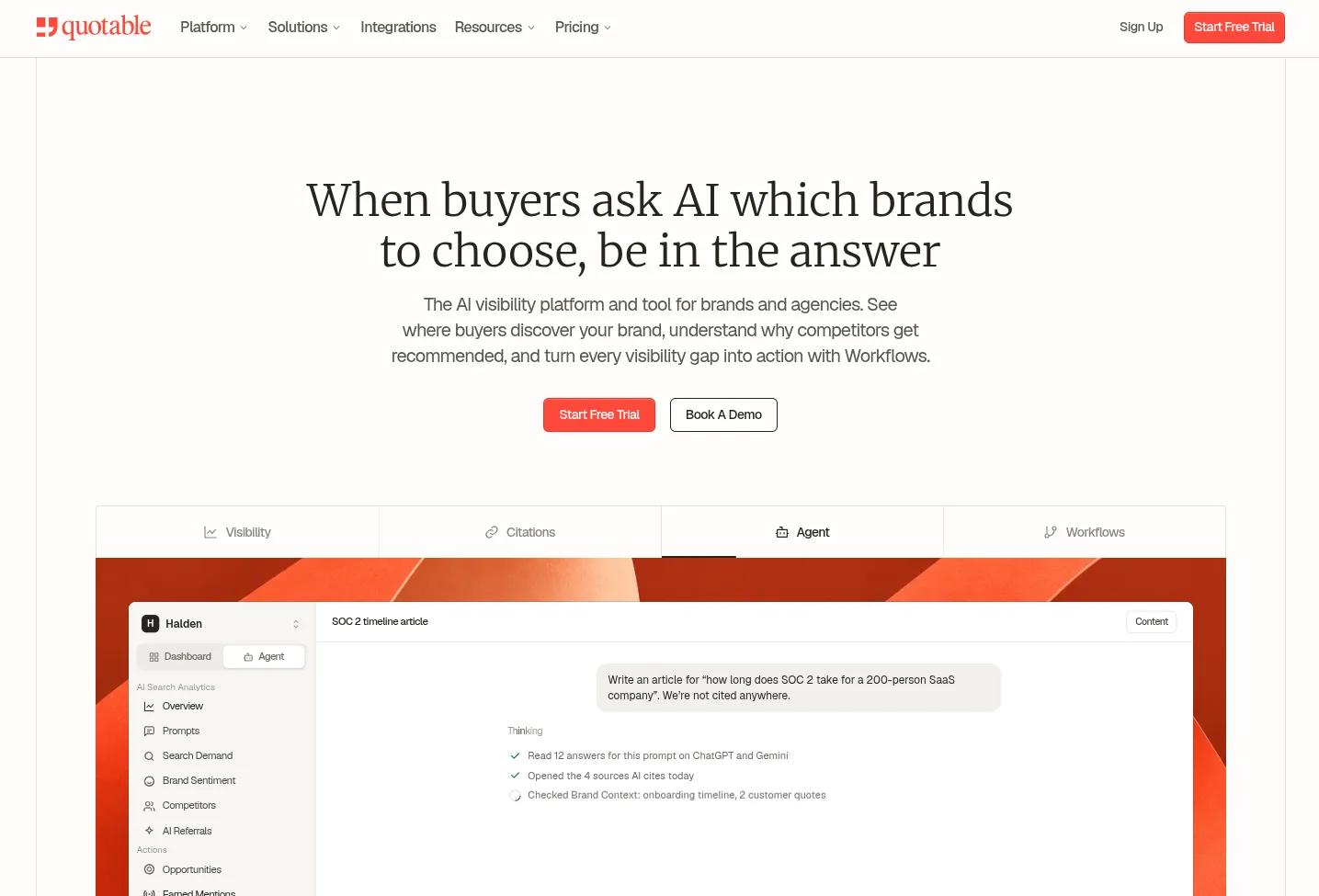
We built Quotable for teams that want to find where they’re missing from AI answers, work out why, and do something about it in the same place. It tracks prompts per model, shows the brands and cited sources behind each answer, reads verified crawler activity from server or CDN logs, and covers AI Shopping and ChatGPT Ads alongside organic mentions. Answers are captured client-side from the AI apps themselves rather than through model APIs, which matters when you want the citations your buyers actually see.
What changes the comparison is Quotable Agent, the chat assistant inside the product. Ask it why you’re not mentioned in ChatGPT and it answers from your tracking data, then it can draft the article, rewrite an existing page against the sources that won, write the LinkedIn post, build an agent, or edit a table, and it asks for approval before anything goes out to Slack, Notion, Linear, Gmail, Outlook, Webflow, or Contentful. Tables and agent workflows take the same work across many prompts or pages at once.
It also has the lowest cost per tracked prompt on this list. Its Starter plan costs less per prompt than any other entry plan, and Pro and Business have the lowest cost per tracked prompt of any plan here that publishes one. Every prompt runs on the three models you choose.
The fair test is a trial on your own prompts. If your team needs SSO, audit controls, or a long list of enterprise integrations, check those specifically, since that’s where an Enterprise contract with Profound still offers more.
Pricing
- Starter: $99/month ($0.99 per prompt). One brand; 100 tracked prompts per selected model; three models; daily tracking; 250 workflow credits a month; AI Shopping, crawler analytics, API, and MCP. Three-day trial.
- Pro: $249/month ($0.83 per prompt). Three brands; 300 prompts per model; 1,500 workflow credits a month; 50 Prompt Volume searches; unlimited seats and knowledge base.
- Business: $499/month ($0.83 per prompt). Ten brands; 600 prompts per model; 3,000 workflow credits a month; 200 Prompt Volume searches.
- Enterprise: custom.
Pros
- The lowest cost per tracked prompt in this comparison.
- Tracking, source analysis, crawler analytics, and execution in one self-serve subscription.
- Prompt allowances are stated per model, so the number means what it says.
- Quotable Agent turns a finding into a draft, a rewrite, or a workflow without leaving the product.
Cons
- A newer product with little independent review evidence so far.
- Starter covers a single brand, and workflow credits are a separate pool from tracked prompts.
- Enterprise controls such as SSO need a separate check.
Peec AI: best for focused AI visibility analytics
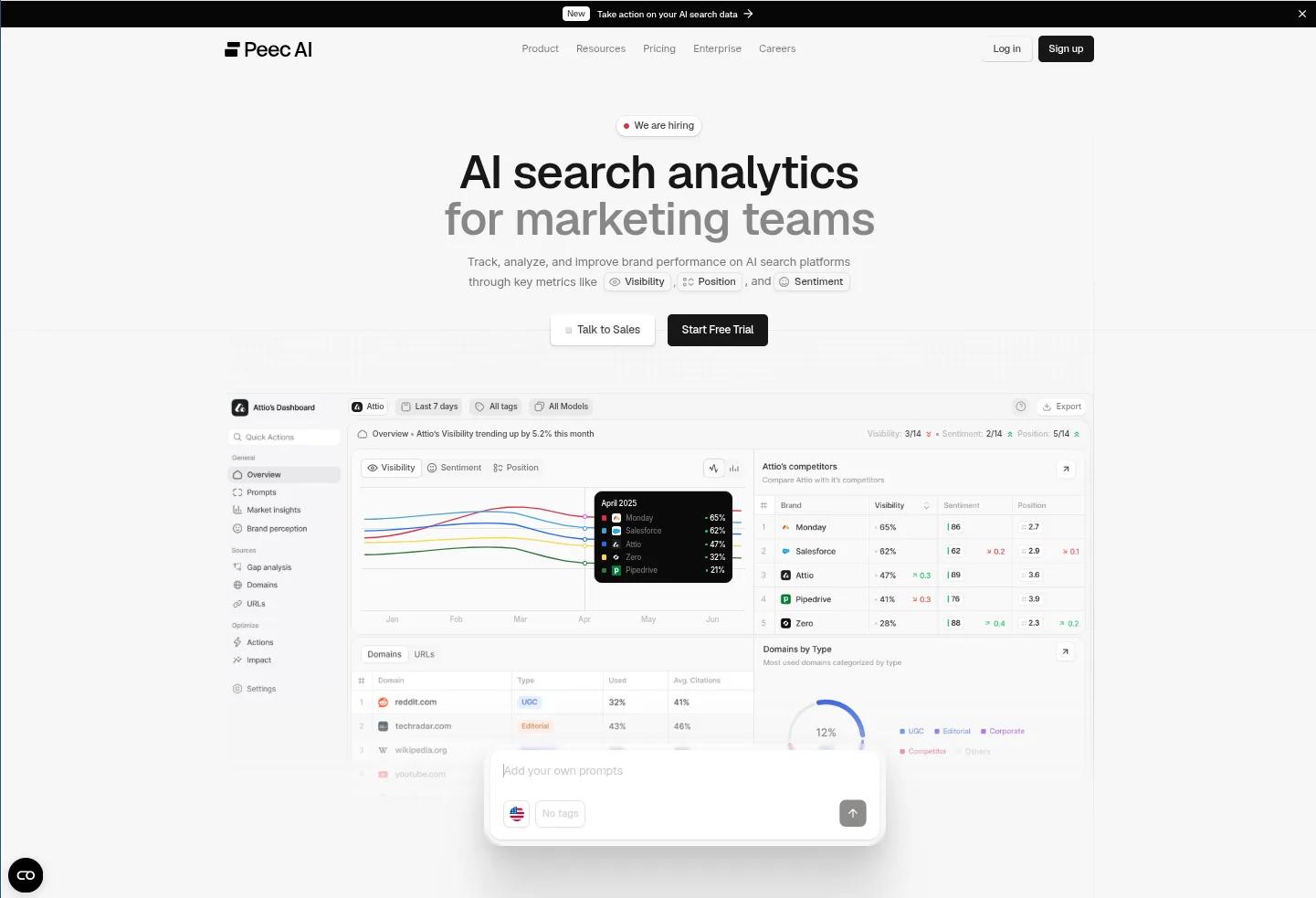
Peec is the closest like-for-like alternative to Profound AI for the monitoring job its old Starter plan did. It organizes results by visibility, position, sentiment, prompts, topics, and competitors, runs prompts daily through the chat interfaces, and its source views show which URLs get referenced and where your brand is absent. A marketer can start from a visibility drop, filter to the affected model and prompts, and then read the responses and the sources that keep coming back.
It also stopped being only a dashboard in October, when Peec launched Peec Agent and redesigned Actions. Recommendations now come ranked on a five-level impact scale with the evidence attached, the agent can investigate any chart you point it at, and it works with more than 25 connectors while asking for approval before it changes anything. Peec says more than 4,000 companies now use it, and it passed $20 million in annual recurring revenue this month, which tells you it’s a safe vendor to build a process around.
Users often find setup quick and the dashboards easy to read, although some recent reviewers say navigation has gotten crowded and they’d like clearer guidance on what to fix, and others found the auto-suggested prompts overlapping and in need of pruning. As one head of growth put it on G2, they’d like “more insights about how LLMs pick their sources.”
Peec fits a team or agency whose main job is a trustworthy daily view of mentions and sources. If publishing or engineering changes are the real bottleneck, test how far Actions and the agent go on your plan before you assume the remediation is covered.
Pricing
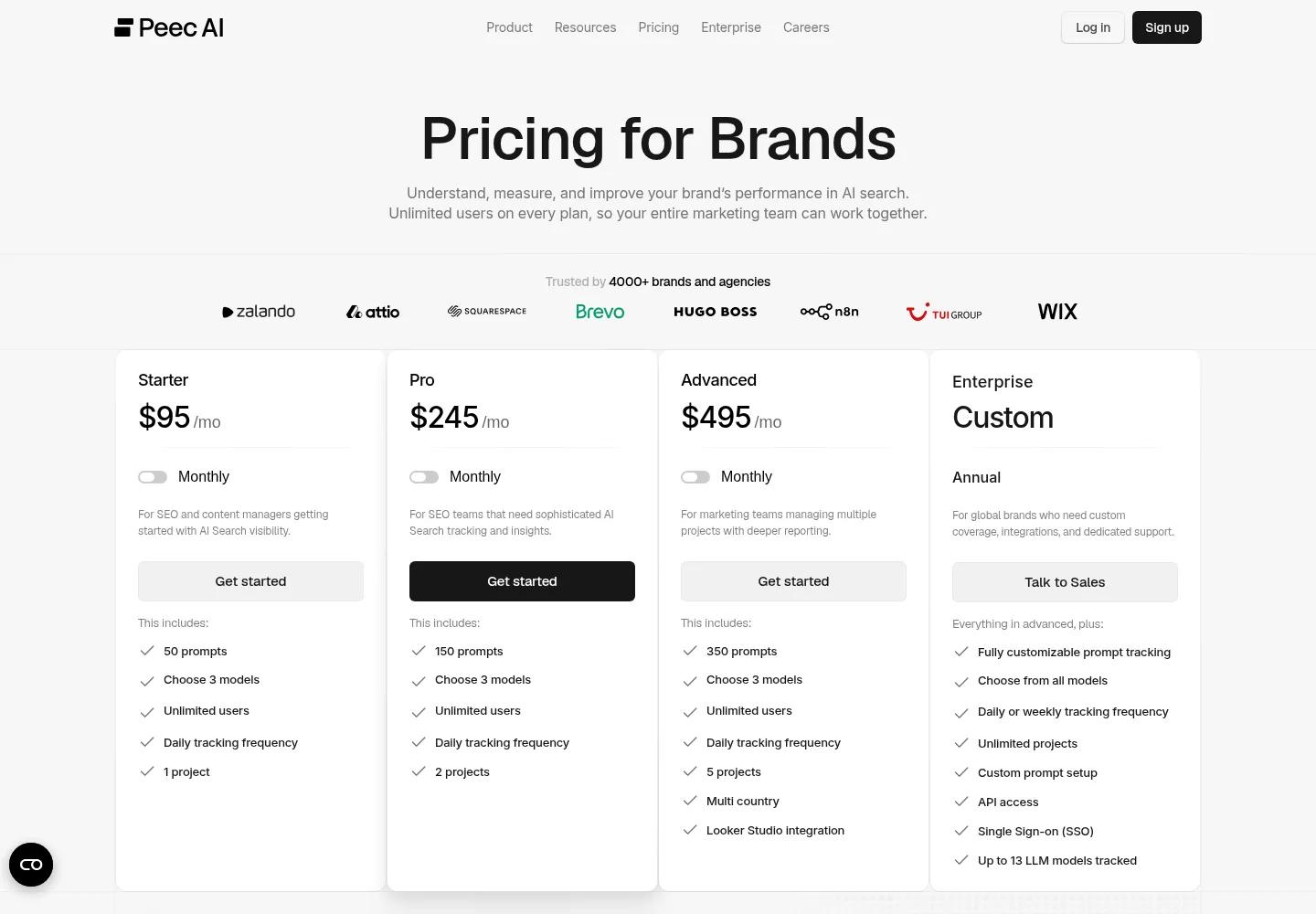
- Starter: $95/month ($1.90 per prompt). 50 tracked prompts; three selected models; daily tracking; one project.
- Pro: $245/month ($1.63 per prompt). 150 prompts; two projects.
- Advanced: $495/month ($1.41 per prompt). 350 prompts; five projects; more reporting.
- Enterprise: custom.
Pros
- Clear specialization in analytics, with strong source and competitor investigation.
- Peec Agent and Actions are available on every plan.
- A simple self-serve entry with no sales-led contract.
Cons
- Standard plans include a limited number of selected models, and more models cost more.
- Prompts are allocated across projects, so 150 prompts doesn’t mean 150 per brand.
- It doesn’t replace a CMS or a content operations tool.
AIclicks: best for a lower entry price with built-in actions

AIclicks pairs daily prompt tracking with citation-source analysis, competitor comparison, prompt discovery, AI content creation, and recommendations, and its docs say it collects responses from the user-facing interfaces rather than relying only on APIs. The Sources screen is the practical part. You can switch between URL, domain, and brand views, filter by model, date, page type, and whether your brand is mentioned, and sort by how often a source gets cited or how many of your prompts it touches. Find a comparison article cited across your high-intent prompts where you’re missing, and the next step is a specific correction, a pitch, or better first-party evidence, which the Recommendations area turns into tasks.
One wording to watch: when the interface calls a URL “retrieved,” check whether it’s showing observed citations or an actual retrieval trace, because the first is visible and the second usually isn’t. Its pricing page is also inconsistent about how many websites Starter covers, so confirm the allowance in writing.
Users often find the citation insights actionable and the reporting manageable, while others say the number of features felt overwhelming at first, prompt allowances run out quickly, and the interface lags at times. One agency reviewer on G2 said it gives them “a clearer view of how brands are being discovered.”
AIclicks is a credible budget-first option. If you need more than a few dozen tracked questions or API access, though, compare its Pro plan against the other tools here, since Starter won’t cover a real buyer panel.
Pricing
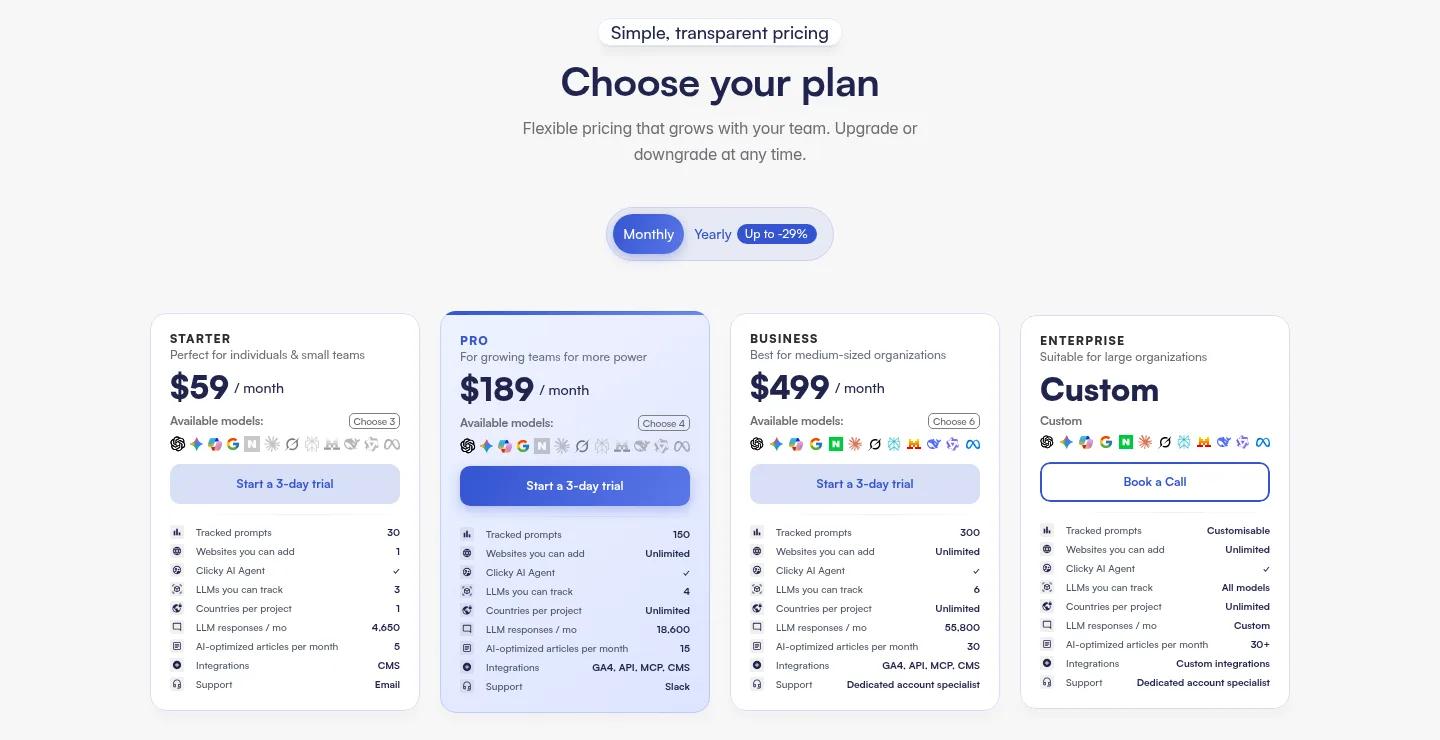
- Starter: $59/month ($1.97 per prompt). 30 prompts; three engines; one country; five AI-optimized articles a month. Three-day trial.
- Pro: $189/month ($1.26 per prompt). 150 prompts; four engines; more projects; GA4, API, and MCP.
- Business: $499/month ($1.66 per prompt). 300 prompts; six engines.
Pros
- A clear self-serve entry point.
- Content and outreach actions go beyond passive monitoring.
- API and analytics connections on Pro without an enterprise contract.
Cons
- Starter’s prompt limit is tight for several buyer categories or markets.
- Integrations and API wait until Pro.
- Recommended actions still need editorial and compliance review.
Evertune: best for brand research, sampling, and AI advertising
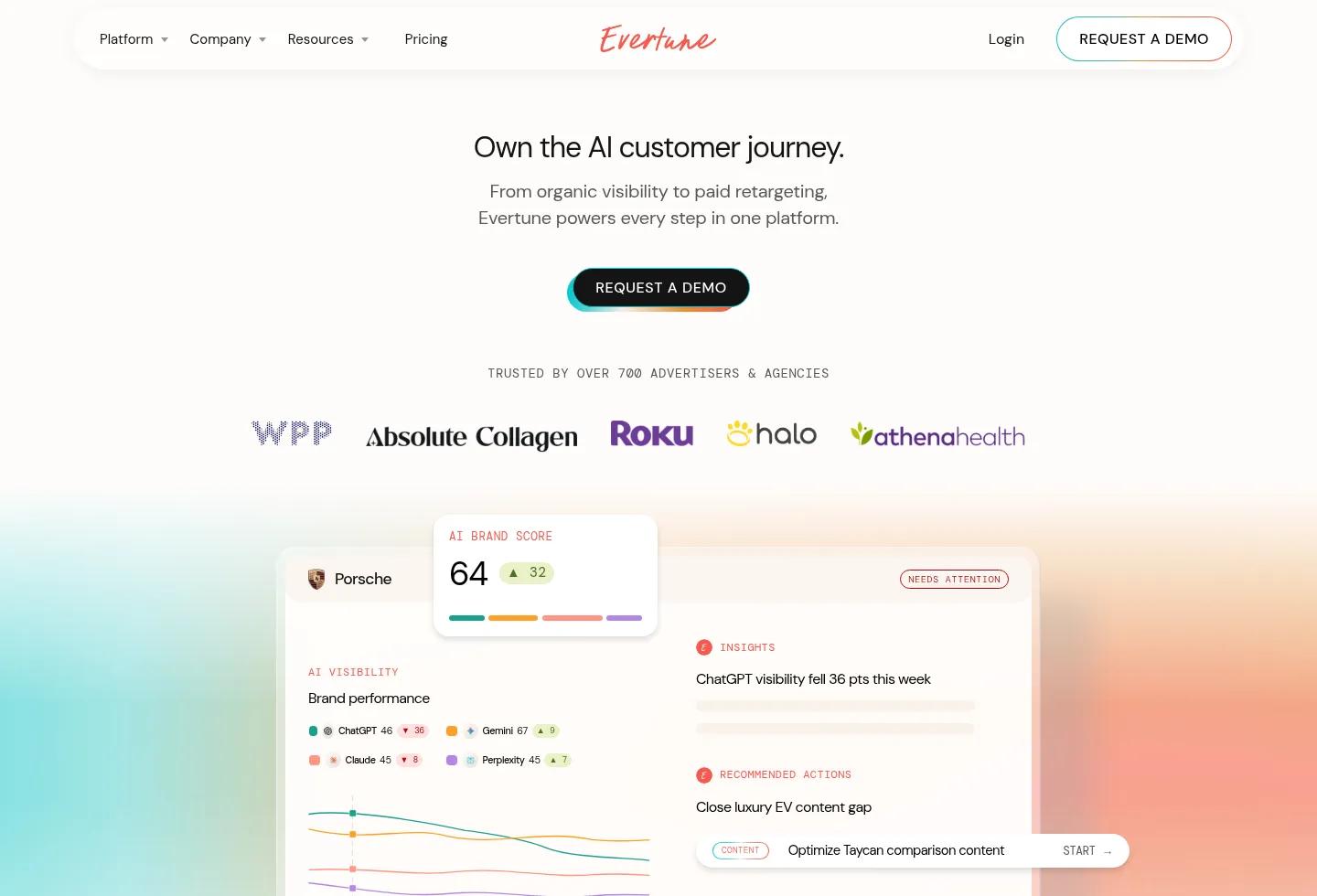
Evertune answers a different question from a rank tracker: which attributes AI associates with your brand, and how that shapes a purchase. Its AI Brand Index measures unaided recommendations by mention frequency and position, Consumer Preferences breaks a category into buying attributes with a competitor radar and leaderboards, and Content Analytics shows which domains and URLs shape how you’re described. A running-shoe brand can see whether it’s linked with cushioning or durability instead of reading one generic “best shoes” prompt. It also sells an Ads Agent and a Content Agent, which is rare in this category.
The measurement approach is the real differentiator. Evertune runs each prompt up to 100 times on every model you track, which gives a research team enough observations to see how much answers vary. That 100-sample setup is a Pro and Enterprise feature, though, and Starter tracks up to five models where Pro tracks eleven. More samples also still describe the prompts and models you picked, not your odds with a random buyer.
I couldn’t find a meaningful body of independent user reviews for Evertune, so there’s no review pattern to report here. Its published customer stories are vendor case studies, which are useful for seeing the workflow but don’t prove the work caused the result.
Evertune makes sense when understanding and influencing consumer choice matters more than a monthly prompt report. If a fixed panel of 50 questions is the whole job, it’s more than you need.
Pricing
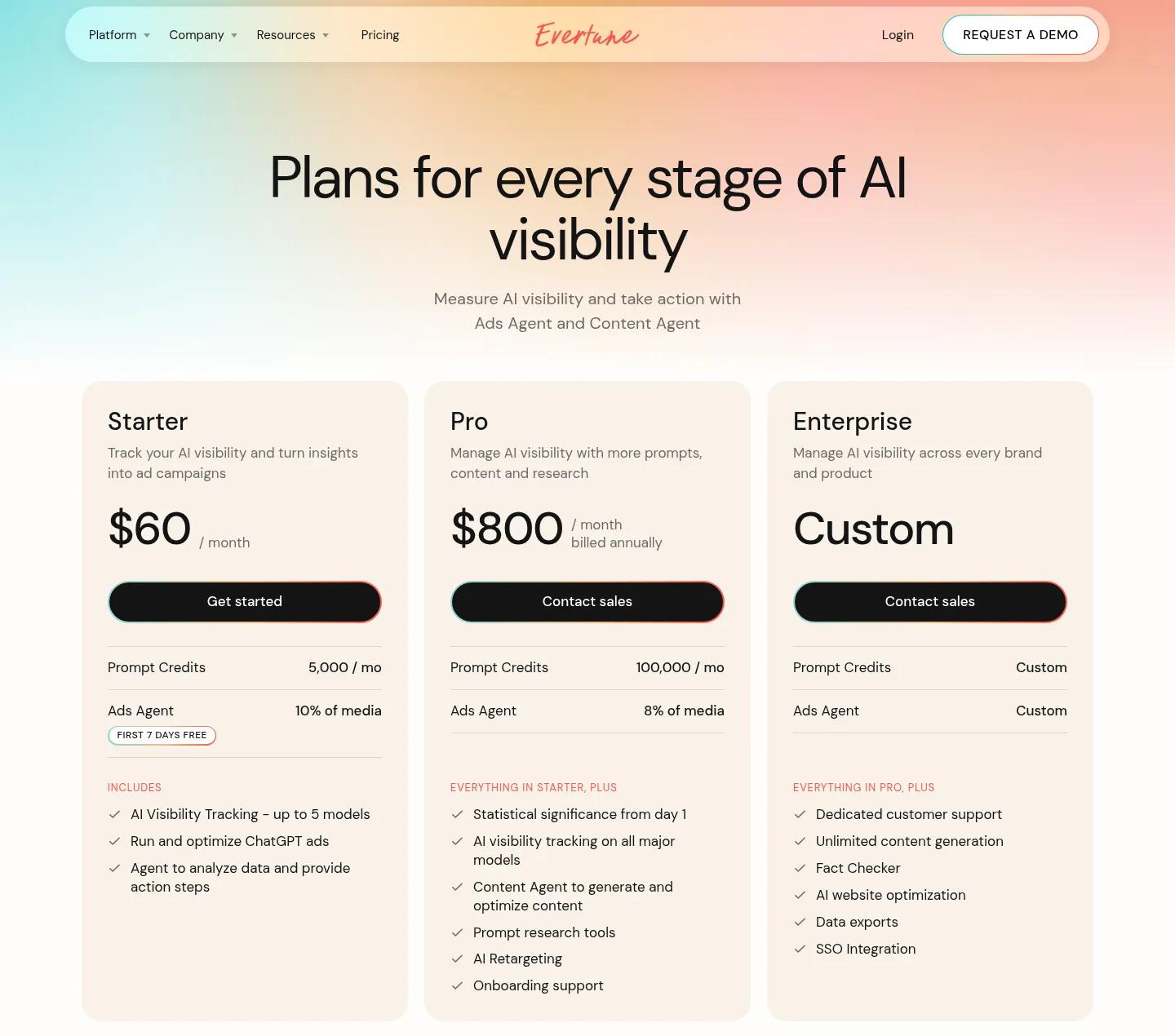
- Starter: $60/month (credit-based). 5,000 prompt credits a month; up to five models; prompt research; AI retargeting; onboarding support.
- Pro: $800/month, billed annually (credit-based). 100,000 prompt credits; 100 samples per prompt; eleven models; prompt volumes and Prompt Lab.
- Enterprise: custom. Adds dedicated support, unlimited content generation, a fact checker, AI website optimization, data exports, and SSO.
Pros
- Repeated sampling gives research teams real variance data.
- Research and advertising sit in the same product.
- A better fit than a tracker for CPG, ecommerce, and brand teams deciding where to invest.
Cons
- The most distinctive features are on Pro or Enterprise.
- Prompt credits aren’t unique tracked prompts, so model the consumption before you buy.
- Pro is billed annually, so the step up from Starter is a yearly commitment.
AirOps: best for content teams that need to execute at scale
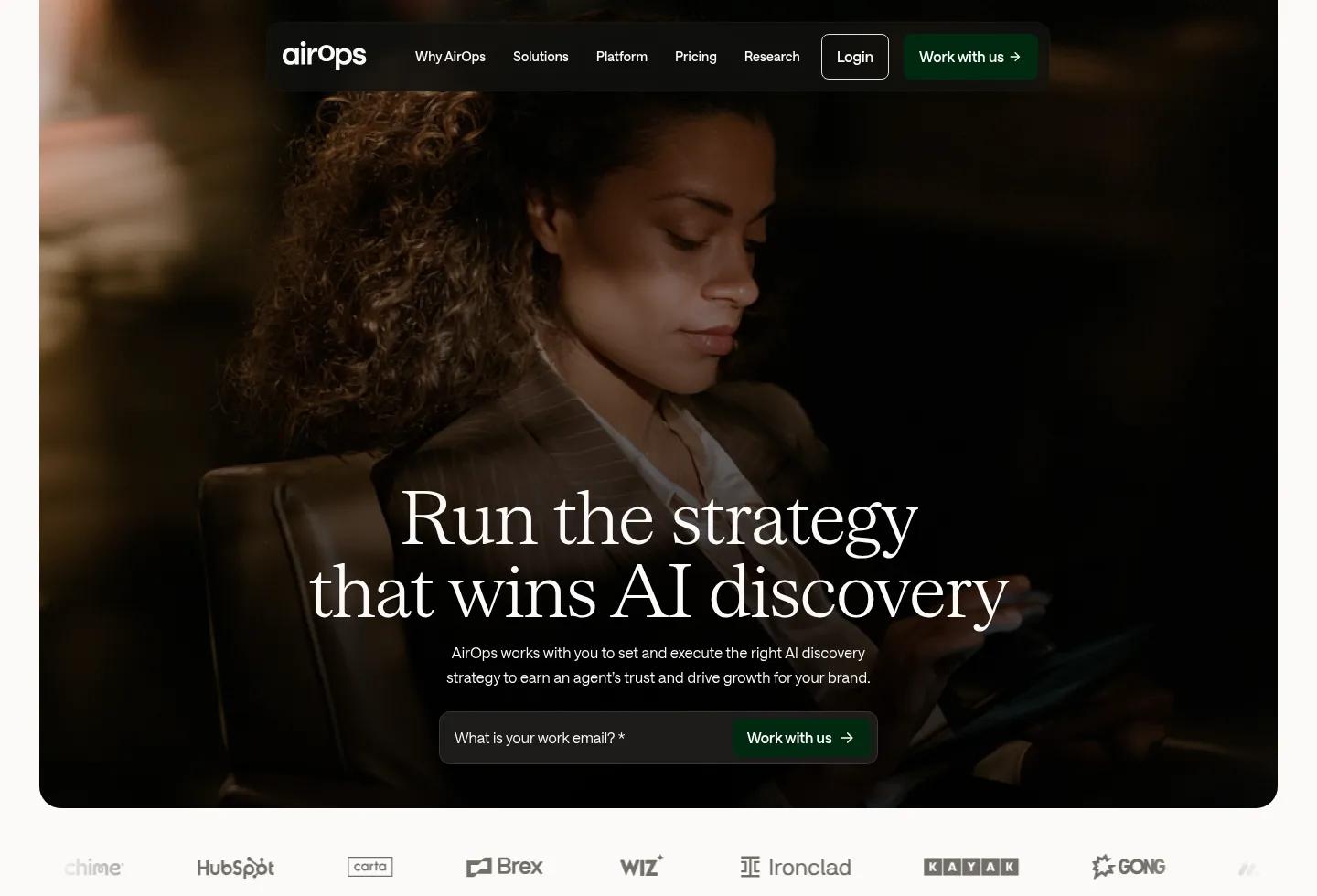
AirOps has AI search insights, but its value is operational: playbooks, workflows, brand kits, knowledge bases, CMS integrations, human review, and content production tasks. Its defining interface is Grid, which behaves like an operational spreadsheet. You import URLs or performance data, add workflow columns, run research or writing steps across many rows, review drafts side by side, and send approved changes to the CMS, so a content team with 80 weak category pages can run the refresh as one batch instead of 80 separate documents.
The catch for a monitoring buyer is coverage and cost. Solo tracks ChatGPT only, multi-engine insights start at Pro, and AirOps doesn’t publish its prices, so expect a sales conversation and a big jump between the two plans. There’s no free plan to fall back on, either.
Users often find the workflows productive and the support helpful, but the learning curve is the most common complaint by a distance, tagged in more than 30 G2 reviews. One reviewer was blunt about it: “This software has a steep learning curve, and it is not a plug and play.”
AirOps fits when publishing is the bottleneck and you have editors to review the output. It’s overkill for a founder who needs to check 20 prompts every Monday.
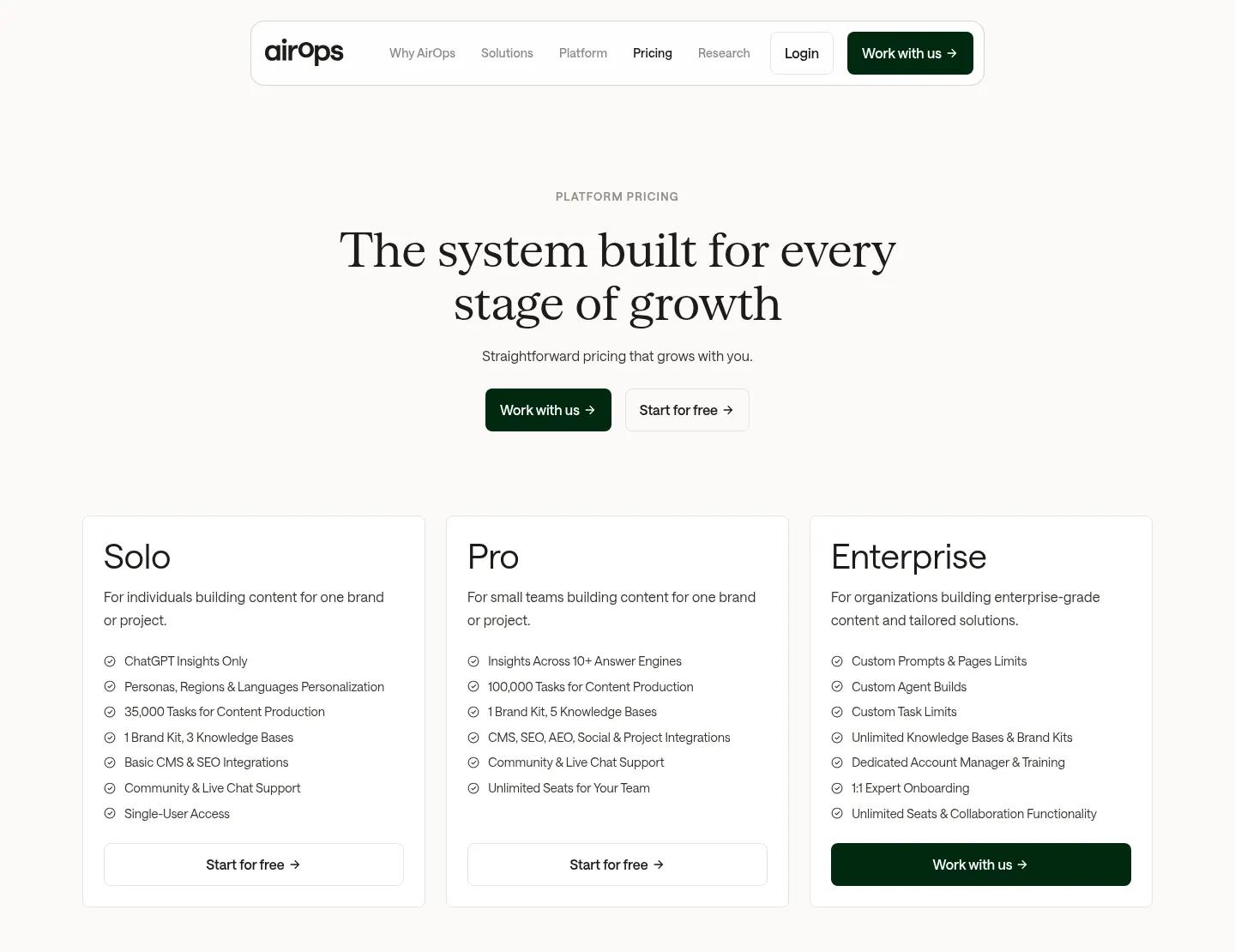
Pricing
- Solo: about $199/month, reported rather than published. 35,000 tasks a month; 100 tracked prompts and pages; ChatGPT-only insights; one seat; one brand kit; three knowledge bases; overage of about $9 per 1,000 extra tasks.
- Pro: about $1,999/month, reported rather than published. 100,000 tasks; 250 tracked prompts and pages; insights across 10+ answer engines, Claude included; unlimited seats; one brand kit; five knowledge bases.
- Enterprise: custom. Unlimited brand kits and knowledge bases, custom limits, unlimited seats, and SSO.
Pros
- Built for content throughput, with human review in the loop.
- Broad CMS and SEO integrations.
- A better fit than a monitoring tool when many pages need coordinated updates.
Cons
- A heavier system to learn than a tracker.
- Multi-engine insights require Pro, at roughly ten times the price of Solo.
- No published prices and no free plan.
- Task consumption needs modeling before you build a process on it.
Bluefish AI: best for brand accuracy and governance at large companies
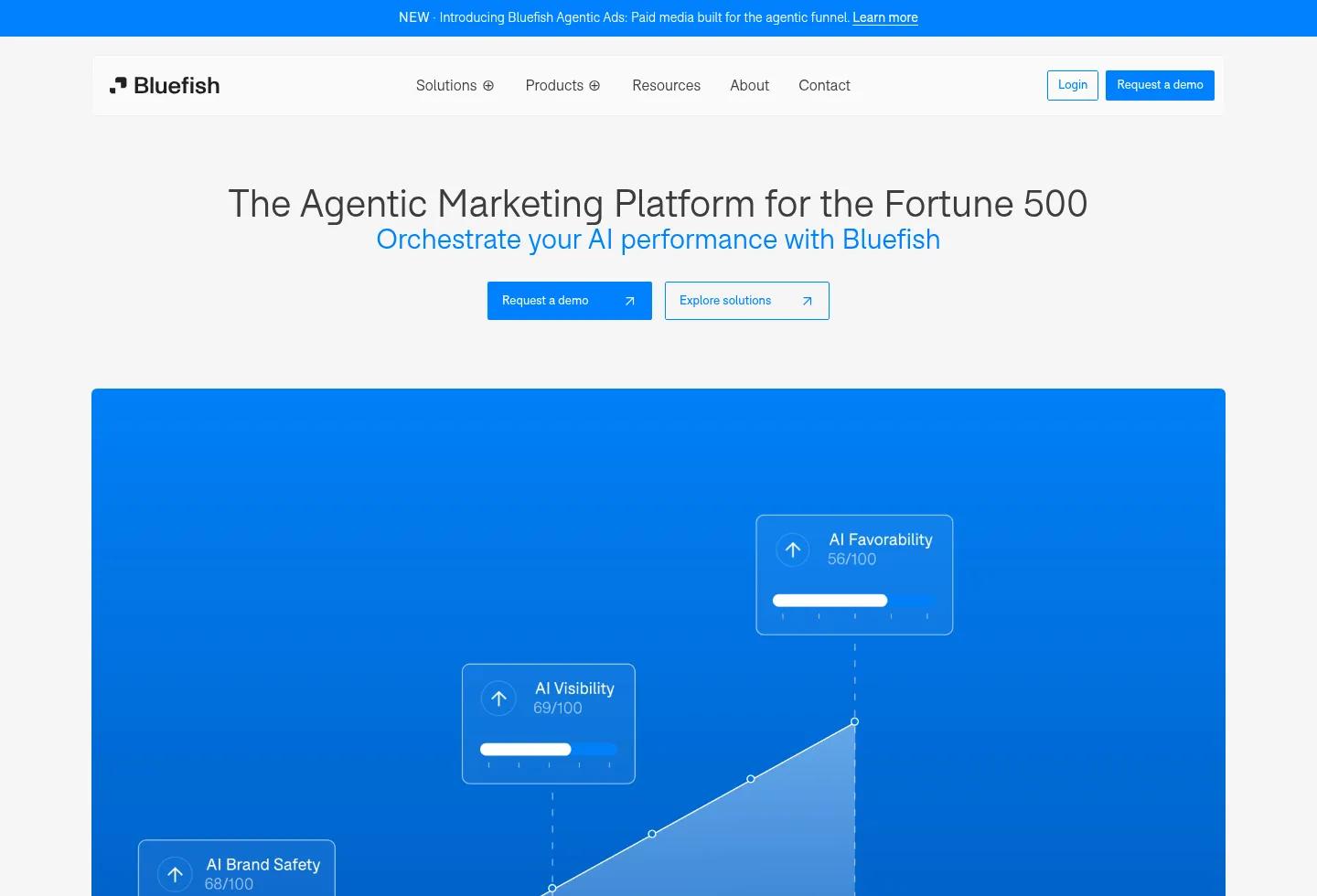
Bluefish is built for enterprise brand, comms, and marketing teams that need to coordinate how AI describes the company across products, audiences, and markets. Its AI Monitoring Suite covers visibility, sentiment, competitors, source analysis, and persona segmentation, and AI Accuracy compares AI claims with approved brand facts and traces errors back to their sources. The audience framing is the useful part, since a bank can see whether a misleading rate or eligibility claim reaches students more often than high-income buyers.
Bluefish publishes ambitious accuracy and influence claims, so ask for a live demo on your own disputed claims, and ask how it separates the sources it observed from the ones it inferred.
I didn’t find a verifiable independent review sample for Bluefish’s marketing platform. The G2 page called “Bluefish” is a software-development text editor, a different product entirely, so any rating quoted from it is wrong.
Bluefish belongs on a shortlist next to Profound Enterprise. It’s the wrong comparison for an entry-level tracker, and the right one when a wrong AI answer creates brand or compliance risk.
Pricing
- Custom quote. There’s no public self-service price for the marketing platform.
Pros
- Clear focus on factual accuracy and audience-specific findings.
- Built for coordinating several marketing functions.
- Most relevant when a wrong claim about products, compliance, or safety has commercial consequences.
Cons
- Not an inexpensive replacement for Profound’s old Starter plan.
- Enterprise procurement and a defined services scope.
- Little independent validation of its accuracy and impact claims.
Promptwatch: best for monitoring with built-in content agents
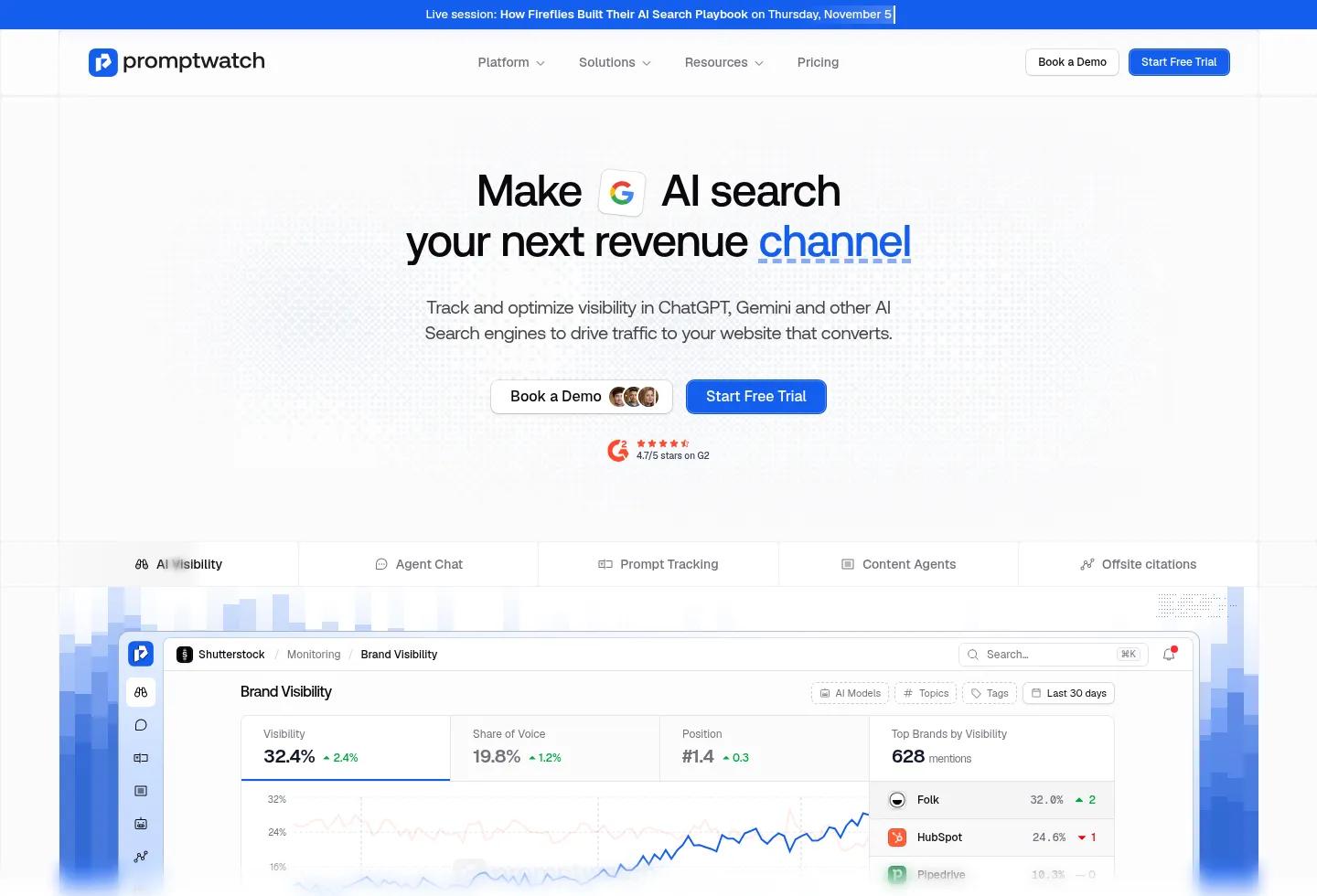
Promptwatch pairs prompt monitoring with AEO content agents, and it collects answers from each engine’s user interface rather than its API, so you see what a user sees. It scores visibility instead of only counting mentions, breaks cited pages down by source type, shows the query fan-outs behind an answer, and its Agent Analytics logs AI agents as they visit your site and records which pages they fetch. It’s also one of the few trackers that shows the ad attached to a ChatGPT answer, even on the entry plan. The company raised 6 million euros in July 2026, so it has the runway to keep shipping.
Two details change what you’re buying. Every brand plan tracks four models, picked from a supported list of around nine, so the long engine list on the website isn’t what one plan covers. And the content side starts a tier up: Essential comes with agent credits but no AEO articles, and crawler logs unlock on Professional as well. One hands-on test also found that the suggested starter prompts include your brand name, which pushes the visibility score up, so rewrite them before you trust the baseline.
Users often find setup easy and the seven-day trial a low-risk way in, and they like how often new features ship, while the complaints are mostly about plan structure, with seats and websites that scale by tier. It holds a 4.6 on G2 from around 20 reviews, and one agency owner there was clear about the best part: “What I like most is the article generation.”
Promptwatch fits a single-brand team that wants tracking and article drafts in one subscription. If you need more than a couple of seats or several websites, price the Business plan before assuming Professional covers you.
Pricing
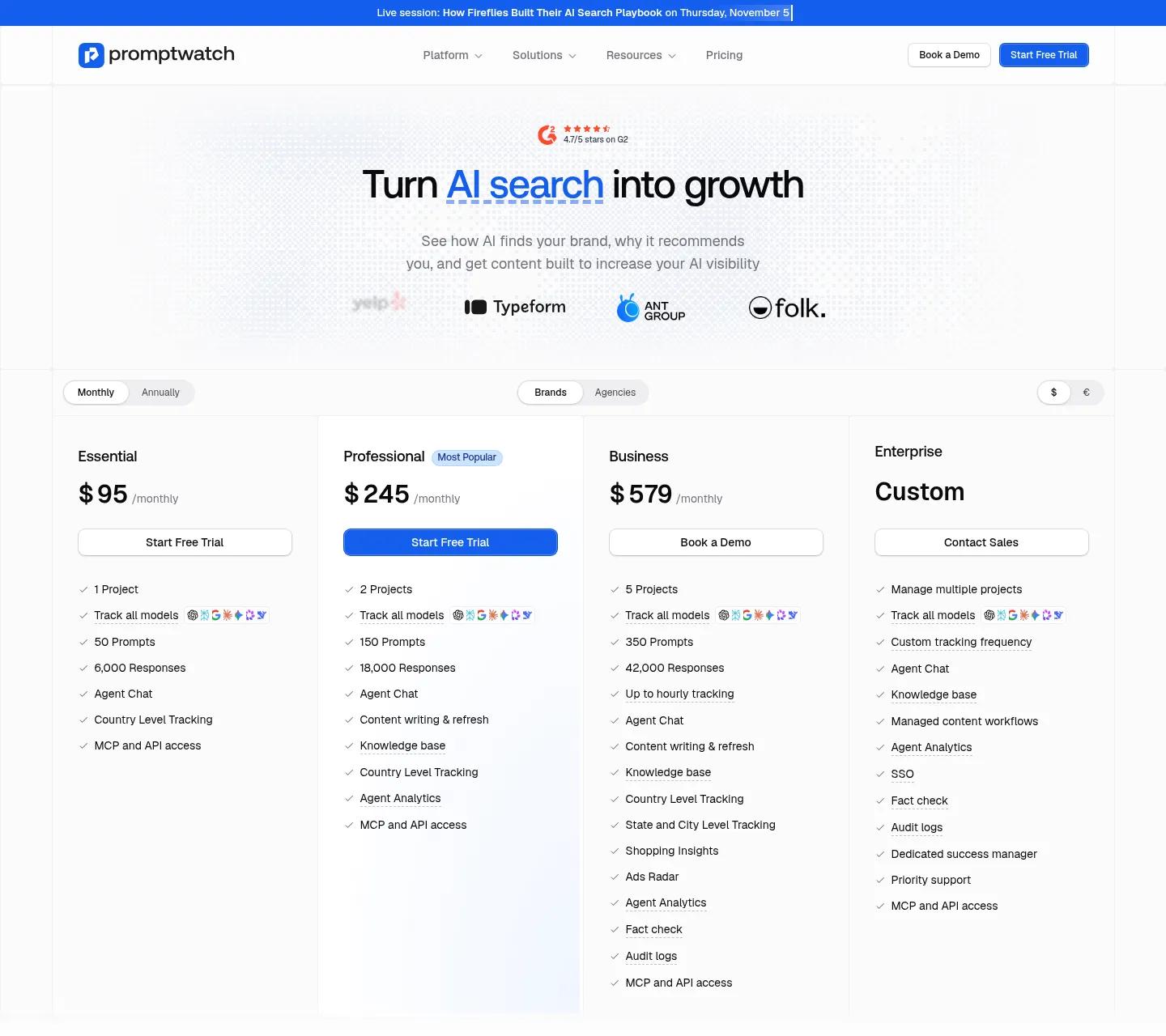
- Essential: $95/month ($1.90 per prompt). 50 prompts; four models; 6,000 responses a month; one project; one seat; 500 agent credits. Seven-day trial.
- Professional: $245/month ($1.63 per prompt). 150 prompts; 18,000 responses; two projects; two seats; 1,500 agent credits; five AEO articles a month; crawler logs and Looker Studio. Seven-day trial.
- Business: $579/month ($1.65 per prompt). 350 prompts; 42,000 responses; five projects; five seats; 2,500 agent credits; ten AEO articles a month; shopping data. Sold through a demo.
- Enterprise: custom. Agency plans start at $199/month.
Pros
- Answers are collected from each engine’s interface, not its API.
- Content agents, crawler logs, and Agent Analytics in a self-serve product.
- Ad visibility on ChatGPT answers.
Cons
- Four models per plan, whatever the supported list says.
- AEO articles and crawler logs start on Professional.
- Seats and websites scale by tier, which adds up for agencies and larger teams.
The test that matters most: follow one missed recommendation
Before you commit to a Profound AI alternative, ask every shortlisted vendor to walk through the same task from start to finish: a buyer asks for a product with a specific integration and a geographic requirement, a competitor gets recommended, and your brand doesn’t.
| What you need to learn | What a convincing demo shows | A red flag |
|---|---|---|
| What happened? | The exact question, engine and mode, response, date, and the brands recommended | Only a composite visibility score |
| What evidence was used? | Cited URLs with context, filters by intent and model, and a clear line between citations and unobserved retrieval | Claims to show every hidden source the model considered |
| Is the product information wrong? | The original answer next to your verified product facts | An “accuracy score” with no claims underneath |
| What should change? | A specific URL, the missing information, an owner, and a content or outreach task | Generic advice to add schema and FAQs |
| Can the team execute? | A handoff into a brief, a reviewed workflow, or a ticket, with clear permissions and usage cost | A feature called “agent” with no demonstrated output |
| Did it work? | The same prompt panel, separate citation and recommendation metrics, dated interventions, and caveats about volatility | One improved answer offered as proof |
That single walkthrough tells you more than a page of feature checkmarks, and it exposes the real differences quickly. Peec and AIclicks are strongest at tracing monitored prompts to cited sources, AirOps at producing and publishing content, Evertune at brand associations, Bluefish at verified claims, and Promptwatch at pairing monitoring with article drafts. Quotable’s aim is to keep diagnosis and execution in one place for self-serve teams, and the walkthrough is the right way to check whether it does that for you.
The real cost: compare the work, not the sticker price
Say a small in-house team wants to track 50 buyer questions daily across three engines for one brand. That’s about 4,500 answers in a 30-day month before any repeats or experiments, and here’s what each entry offer means for that workload:
| Platform | What the entry offer means for this workload |
|---|---|
| Quotable Starter, $99/mo | 100 prompts per model across three models, enough on paper |
| Peec Starter, $95/mo | 50 shared prompts and three selected models, a match on paper |
| AIclicks Starter, $59/mo | 30 prompts, not enough; Pro at $189/mo lists 150 prompts and four engines |
| Evertune Starter, $60/mo | 5,000 prompt credits; ask how unique prompts, repeat samples, and model calls consume them |
| AirOps Solo, about $199/mo | ChatGPT-only insights, not enough for three engines; Pro, at about $1,999/mo, covers 10+ |
| Bluefish AI | Quote required |
| Promptwatch Essential, $95/mo | 50 prompts on four models, a match on paper; articles and crawler logs need Professional at $245/mo |
| Profound trial, free | 50 prompts and three engines for seven days, with no ongoing self-serve equivalent for brands |
Two products with the same “50 prompts” label can deliver very different amounts of data. Before you compare price per prompt, ask whether the allowance is per engine or shared, whether responses get repeated, and whether regions, brands, history, exports, and agents cost extra.
How to test two Profound AI alternatives in a week
Rather than buying on checkmarks, run a seven-day evaluation. It won’t tell you which vendor has the most accurate AI data in a statistical sense, but it will tell you which one your team can work with.
- Write down your non-negotiables first: engines, languages, countries, brands, reporting frequency, source URLs, API and exports, SSO, and budget. Drop any plan that misses them before you judge the interface.
- Run the same 20 to 30 buyer prompts in both trials, mixing unbranded discovery, high-intent recommendations, comparisons, and fact checks, and keep those groups separate in your report.
- Open the raw evidence. You should be able to see the full answer, run date, market settings, cited URLs, and the brands actually named.
- Pick a real missed opportunity, a prompt where a competitor appears and you don’t, and check whether the product identifies relevant sources, wrong product facts, or useful next steps you can verify.
- Build one stakeholder-ready report and check that it shows counts and denominators, separates engines and segments, and keeps history when the prompt set changes.
- Push one fix through the workflow: a brief, a CMS or data-stack integration, review permissions, and what happens when an agent gets something wrong.
- Work out your actual bill from your own model, brand, and prompt requirements, including extra engines, credits, country limits, onboarding, and annual commitments.
If you’re already on Profound, export your prompt set and reports where your contract allows, and keep the old and new data separate, because a changed visibility score may reflect a change in methodology rather than in the market. A short overlap period is worth it if the budget allows.
For the fuller method, see our guide to conducting a GEO audit and our guide to choosing AI visibility prompts.
Should you leave Profound?
Choose a self-serve alternative to Profound AI if you mainly need scheduled prompt monitoring, competitor comparisons, sources, and an affordable way to act on the gaps. Start with Quotable, Peec, AIclicks, or Promptwatch, and test which gives your team better evidence and workflows on the plan you can afford.
Evertune is the better fit if you’re researching how AI perceives a consumer brand, want repeated sampling, or plan to connect organic visibility with AI advertising. AirOps fits when publishing is the bottleneck, and Bluefish AI fits an enterprise procurement focused on brand governance across departments.
And stay with Profound, or ask for its Enterprise quote, if your team already depends on Agent Analytics, Prompt Volumes, Shopping, Aim, and its integrations. Moving to a cheaper tracker could leave you rebuilding the parts your team uses every day, and if you’re an existing customer, check your contract and renewal terms before assuming anything changed.
Profound’s pricing change opened a real gap for transparent self-serve tools, but I’d still bet against the cheapest option being the best one. The right Profound AI alternative is the one that shows you the answer, the sources behind it, and what your team should change by Monday.
Sources and product documentation
- Pricing pages: Profound, Peec AI, AIclicks, Evertune, AirOps, Promptwatch. Quotable pricing comes from its own pricing page.
- Product documentation: Peec AI docs, AIclicks Sources, Evertune Consumer Preferences, AirOps Grids, Bluefish AI Monitoring Suite.
- User reviews on G2: Profound, Peec AI, AIclicks, AirOps, Promptwatch. Ratings and counts are point-in-time snapshots.
Frequently asked questions
Is Profound enterprise-only now?
For new brand subscriptions, yes in practice. The public pricing page shows a free seven-day trial and custom Enterprise pricing, with no paid self-serve Starter or Growth plan. Profound still has a separate agency offering, and the change doesn't mean existing self-serve contracts were ended.
Does Profound still offer a free trial?
Yes. The trial tracks 50 prompts daily for seven days on ChatGPT, Gemini, and Google AI Overviews. Its prompt set can't be customized, and it has no history, exports, or API access.
What is the cheapest Profound AI alternative in this comparison?
Among paid monitoring plans with a published price, AIclicks starts at $59 a month, Evertune at $60, Peec and Promptwatch at $95, and Quotable at $99. Quotable has the lowest cost per tracked prompt of the plans that publish one: $0.99 on Starter and $0.83 on Pro and Business. Those plans cover different capabilities and units, though, so the cheapest suitable option for your panel may be a higher tier. AirOps doesn't publish its prices, and its Solo plan, reported at about $199 a month, covers ChatGPT only.
Which Profound AI alternative is closest to its former Starter plan?
For straightforward prompt and source tracking, Peec Starter and Quotable Starter are the sensible first comparisons. AIclicks can fit too, but its entry plan has a smaller prompt allowance. None of them matches everything in Profound Enterprise.
Can I compare visibility scores directly between platforms?
Not safely. Prompt sets, engine access, markets, sampling, and definitions of visibility all differ, so compare the full answers and source evidence rather than the top-line percentages.
Written by