How to Choose the Right Prompts for AI Visibility Tracking

Choose prompts that represent real buying decisions, not keywords. Map each to a buying task and market status, keep unbranded discovery prompts separate from branded checks, test category labels and realistic buyer constraints, and track a stable benchmark panel apart from an exploration panel. For a small B2B brand, about 30 well-tagged prompts is a practical start.
If you ask ChatGPT whether your brand is worth considering, you’ve already put your brand in the answer. That’s a useful question if you want to check how accurately AI describes you, but it’s a terrible one if you’re trying to find out whether someone who has never heard of you would discover you.
The opposite mistake is tracking nothing but “best [category] tools.” Those prompts show you which brands make a shortlist, but they can’t tell you whether AI recommends the right product once a buyer adds a budget, a use case, an industry, or an integration they can’t live without. And they say almost nothing about the questions buyers ask before they even know your category exists.
A good prompt library reflects the decisions your customers make rather than the phrases your marketing team wants to win. Read together, its answers should tell you where buyers are in their journey, what kind of solution they think they need, what evidence the AI leans on, and what you could do about a recommendation you missed.
Here’s how I’d build one.
Start with the decision, not the keyword
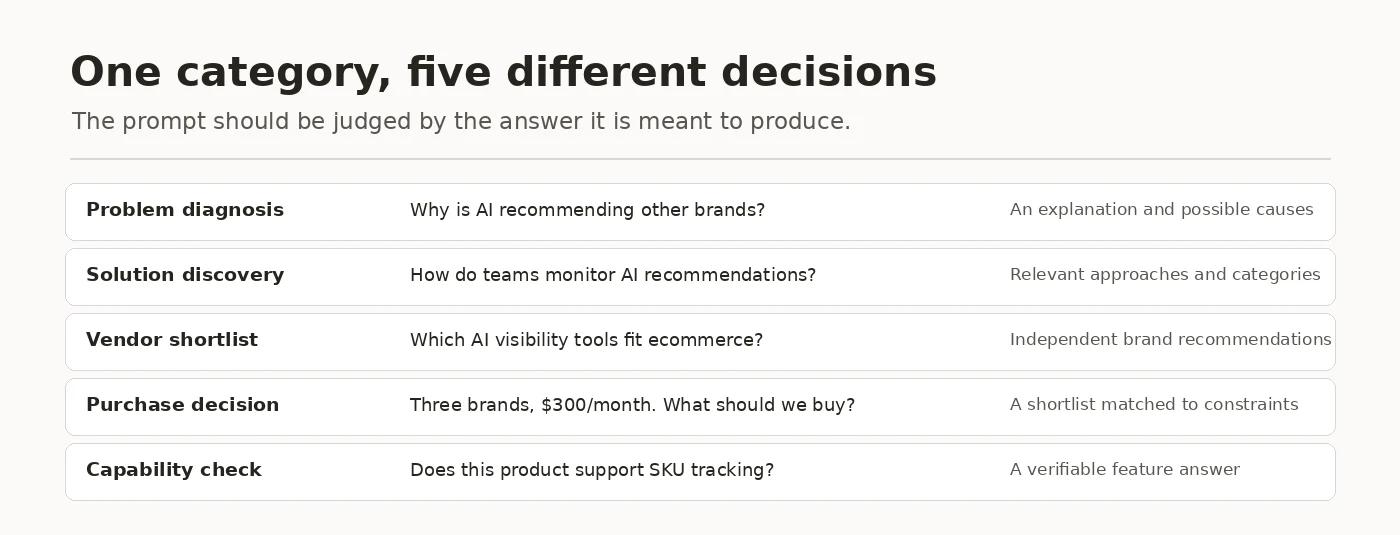
Say you sell software that monitors brand visibility in AI search. The keyword AI visibility tool is a fine starting point, but it doesn’t describe a single buying situation. Someone might ask any of these:
- “Why does ChatGPT keep recommending our competitors?”
- “How can we track which websites AI answers cite?”
- “What are the best AI visibility tools for an ecommerce brand?”
- “We need AI search monitoring for three brands and a $300 monthly budget. What should we shortlist?”
- “Does this product track which individual SKUs appear in AI shopping results?”
They all belong to the same market, yet they ask for very different answers. The first wants a diagnosis, the second might invite a method or a product category, the next two want recommendations, and the last is a straightforward product check.
So before you add a prompt, write down which decision it represents and what a useful answer would contain. Otherwise you’ll end up scoring a perfectly reasonable explanation as a failure just because it didn’t mention your company.
Map the buyer’s journey, and whether they’re actually in market
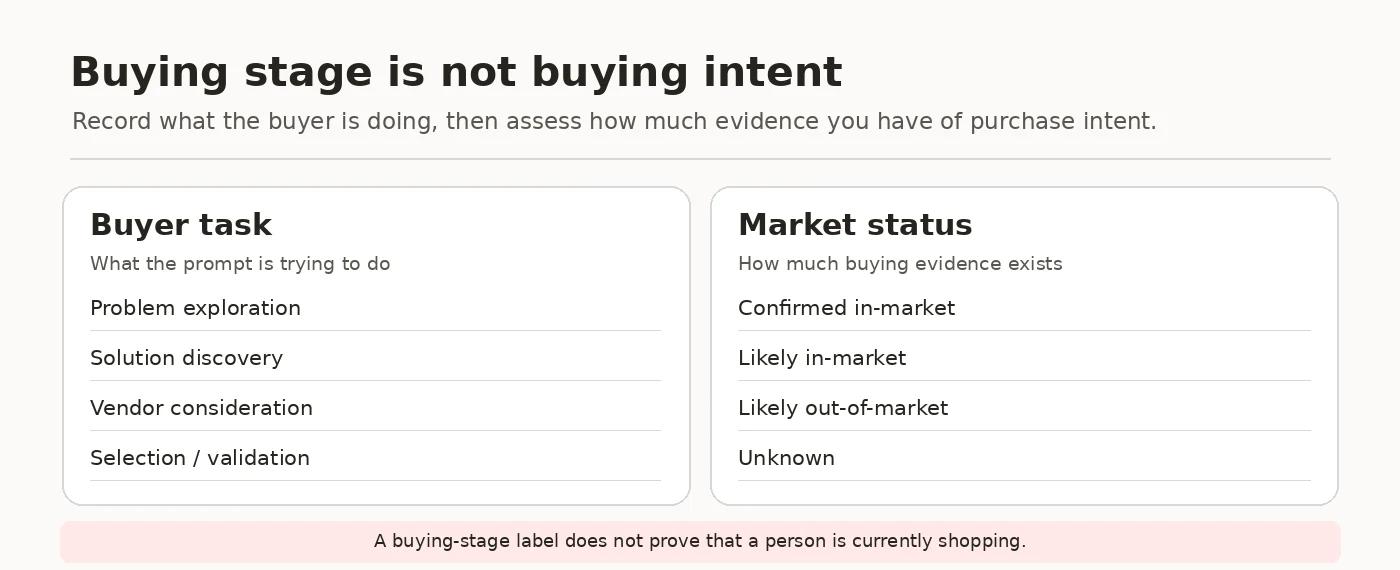
Buying stage and purchase intent are related, but they aren’t the same thing. Someone can research a technical problem with no plan to buy anything, while someone else asks a broad question in the middle of evaluating software for a project due next month.
That’s why I use two separate labels:
- Buying task: problem exploration, solution discovery, vendor consideration, or selection and validation.
- Market status: confirmed in-market, likely in-market, likely out-of-market, or unknown.
Treat market status as an inference unless you have evidence from a real customer conversation. A hypothetical question that says “we’re buying this quarter” is an in-market scenario, which is worth testing, but it doesn’t prove that people are asking it at scale.
| Buying task | Example | What to look for |
|---|---|---|
| Problem exploration | “Why does our brand rank on Google but disappear from AI recommendations?” | Does the answer explain the problem accurately? Which categories and sources does it introduce? |
| Solution discovery | “How do marketing teams monitor brand recommendations in ChatGPT?” | Does AI introduce AI visibility monitoring as a possible solution? |
| Vendor consideration | “Which AI visibility tools track citations and crawler activity?” | Which brands make the shortlist without being named in the prompt? |
| Selection | “We’re choosing a tool for three brands under $300/mo. Which would you recommend?” | Which product wins against the buyer’s real constraints, and why? |
| Validation | “Does this platform support an MCP server and daily tracking?” | Are the claims factual, current, and supported by credible sources? |
Keep in mind that validation is a buying task rather than a final funnel stage, since a buyer can check an integration before they’ve even built a shortlist.
Branded and non-branded prompts answer different questions
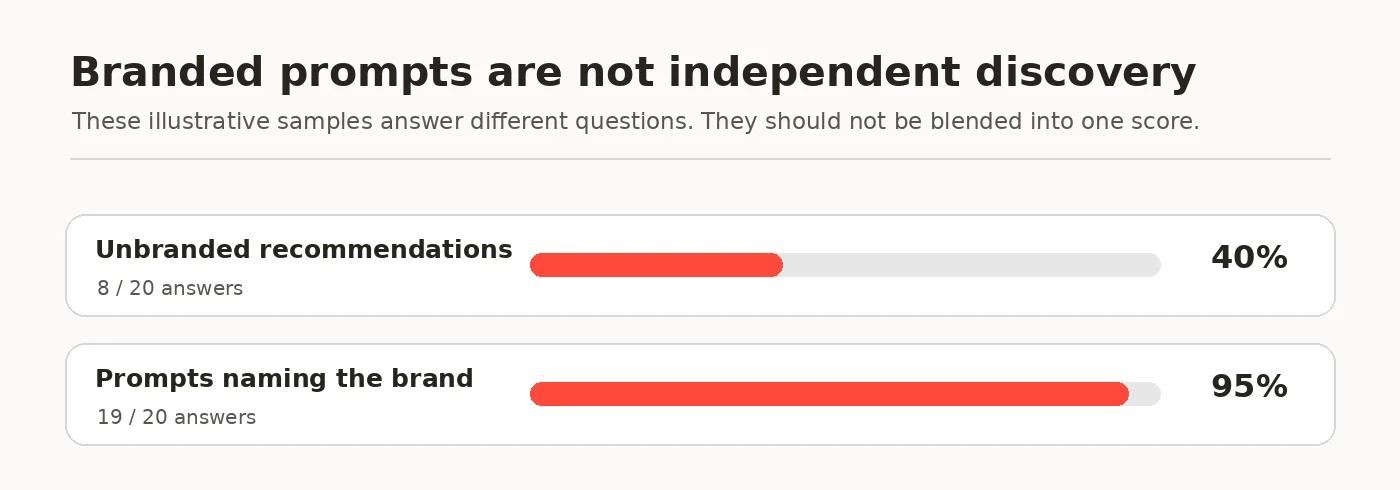
Unbranded prompts are where you test independent discovery, whereas branded prompts test what an assistant says once a company is already part of the conversation.
I keep four labels apart: unbranded, your brand named, another brand named, and named comparison. Mixing their mention rates into a single discovery score is the fastest way to fool yourself, and these two results show why:
- Your brand appears in 8 of 20 unbranded recommendation answers, which is a 40% observed mention rate for that panel and period.
- Your brand appears in 19 of 20 answers to questions containing its name, which is a 95% observed mention rate but nowhere near 95% independent discovery.
Both numbers are useful. The mistake is blending them and reporting the average as “AI search visibility.”
Map the category buyers enter, not just the one you sell
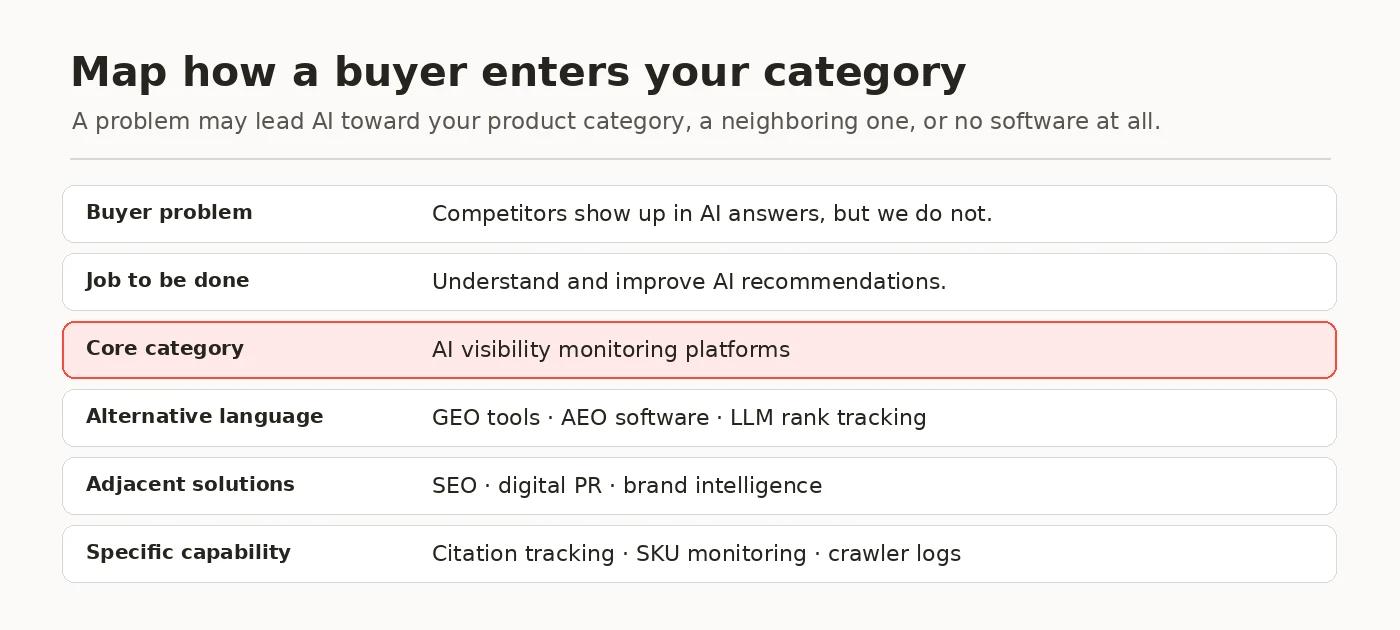
Most prompt lists start too late, with a product category the company has already chosen for itself. Buyers, on the other hand, usually start with an outcome or a frustration, and AI may send them toward an adjacent category entirely.
Suppose someone asks, “How do we get our company cited more often in ChatGPT?” The answer might cover technical SEO, digital PR, expert content, third-party mentions, or AI visibility software. If you only monitor prompts containing AI visibility platform, you’ll never see whether AI considers your category a relevant answer to the underlying problem.
That’s why it pays to sketch a small category map before you write a single prompt:
| Layer | Example | What you’re testing |
|---|---|---|
| Buyer problem | “Our competitors keep appearing in AI answers.” | Whether AI identifies the underlying need correctly |
| Job to be done | “Monitor where AI recommends our brand.” | Whether AI connects the job to a solution |
| Core category | “AI visibility platform” | Your presence on standard category shortlists |
| Related category language | “GEO tool,” “AEO software,” “LLM rank tracker” | Whether different valid labels change recommendations |
| Adjacent solutions | SEO platforms, digital PR, brand-monitoring tools | Whether AI points buyers into a different category |
| Differentiating capability | SKU-level shopping, crawler logs, API, automated workflows | Whether you’re associated with specific capabilities |
You don’t need to turn every near-synonym into a new prompt, though. Some labels really do imply different work, since a monitoring tool observes while an optimization platform is expected to help teams act. Add a variation when that distinction could change the answer, not to pad your prompt count.
Run a controlled category-language test
Hold the buyer, market, and use case constant, and change only the category label:
- “What AI visibility tools would suit a mid-sized ecommerce business?”
- “What GEO platforms would suit a mid-sized ecommerce business?”
- “What AEO software would suit a mid-sized ecommerce business?”
Then compare which brands appear, the reasons given, and the sources cited. If the shortlist changes, you’ve found category-label sensitivity. What you haven’t established is which phrase buyers use most often, and for that you’ll need evidence from customers, search research, and any AI demand data you can defend.
Design each prompt to do one job
Every tracking question should have a clear purpose. These are the six jobs I find most useful:
| Prompt job | Example | A meaningful result |
|---|---|---|
| Discovery | “Which AI visibility tools would you recommend to a SaaS marketing team?” | A relevant shortlist with reasons |
| Buyer fit | “We sell 12,000 products online. What could track our visibility in AI shopping results?” | Recommendations that address catalog-level needs |
| Head-to-head decision | “Which of these two shortlisted platforms better supports multilingual tracking, and why?” | A decision with verifiable trade-offs |
| Capability validation | “Can this platform track AI crawler requests from CDN logs?” | A correct yes or no, backed by the actual product capability |
| Accuracy check | “What are the plan limits and monthly prices for this product?” | Verifiable claims, not outdated numbers |
| Category framing | “What should an ecommerce team look for when buying AI search monitoring software?” | Evaluation criteria, not necessarily a list of brands |
Discovery prompts need to produce actual product recommendations. “How do I improve AI visibility?” may return helpful tactics without naming a single vendor, which makes it a poor discovery prompt but a potentially excellent category-framing one.
For buyer-fit prompts, add constraints only when a real buyer would care about them. Company size, geography, use case, integrations, compliance, and budget can all change a recommendation, but a paragraph carefully built around your product’s exact selling points isn’t buyer research. It’s a mirror.
Find prompt ideas where customers already reveal their decisions
You don’t need a brainstorming session or a hundred AI-generated questions to get started. The better raw material is evidence that reflects real buying situations:
- Sales calls and lost-deal notes, for objections, evaluation criteria, constraints, and the words prospects use to compare options.
- Customer interviews and support tickets, for the problems customers were trying to solve before they knew your category existed.
- Search Console and keyword research, for established needs and category language. Treat these as useful proxies rather than exact ChatGPT prompt counts.
- Review-site questions and community threads, where buyers discuss trade-offs in their own words.
- AI-originated inquiries that customers share with you, meaning the prompt or recommendation path a customer remembers. These are valuable examples, though not a representative sample.
- Synthetic prompts, the controlled scenarios you write to test a specific risk or capability. Just label them as synthetic.
Whatever the origin, keep an evidence-source field for every candidate prompt. If a prompt came from three sales conversations, note that, and if you invented it to stress-test pricing accuracy, note that instead. Both can earn a place in a useful library, but they shouldn’t carry the same claim about market demand.
Query fan-outs: find the questions behind the answer
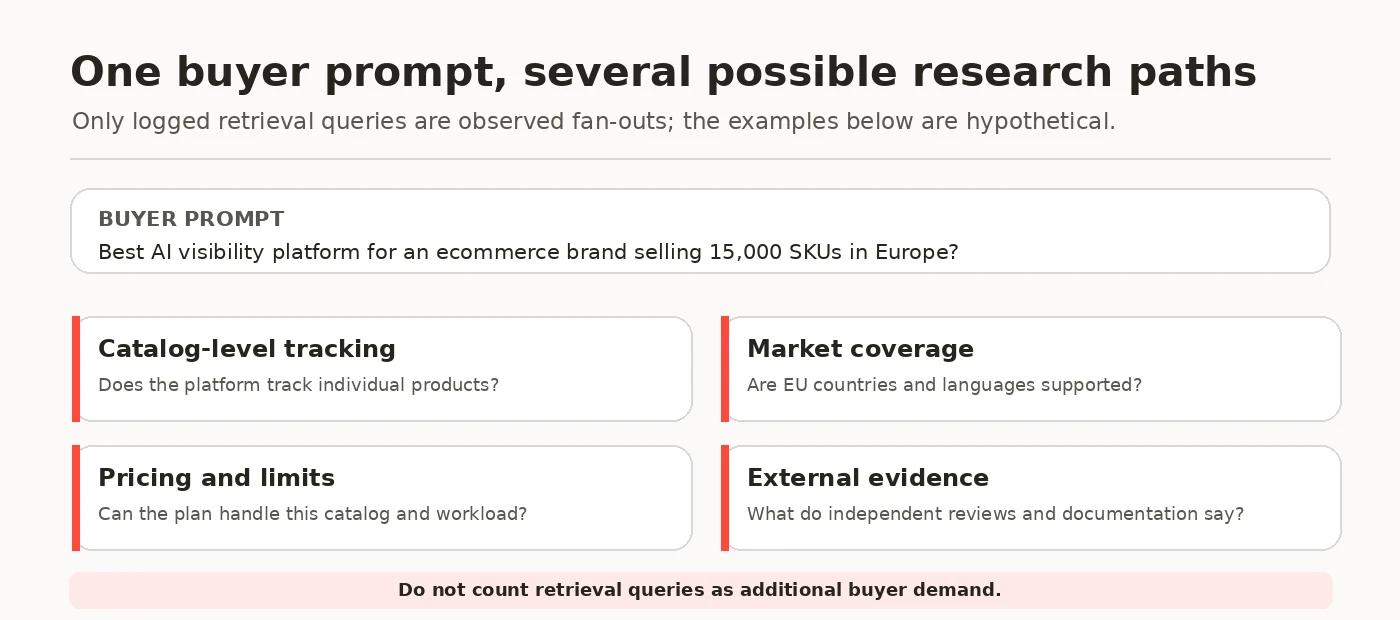
Before answering, an AI assistant may take a buyer’s question and search the web for several narrower things. Those retrieval searches are usually called query fan-outs, and they’re often more revealing than the original question, because they show which facts the system needs before it can compare products.
Imagine a buyer asks:
“What’s the best AI visibility platform for an ecommerce company selling 15,000 SKUs across Europe?”
The assistant might go looking for catalog-level tracking, Google Shopping or AI shopping visibility, regional coverage, pricing, and customer reviews. Those are illustrative research angles rather than observed searches, though, and you can only call them fan-outs once you’ve captured the retrieval queries from a real run.
| Layer | Example | What to do with it |
|---|---|---|
| Buyer prompt | “Which AI visibility tool works for a large ecommerce catalog?” | Track whether your brand is independently recommended |
| Observed fan-out, if available | A captured query about SKU-level AI shopping analytics | Preserve the exact query, engine, market, time, and parent prompt |
| Cited source | A pricing page, technical guide, review, or category list | Check whether it contains accurate, decision-useful evidence |
| Final answer | The assistant recommends a shortlist and explains its criteria | Record mentions, positioning, accuracy, and supporting citations |
A fan-out is not a second buyer prompt, so don’t add it to your buyer-intent panel or count it as proof of user demand. Treat it as a clue about the evidence the assistant went looking for while it decided.
Turn fan-out patterns into content opportunities
Three patterns come up again and again:
The assistant searches for an integration you support but can’t find a clear answer. Create or improve the integration page with supported methods, limitations, and setup details, rather than just adding the integration’s name to a feature list.
The assistant relies on an old comparison that quotes the wrong price. Update your own pricing and documentation first, then work out whether an important third-party source needs correcting, because a new blog post won’t necessarily displace the old one.
The assistant keeps looking for customer proof in a particular industry. Publish a real case study that explains the use case, the starting point, the implementation, the measured result, and the limitations, and resist the temptation to invent a before-and-after.
Keep in mind that you won’t always see every retrieval step. If all you have is a final answer and its citations, describe the source pattern as observed citations rather than presenting it as a reconstructed search trace.
Build one prompt library with two distinct panels
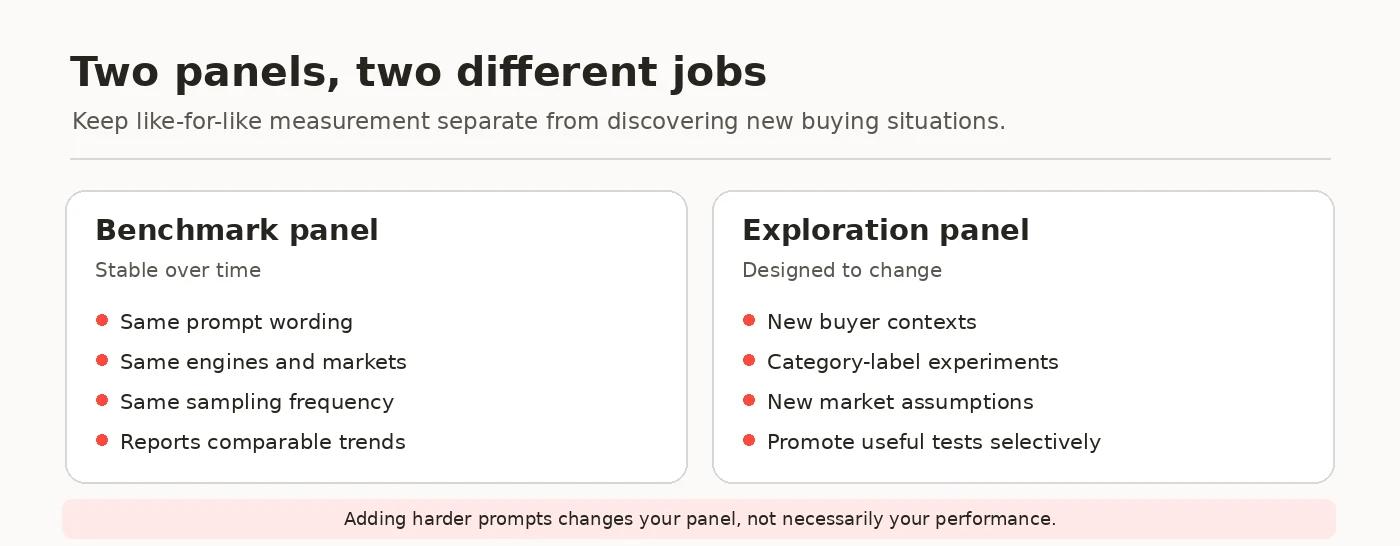
Your benchmark panel is the fixed set you use for trend reporting, so keep its wording, engines, geography, sampling frequency, and segments consistent. Your exploration panel is where you test new category labels, buying scenarios, emerging needs, and possible evidence gaps.
Why split them? Say your brand appears in 18 of 30 benchmark answers, a 60% mention rate, and you then add 20 new, difficult prompts where your brand doesn’t appear yet. Your combined score drops to 36% even though nothing changed on any of the original questions, because the lower percentage describes a different panel rather than a decline in performance.
So report both the like-for-like benchmark and the broader current portfolio, and log every addition or change that affects the denominator.
A 30-prompt starter framework
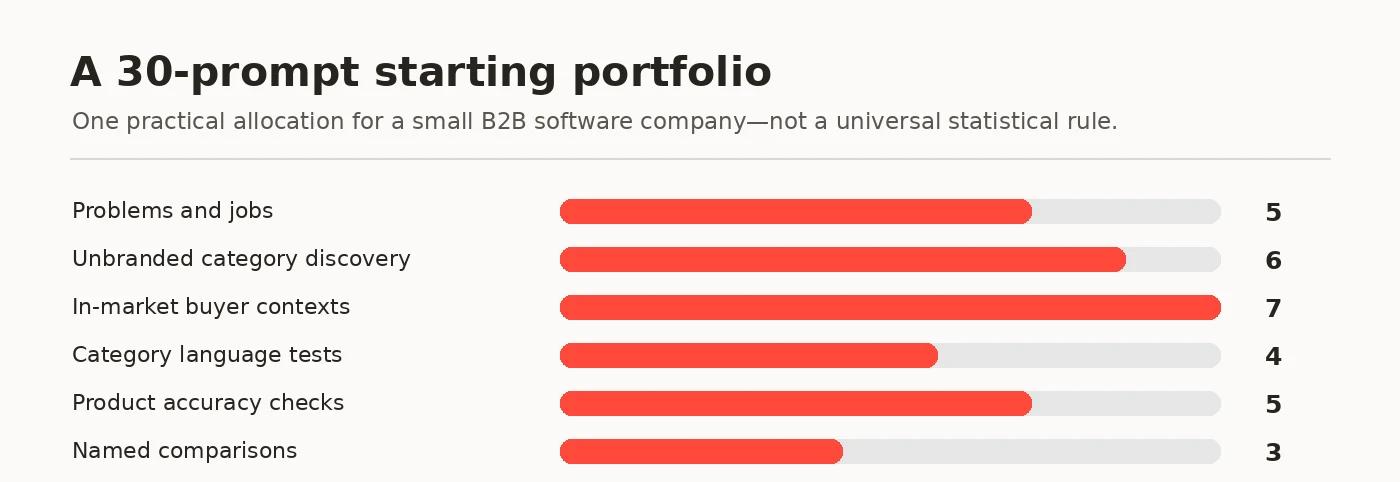
For a small B2B software brand, I’d start with 30 carefully chosen prompts. Thirty isn’t statistically magical, but it’s small enough to review every answer and broad enough that you’re not measuring one phrase over and over.
| Group | Prompts | Purpose |
|---|---|---|
| Problems and jobs to be done | 5 | Do assistants connect customer frustrations to the correct solution category? |
| Unbranded category discovery | 6 | Does the brand appear on relevant shortlists? |
| In-market buyer contexts | 7 | Does it fit realistic budgets, markets, and integrations? |
| Adjacent category and terminology tests | 4 | Does category language change the shortlist? |
| Named-brand accuracy and capability checks | 5 | Are product facts correct? Report separately from discovery. |
| Named comparisons and objections | 3 | What would make a buyer choose or reject the product? Report separately. |
| Total | 30 |
Tag every prompt with its buying task, market-status hypothesis, branded or unbranded status, category, target buyer, country and language, evidence source, and intended metric. Some of those labels can stay unknown, and that’s fine, since forcing certainty you don’t have only makes the data look cleaner than it is.
Use the benchmark for repeated tracking and keep new variations in exploration, promoting only the ones with a clear business reason and disclosing whenever the benchmark’s composition changes.
Choose breadth, frequency, and weighting on purpose
Running the same ten prompts five times a day gives you more observations of those ten questions, but it tells you little about the many other questions buyers might ask. Running fifty distinct prompts once a day covers far more ground, at the cost of fewer observations per question.
Both of these schedules use 1,500 prompt-engine executions a month:
- 50 prompts × 1 engine × 1 daily run × 30 days = 1,500 executions, which buys breadth across buyer situations.
- 10 prompts × 1 engine × 5 daily runs × 30 days = 1,500 executions, which buys repeated observations of fewer situations.
If your goal is broad category coverage, I’d usually favor the more diverse panel, whereas if one high-stakes comparison keeps flipping, I’d run extra observations on that prompt alone. Neither choice makes your dataset representative on its own, because selection bias is still possible either way.
And don’t assume every prompt deserves the same business weight. A handful of highly specific purchase scenarios can matter more commercially than dozens of broad educational questions. Show the unweighted result first, and if you introduce a weighted index, publish the weighting logic and the evidence behind it. Quietly picking weights that flatter your brand is how a report stops being trusted.
Score each segment for what it was designed to measure
A single “AI visibility” percentage is tempting, but it can hide the difference between being known and being chosen. I’d use at least four separate views:
- Unbranded discovery rate, the share of completed, relevant recommendation answers that mention your brand without the prompt naming it.
- Buyer-fit recommendation rate, how often your brand is recommended within a defined buyer-context segment, along with the reasons and constraints.
- Brand accuracy, the share of tested factual claims that match a verified source of truth. Report individual material errors too, not just an average.
- Category and evidence coverage, meaning which buyer problems lead AI toward your category, and which domains and URLs supply the cited evidence.
Here’s how that plays out. You might appear in 12 of 20 broad, unbranded recommendation answers (60%) but in just 2 of 10 in-market ecommerce buying scenarios (20%). If ecommerce is your most valuable market, that second number is your real strategic problem. Just don’t generalize either figure to the whole population of AI users, since both come from a small, curated sample.
Citations and mentions deserve separate treatment as well. A brand can be recommended without its own website being cited, or its website can be cited without the brand being recommended, and while both outcomes tell you something, they aren’t interchangeable.
A walkthrough: from missing recommendation to useful action
Take a fictional SaaS company, Northstar, which sells multilingual customer-support software. The team wants to know why it isn’t showing up in AI recommendations for European mid-market businesses.
Step 1: Define the purchase situation. The buyer is a support director at a 150-person ecommerce business who needs a multilingual help desk, EU data handling, and a Shopify integration. One tracking question might be: “Which customer support platforms should an EU ecommerce company shortlist for multilingual service and Shopify?”
Step 2: Add comparison questions that change one variable. Run the same scenario without the regional requirement, then again without the company-size constraint. If the shortlist changes, note which constraint seems to matter, rather than treating all three as interchangeable prompts.
Step 3: Inspect the actual answers and evidence. Say the model recommends three providers but not Northstar, citing an integrations directory, an industry comparison, and a documentation page. The team then checks whether Northstar’s Shopify connection and language support are described clearly, both on its own site and wherever buyers usually research tools.
Step 4: Check knowledge separately. Ask, “Does Northstar support Shopify and multilingual ticket routing?” If the answer is wrong, fix the relevant documentation and public product facts. If it’s right but the brand still isn’t recommended, look at other explanations, such as market fit, competing proof, reviews, and source authority, without pretending that a single prompt establishes cause and effect.
Step 5: Make a targeted improvement. Publish an integration page that explains the workflow, its limits, and the setup steps, and back it up with a real customer example if you have one. What you shouldn’t do is churn out a vague “best support software” article just because the brand was missing from a list.
Step 6: Recheck the unchanged benchmark. Keep the original prompts and tracking conditions, and watch both the mentions and the reasons given. If visibility shifts, report the observation, the time window, and any other plausible influences, but don’t claim the new page caused the change without stronger evidence.
That’s the difference between a prompt list and a research program. What comes out the other end isn’t another dashboard, it’s a decision about what to improve that you can actually defend.
Your monthly prompt review should answer six questions
Before you send a report, make sure you can answer these without opening ten separate dashboards:
- Which buyers, buying tasks, and markets did the prompt sample represent, and which did it miss?
- Where did AI recommend the brand independently, rather than because the question named it?
- Which realistic in-market situations favored another brand, and what reasons did the answers give?
- Which category labels changed the shortlist or framed the category differently?
- Which sources, and where observable, which retrieval queries supported the recommendations?
- What one to three changes should the team make next, and how will you measure them on a stable benchmark?
If you can’t answer those, add context and interpretation before you add more prompts.
The bottom line
The right prompts aren’t necessarily the most popular, the longest, or the most flattering to your brand. They’re the ones that represent distinct, meaningful decisions and surface evidence you can act on.
So start with the buyer’s problem, map the category the assistant might steer them toward, and keep independent discovery apart from branded checks. Add realistic purchase constraints, inspect citations and observed query fan-outs where you can, and hold a stable panel so you can tell a changing answer from a changing measurement.
Do that, and you end up with something more useful than a visibility score: a clear picture of where your brand enters a buying decision, why it might be left out, and what to look into next.
Frequently asked questions
How many prompts should I track for AI visibility?
For a small B2B software brand, around 30 carefully chosen prompts is a practical starting point. Thirty isn't statistically magical, but it's small enough to review every answer and broad enough that you're not measuring one phrase over and over. Split them across problems, unbranded discovery, in-market buyer contexts, category-language tests, accuracy checks and named comparisons.
Should I include branded prompts in AI visibility tracking?
Yes, but report them separately. Unbranded prompts test whether AI recommends you independently, while branded prompts test what it says once your company is already in the conversation. A 95% mention rate on prompts that name your brand is not 95% independent discovery, so never blend the two into a single visibility score.
What is a query fan-out?
A query fan-out is one of the narrower web searches an AI assistant may run before answering a buyer's question, such as checking pricing, regional coverage or reviews. Fan-outs show what evidence the assistant needs to compare products. They are not extra buyer prompts, so don't count them as demand or add them to your buyer-intent panel.
What's the difference between a benchmark panel and an exploration panel?
The benchmark panel is a fixed set of prompts with the same wording, engines, markets and frequency, used for trend reporting. The exploration panel is where you test new buyer contexts, category labels and market assumptions. Keeping them apart stops a batch of harder new prompts from looking like a drop in performance.
Where do good AI visibility prompt ideas come from?
From evidence of real buying situations: sales calls and lost-deal notes, customer interviews and support tickets, Search Console and keyword research, review-site questions and community threads, and AI-originated inquiries customers share with you. Synthetic prompts are useful for testing specific risks, as long as they're labeled as synthetic.
Is it better to track more prompts or run fewer prompts more often?
It depends on the goal. Fifty distinct prompts run once a day cover more buyer situations, while ten prompts run five times a day give more observations of fewer questions; both use 1,500 executions a month. Favor breadth for category coverage, and add repeat runs only for high-stakes prompts whose answers keep flipping.
Written by