7 best Peec AI alternatives in 2026 (and when Peec is the better choice)

The best alternatives to Peec AI depend on the job: Quotable for investigation and execution at the lowest daily cost per prompt, Otterly.AI for a cheap pilot, LLM Pulse for five models on weekly tracking, AIclicks for tracking plus articles, AthenaHQ for broad model choice, Ahrefs Brand Radar for search-backed discovery, and Profound for enterprise programs.
Peec AI is a good AI visibility platform, which is why “Peec AI alternatives” gets searched by two kinds of people: buyers comparing it with other tools before they pick one, and customers who’ve run into a limit. Both need the same thing, an accurate picture of what Peec does today. In 2026 it shipped an agent, ranked Actions, brand perception and fact-checking, SKU-level AI Shopping, and crawler analytics from your server logs, so anyone still describing it as a mentions dashboard is working from an old picture. The right choice depends on the job you need done, and a longer feature list won’t settle that.
Peec AI alternatives by use case
- For investigation and execution in one place, at the lowest cost per prompt tracked daily in this comparison, start with Quotable.
- For a cheap first experiment on a handful of prompts, Otterly.AI is the easiest way in.
- For five models on every prompt at a low price, and you can live with weekly tracking, look at LLM Pulse.
- For tracking bundled with a monthly quota of AI-written articles, compare AIclicks.
- For broad model choice with credit-based billing, AthenaHQ is the closer fit.
- For market-wide discovery tied to SEO data, use Ahrefs Brand Radar.
- For an enterprise program with procurement, governance, and agents, Profound belongs on the list.
Full disclosure: this comparison is published by Quotable, one of the products reviewed, so we’re biased. I ran a free trial on every platform that offers one and tested them hands-on, then went through each vendor’s pricing page, documentation, and release notes, read public user reviews, and checked prices on November 3, 2026. Where a product is sold only through sales, as with Profound Enterprise, the description comes from its public documentation.
Peec AI alternatives at a glance
| Tool | Best reason to choose it | Starting at | Entry-plan tracking | Entry-plan cost per prompt/mo | What to check before buying |
|---|---|---|---|---|---|
| Peec AI (the baseline) | Analytics, sources, Actions, and an agent with three active models | $95/mo | 50 prompts, 3 models, daily | $1.90 | Which three models you can run at once |
| Quotable | Investigation and execution in one place, at the lowest daily cost per prompt here | $99/mo, 3-day trial | 100 prompts per model, 3 models, daily | $0.99 | Perplexity, Claude and Copilot on Enterprise only |
| Otterly.AI | A low-cost pilot on a small prompt set | $29/mo | 15 prompts, 4 engines | $1.93 | Claude, Gemini, and AI Mode are add-ons |
| LLM Pulse | Five models on every prompt at a low price | €49/mo | 50 prompts, 5 models, weekly | €0.98 (weekly) | Daily tracking costs extra |
| AIclicks | Tracking bundled with AI-optimized articles | $59/mo | 30 prompts, 3 models | $1.97 | One website on Starter |
| AthenaHQ | Broad model choice with optimization workflows | Free Essential; $295/mo Starter | 3,600 response credits | Credit-based | API and extra credits cost more |
| Ahrefs Brand Radar | Search-backed market and competitor discovery | $50/mo custom prompts; index from $199/mo | 2,500 checks | Check-based | Index and custom prompts are separate purchases |
| Profound | An enterprise AI search program | Free 7-day trial; Enterprise custom | 50 prompts, 3 engines, for 7 days | Not published | No self-serve paid plan for brands |
These are monthly list prices in the currency each vendor publishes, and they don’t buy the same unit of service. A prompt, an engine check, a response credit, and a generated article are different things, so the per-prompt column divides the entry price by tracked prompts and nothing more. LLM Pulse is the exception worth flagging: each of its prompts covers five models, so per prompt and model it’s the cheapest option here, but on weekly tracking. Quotable has the lowest cost per prompt tracked daily.
What you get with Peec AI, and what an alternative has to beat
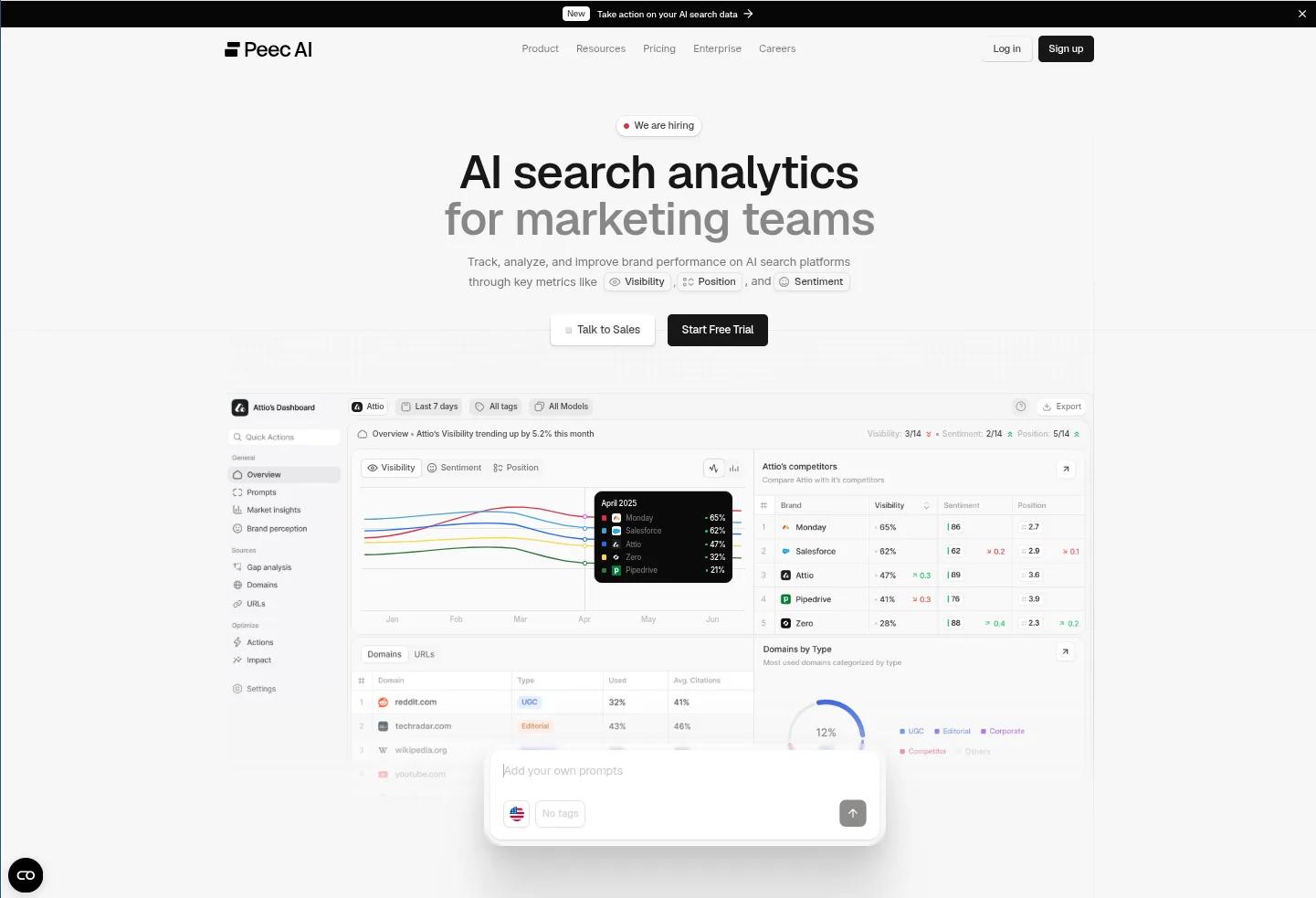
Peec’s brand plans are easy to understand, so the useful question is whether their limits match the shape of your program. Every brand tier runs three active models with daily tracking and unlimited users, while prompts and projects grow by tier. That raises a few specific questions:
- Which three engines can run at the same time on your plan? Peec offers extra models as add-ons and keeps some extended models and platforms on Enterprise, so ask for the exact list rather than trusting the logos on the homepage.
- How many decisions are you monitoring? Fifty well-chosen prompts can cover one category in one market, and they get thin quickly once you split them across personas, product lines, or regions.
- How deep does the research need to go? Mentions and citations are one level, and retrievals, brand attributes, objections, and verified claims are another.
- Who does the follow-through? Some teams hand findings to content or PR, while others need repeatable workflows inside the product.
- Are brands or products being recommended? SaaS recommendations and AI Shopping product cards are different research problems, with SKU, variant, merchant, and price all in play for the second.
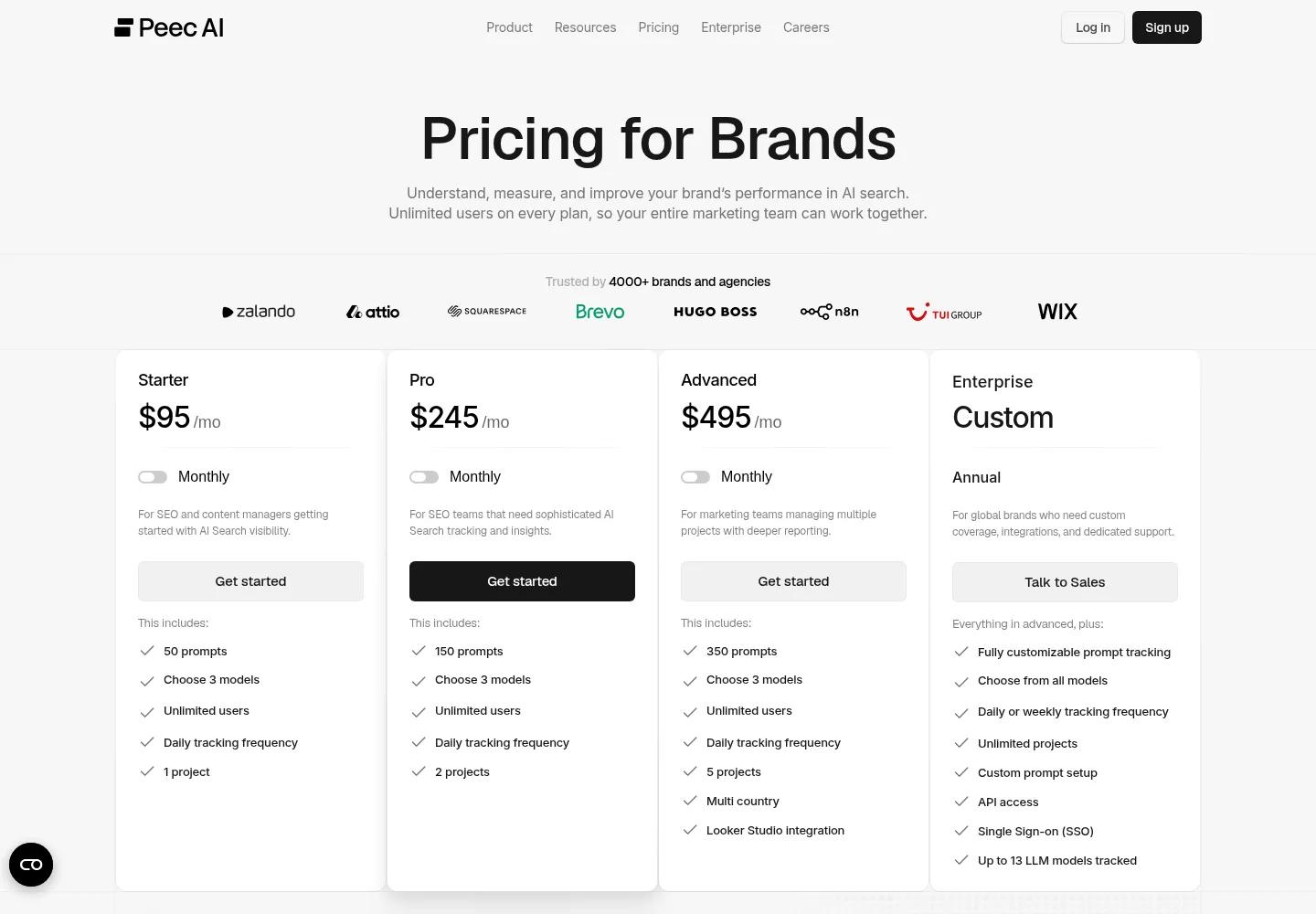
Peec AI pricing
- Starter: $95/month ($1.90 per prompt). 50 prompts; three active models; daily tracking; one project; unlimited users.
- Pro: $245/month ($1.63 per prompt). 150 prompts; two projects.
- Advanced: $495/month ($1.41 per prompt). 350 prompts; five projects.
- Enterprise and agency plans: custom, with agency credits shared across client projects.
What Peec does well in 2026
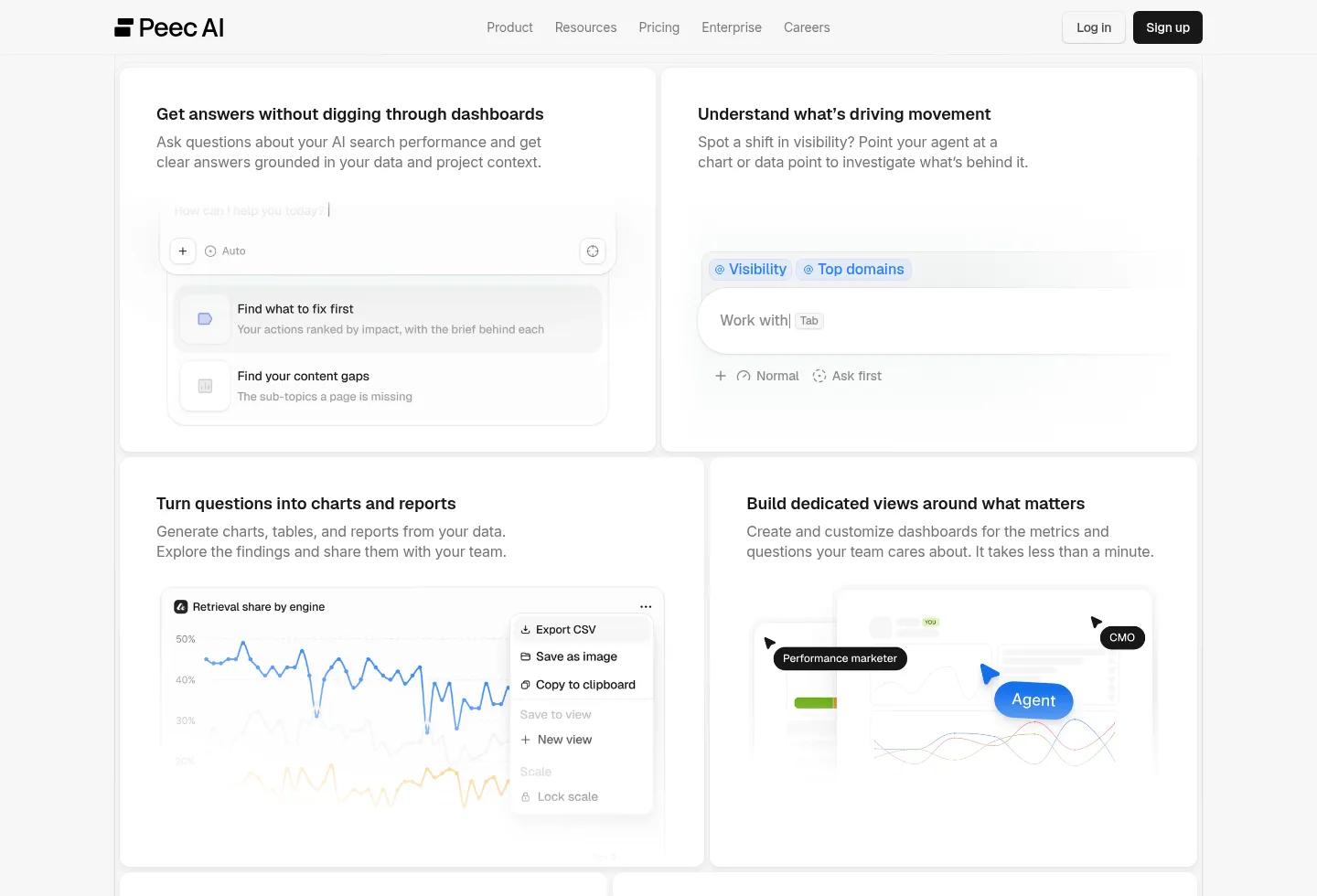
It covers the whole chain from observation to investigation. Its feature matrix includes visibility, share of voice, prompt discovery, sources at domain and URL level, retrievals versus citations, source classification, competitor gaps, and AI referrals. The October release reworked Actions to rank technical, owned, earned, and fact-correction opportunities, and Peec Agent can investigate trends, build tables and reports, and work on tasks you approve.
Brand perception goes beyond sentiment, too. Peec separates what a brand is associated with from where it beats competitors on a given attribute, and it checks AI claims against facts you provide, on 5, 10, or 25 tracked prompts depending on the tier. So the limit is how much fact-checking a plan includes, which is different from not having it.
It also does product-level shopping analysis, with catalog uploads, SKU-level visibility, shopping query fan-outs, merchant information, and shopping sources. And its Agent Analytics reads AI bot activity straight from your server logs, showing which bots hit which pages, how often, and with which status codes, and it’s currently available on all accounts.
Users often find onboarding easy and the dashboards readable, and they value the citation insights. The recurring complaints are crowded navigation, suggested prompts that need pruning, and uncertainty about which recommendation actually moved a number. One G2 reviewer called it “the best tool for measuring how we show up in AI overviews.”
If three engines cover your market, your prompt set fits its tiers, and your team will act on source and recommendation data, Peec is a strong default. And if you already use it that way, switching mostly buys you a migration.
The best Peec AI alternatives, reviewed
Quotable: best Peec AI alternative for investigation and execution together
Full disclosure: Quotable is the product I build, so read this section with that in mind.
A visibility alert only matters if it leads to a decision. Picture an assistant that keeps recommending two competitors for “best contract management software for a 200-person company” and leaves you out. A lower score won’t help you there. You need the original answers, the competitors in them, the pages the engine cited, the explanation it gave, and a clear next step your team can own.
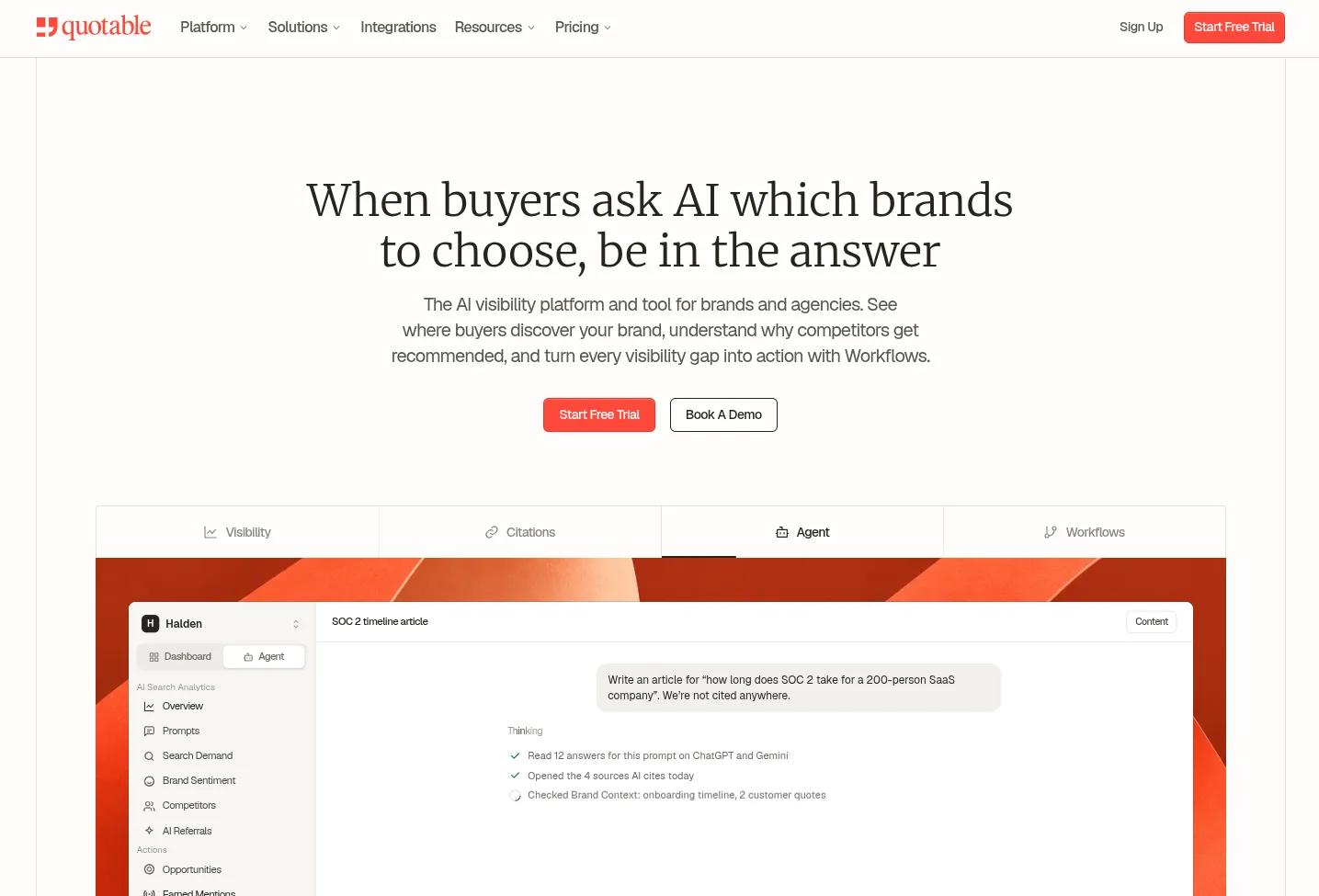
Quotable is built to connect those steps. It tracks prompts daily per model, captures answers client-side from the AI apps rather than through model APIs, and shows the brands, sources, and claims behind each answer. It checks those claims against your brand’s facts, covers AI Shopping at SKU level and ChatGPT Ads next to organic mentions, and reads verified crawler activity from server or CDN logs. Quotable Agent then works from that data: it can draft the article, rewrite the page against the sources that won, write the LinkedIn post, or build an agent, and it asks for approval before anything goes out to Slack, Notion, Linear, Gmail, Outlook, Webflow, or Contentful. Tables runs the same workflow across many prompts or pages at once, which is where the difference from a one-off agent task shows up for agencies and SaaS teams whose claims change every quarter.
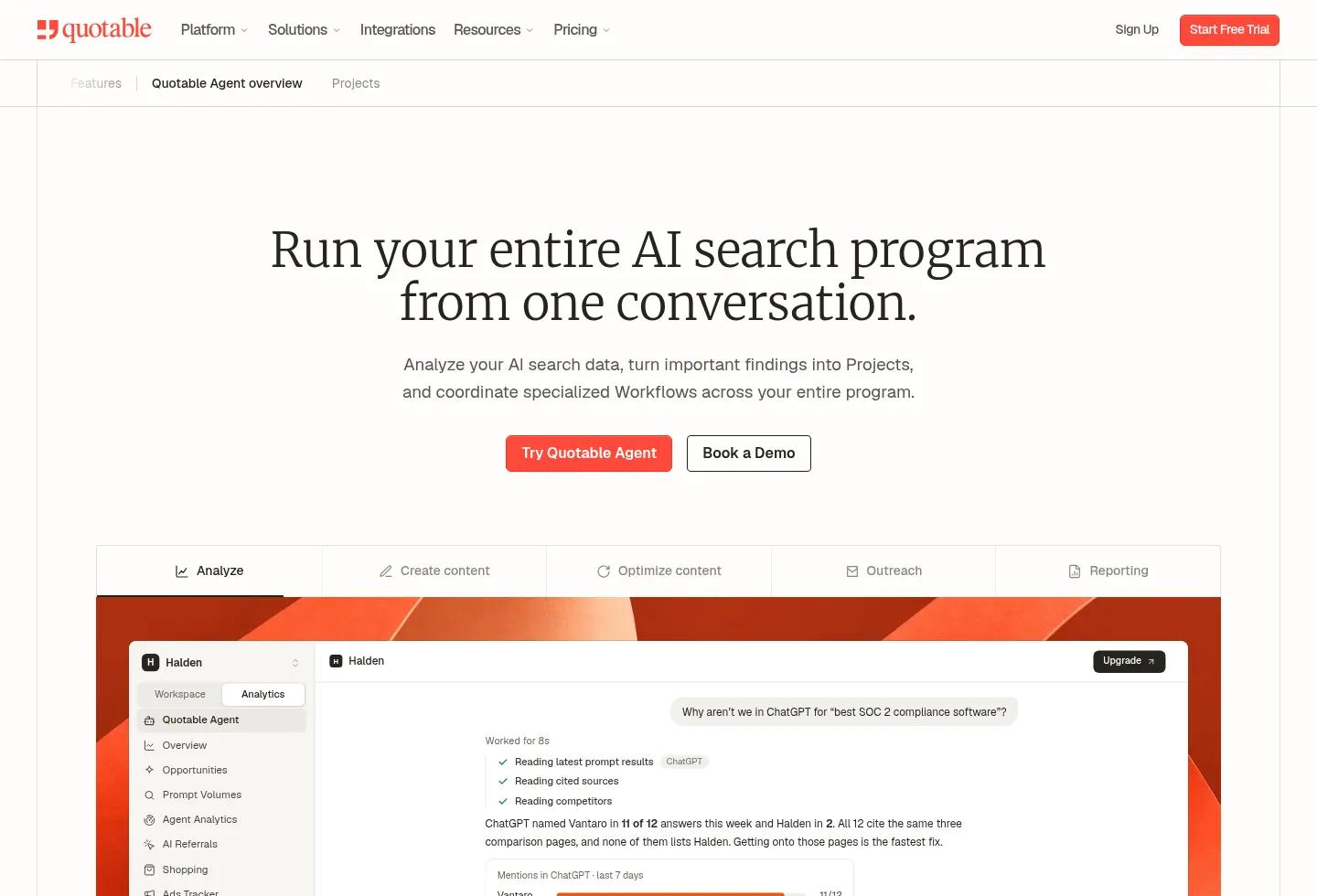
Peec has an agent and Actions too, so the fair way to compare is to run the same losing prompt through both and see how much manual work is left at the end. On price, Quotable has the lowest cost per prompt tracked daily of any plan in this comparison, and each prompt runs on the three models you choose.
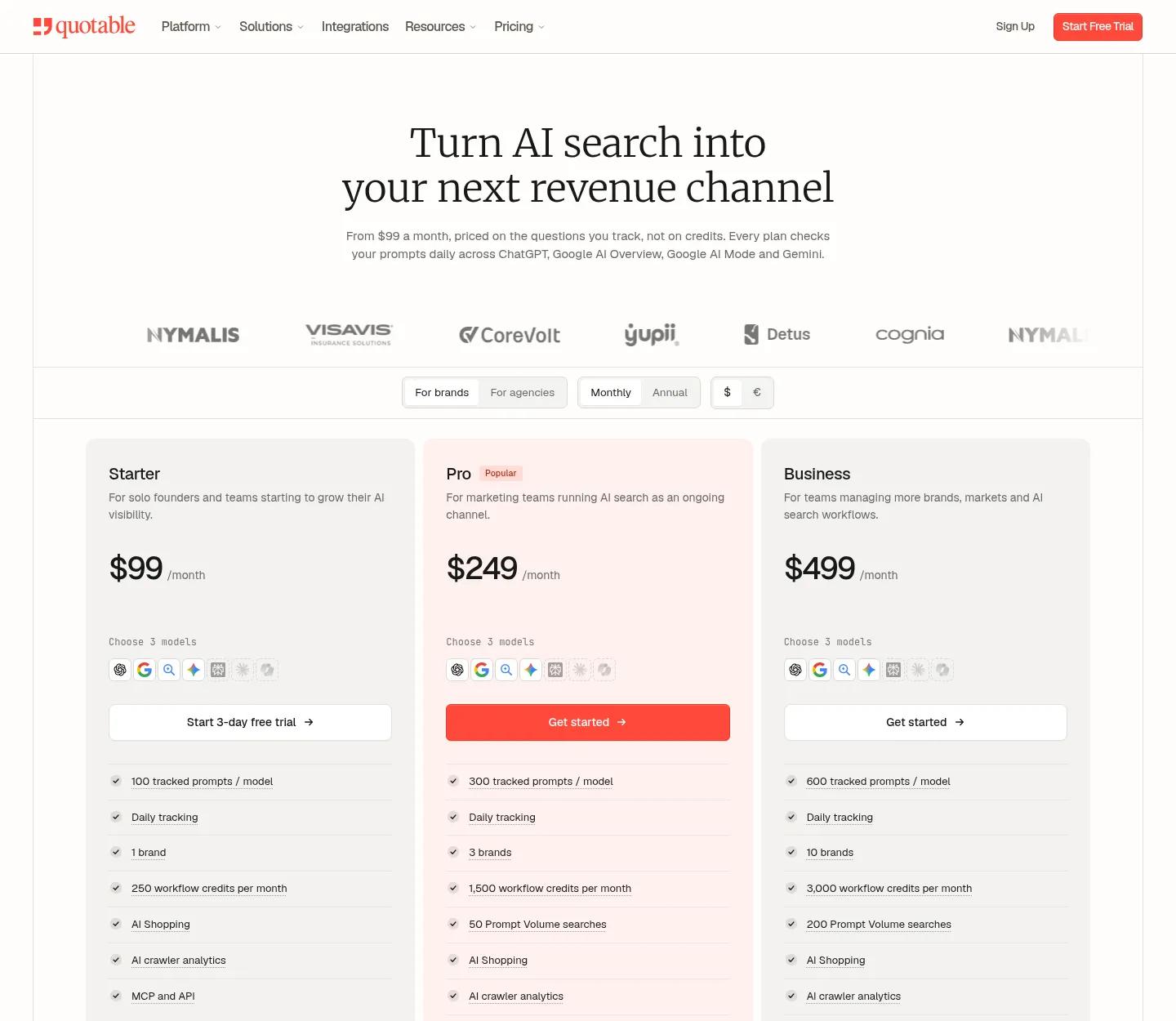
Starter, Pro and Business track three of ChatGPT, Google AI Overview, Google AI Mode and Gemini per brand. If you need Perplexity, Claude or Copilot, those are on Enterprise only.
Pricing
- Starter: $99/month ($0.99 per prompt). One brand; 100 tracked prompts per model; three models; daily tracking; 250 workflow credits a month; AI Shopping, crawler analytics, API, and MCP. Three-day trial.
- Pro: $249/month ($0.83 per prompt). Three brands; 300 prompts per model; 1,500 workflow credits a month; 50 Prompt Volume searches; unlimited seats and knowledge base.
- Business: $499/month ($0.83 per prompt). Ten brands; 600 prompts per model; 3,000 workflow credits a month; 200 Prompt Volume searches.
- Enterprise: custom.
Pros
- The lowest cost per prompt tracked daily in this comparison.
- Answers captured from the AI apps, with fact-checking, AI Shopping, ChatGPT Ads, and crawler data in one place.
- Quotable Agent and Tables turn findings into drafts, rewrites, and repeatable workflows.
Cons
- Little independent review history so far.
- Starter covers a single brand, and workflow credits are a separate pool from prompts.
- Enterprise controls such as SSO need checking.
Otterly.AI: cheapest Peec AI alternative for a small pilot
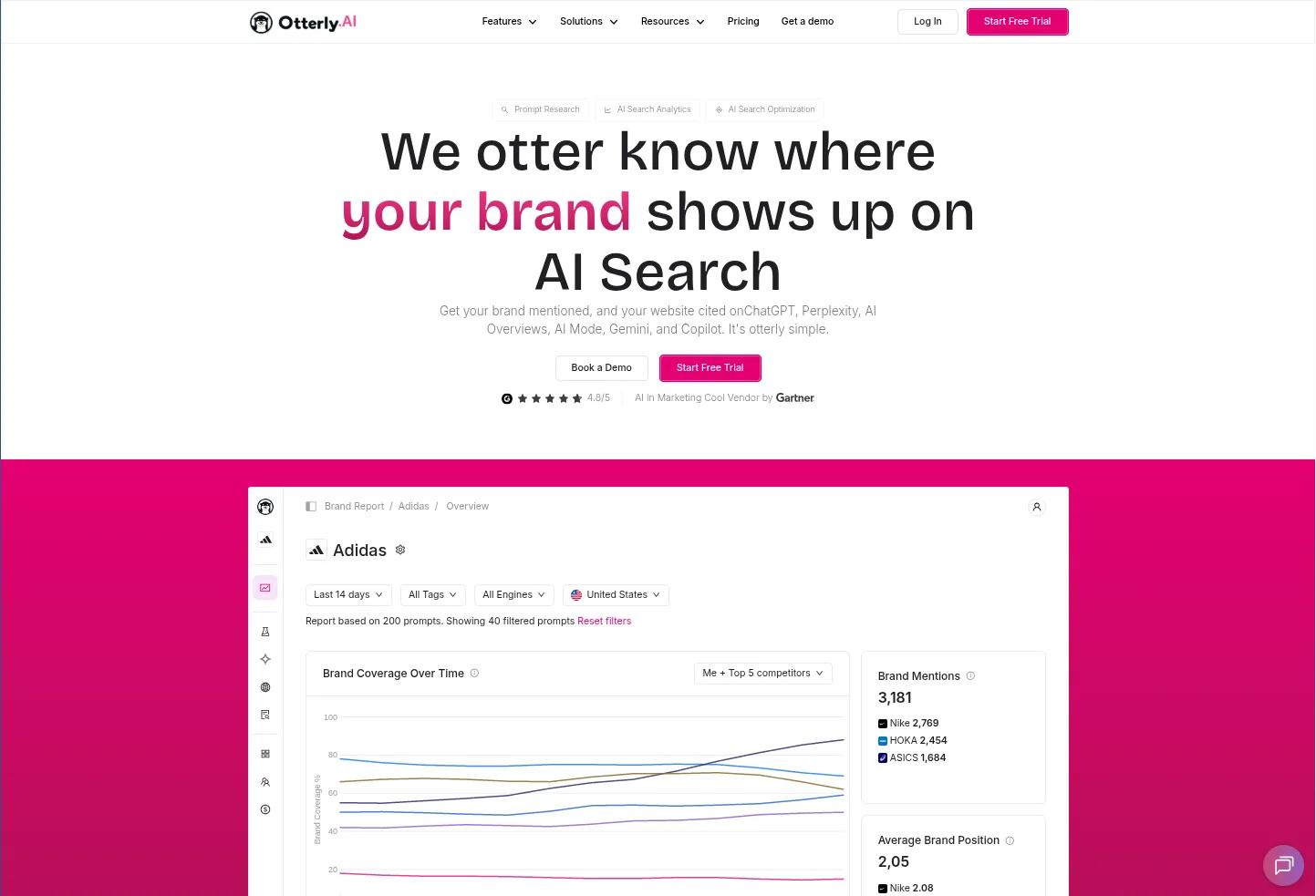
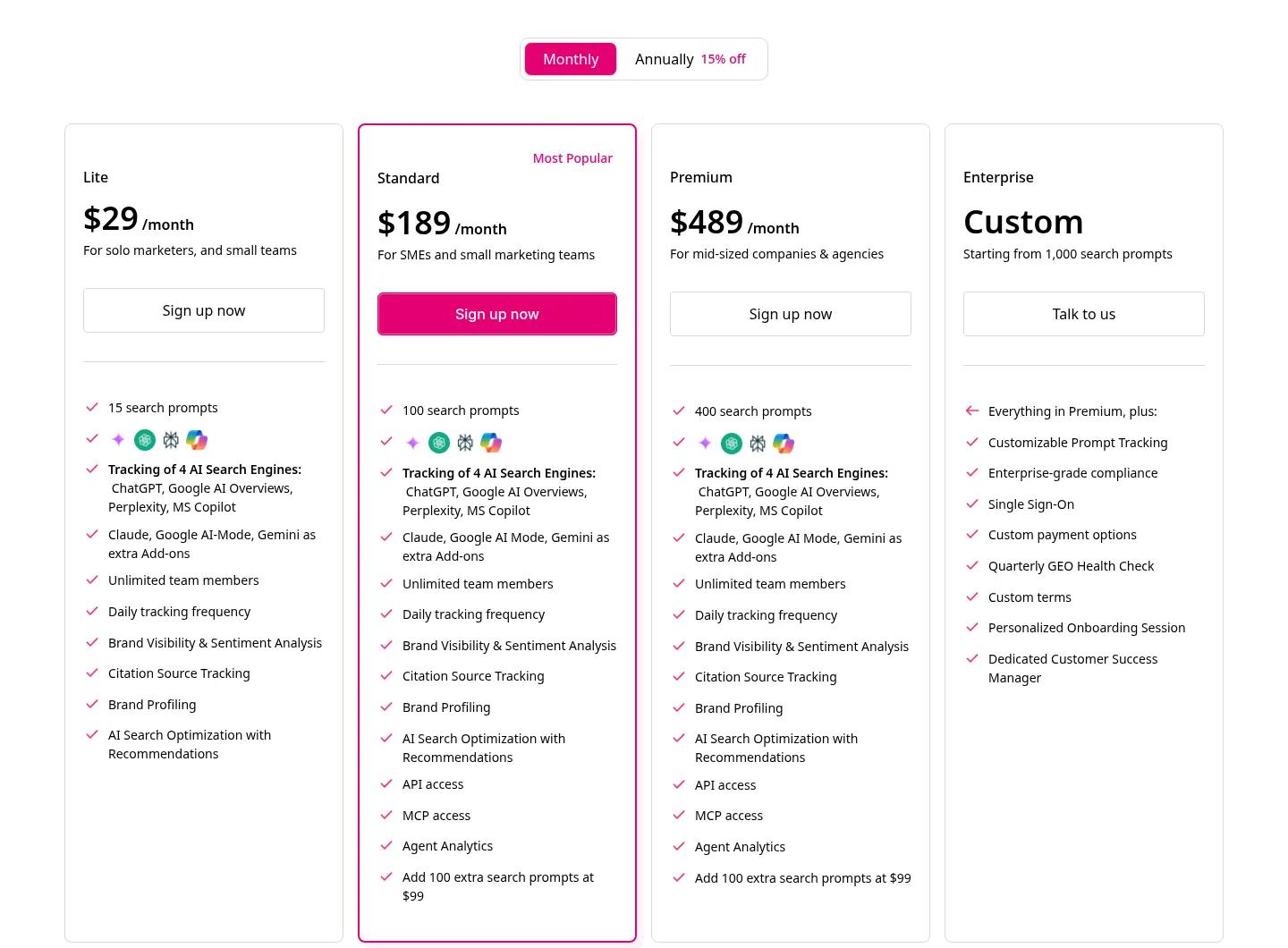
Otterly is the easiest way to find out whether a short list of AI search prompts is worth tracking before you commit to a bigger program. Lite runs 15 prompts daily on ChatGPT, Google AI Overviews, Perplexity, and Microsoft Copilot, with unlimited team members, and it still includes visibility and sentiment, citation sources, brand profiling, recommendations, and a GEO audit. It’s a functional entry-level product, and the higher tiers add API access, MCP, and Agent Analytics.
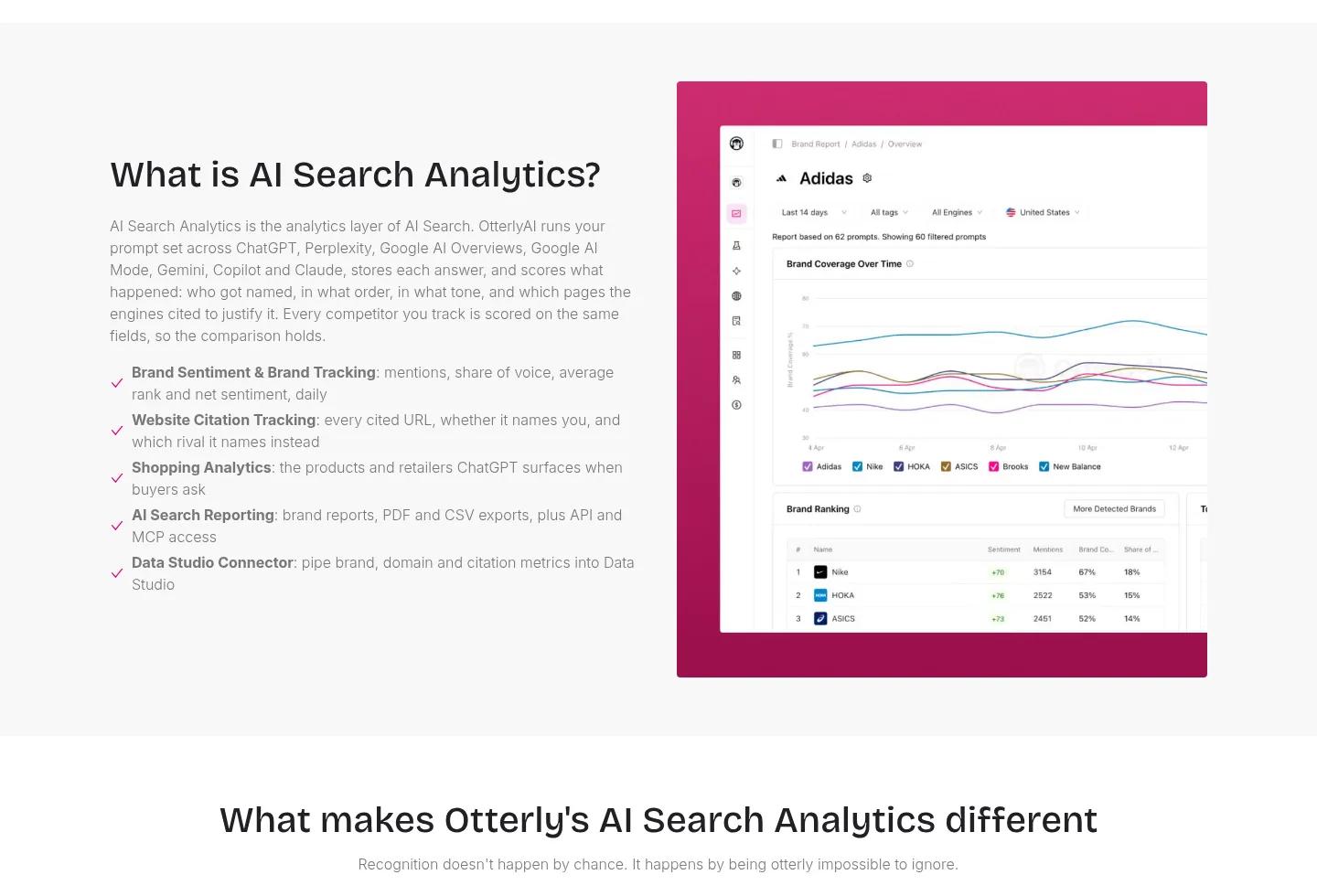
The constraint shows up as soon as you grow. Fifteen prompts comfortably cover 12 carefully chosen buyer questions, and they won’t cover 80 across four categories. Claude, Gemini, and Google AI Mode are paid add-ons per engine, and prompts count per country, so the real cost of a multi-market panel climbs faster than the headline suggests.
Users often find Otterly easy to use and the support quick, while the common complaints are limited filtering and reporting and a sentiment classifier that can read neutral mentions as negative. As one G2 reviewer put it, “The UI is powerful, but it can feel cluttered when you have a lot of prompts.”
Otterly is the right Peec AI alternative when the immediate goal is a small, low-risk experiment. If you need 50 prompts now, with Peec’s source, perception, and shopping workflows, Peec’s Starter is the better buy.
Pricing
- Lite: $29/month ($1.93 per prompt). 15 prompts; four engines; daily tracking; unlimited team members.
- Standard: $189/month ($1.89 per prompt). 100 prompts; API, MCP, and Agent Analytics.
- Premium: $489/month ($1.22 per prompt). 400 prompts.
- Add-ons: Claude, Gemini, and Google AI Mode are priced per engine.
Pros
- The lowest paid entry price in this comparison.
- Four engines included by default.
- Easy to understand and quick to set up.
Cons
- Fifteen prompts at entry is a narrow panel.
- A big jump in price from Lite to Standard.
- Engine add-ons and per-country prompts change the effective cost.
LLM Pulse: the Peec AI alternative with five models per prompt
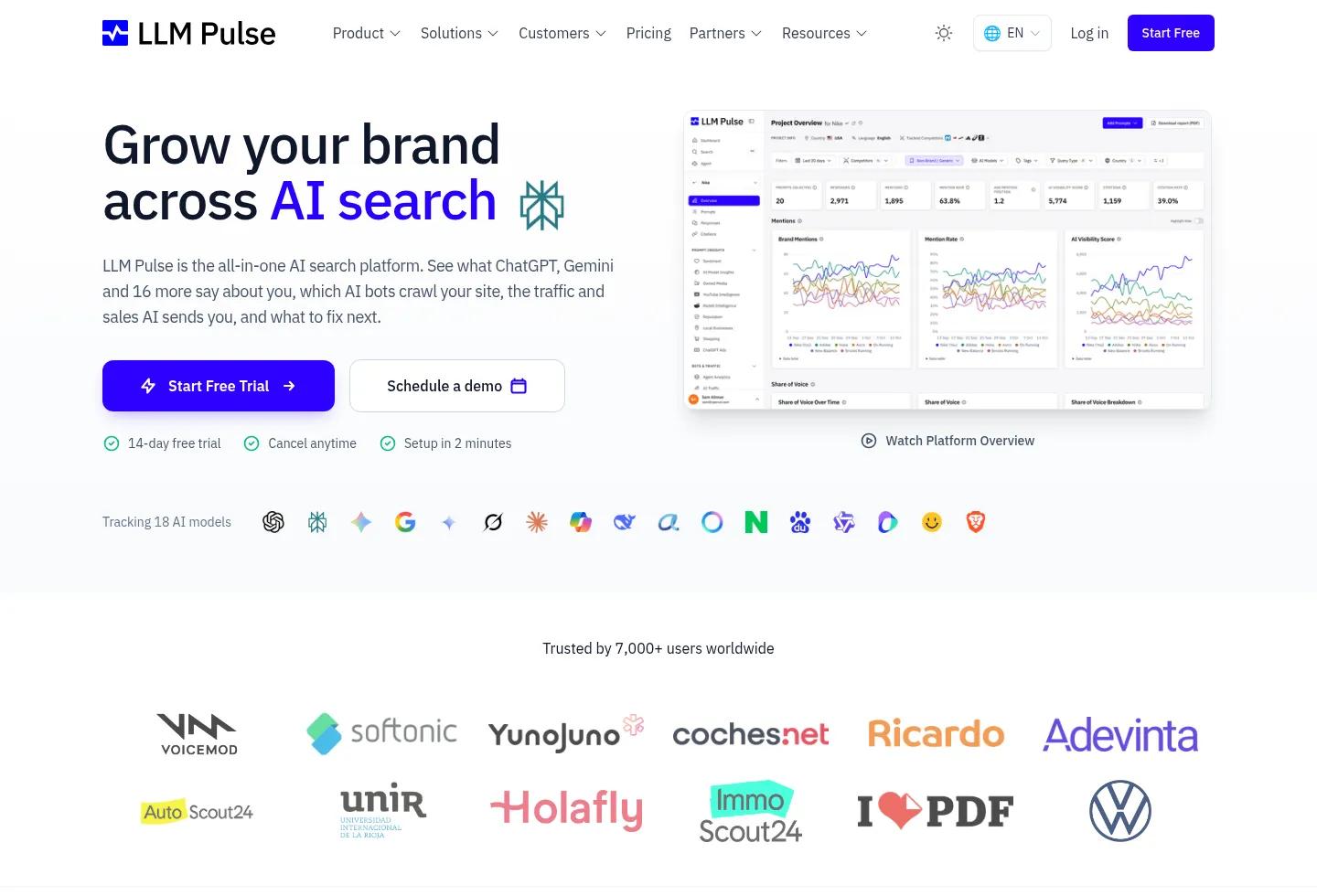
LLM Pulse includes ChatGPT, Perplexity, Gemini, Google AI Mode, and Google AI Overviews on every plan, and a prompt counts once against your limit however many models it runs on. On Growth, 150 prompts means 150 questions watched across all five models, which is a generous allowance next to tools that split prompts between engines. Sentiment analysis, recommendations, and its GEO Writer come in from Growth, and the MCP server is available from the start.
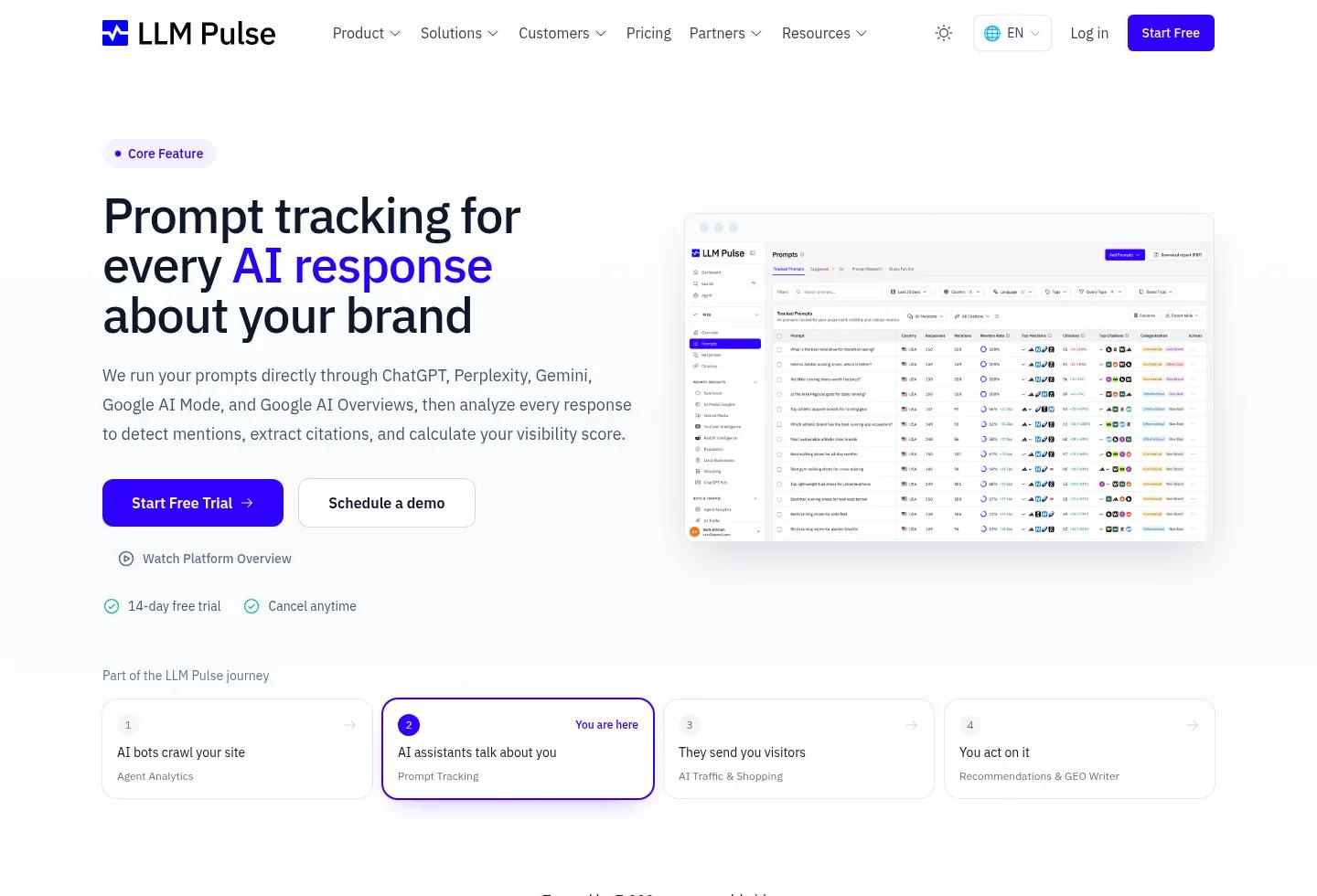
The catch is cadence. Tracking is weekly by default, and daily tracking is a separately paid option on every plan, so compare like with like: a weekly LLM Pulse panel against a daily Peec panel isn’t a fair fight in either direction. LLM Pulse argues that weekly data is enough for strategy work, and I’d agree for monthly reporting, though I’d want daily runs during a launch or when a competitor is moving fast.
I couldn’t find enough independent user reviews to report a real pattern for LLM Pulse, so judge the output quality, source traceability, and GEO Writer drafts on your own prompts during the trial.
LLM Pulse makes sense as an alternative to Peec AI when you want several engines on a limited budget and weekly signals are enough. If daily tracking, source investigation, or shopping analytics matter more than the entry price, compare it with Peec and Quotable at daily cadence.
Pricing
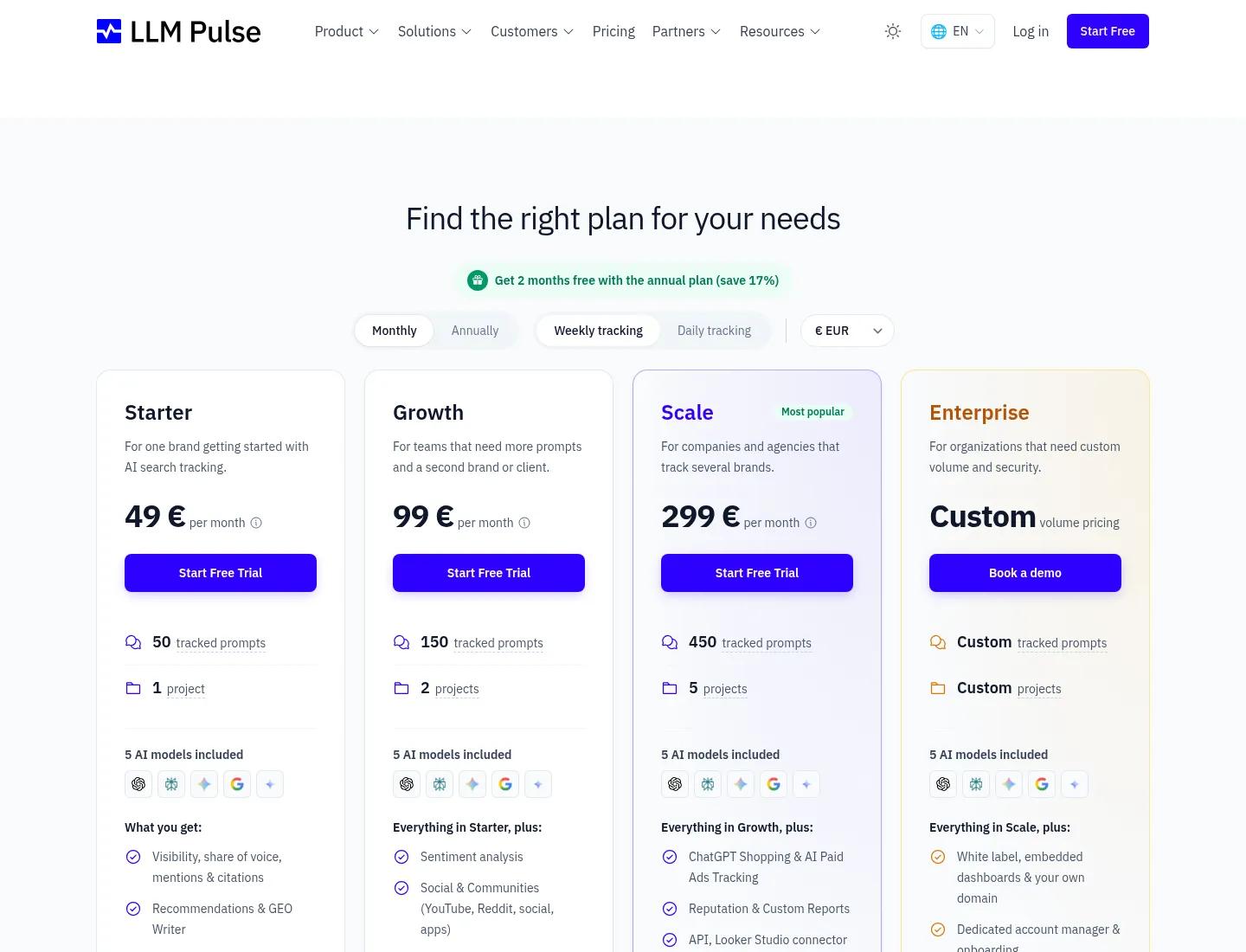
- Starter: €49/month (€0.98 per prompt, weekly). 50 prompts; five models; one project.
- Growth: €99/month (€0.66 per prompt, weekly). 150 prompts; two projects; sentiment, recommendations, and GEO Writer.
- Scale: €299/month (€0.66 per prompt, weekly). 450 prompts; five projects.
- Scale+ and Scale++: €599/month for 1,200 prompts and €1,199/month for 2,400 (€0.50 per prompt, weekly).
- Daily tracking: a paid option on every plan, listed at €79/month for Starter and €149/month for Growth.
Pros
- Five models on every prompt, with prompts counted once.
- The lowest cost per prompt and model in this comparison.
- Clear tiers that scale to large panels.
Cons
- Weekly by default, with daily tracking at extra cost.
- Sentiment, recommendations, and GEO Writer start on Growth.
- A small public review base.
AIclicks: best alternative to Peec AI for tracking plus articles

AIclicks packages tracking around a fixed monthly number of AI-optimized articles, which suits a lean team that already knows what it wants to publish and would rather not pay for a tracker and a writing tool separately. Peec has an agent and AIclicks didn’t invent content execution, so the advantage is the packaging: a clear quantity of drafts each month, with integrations such as GA4, API, MCP, and CMS from Pro.
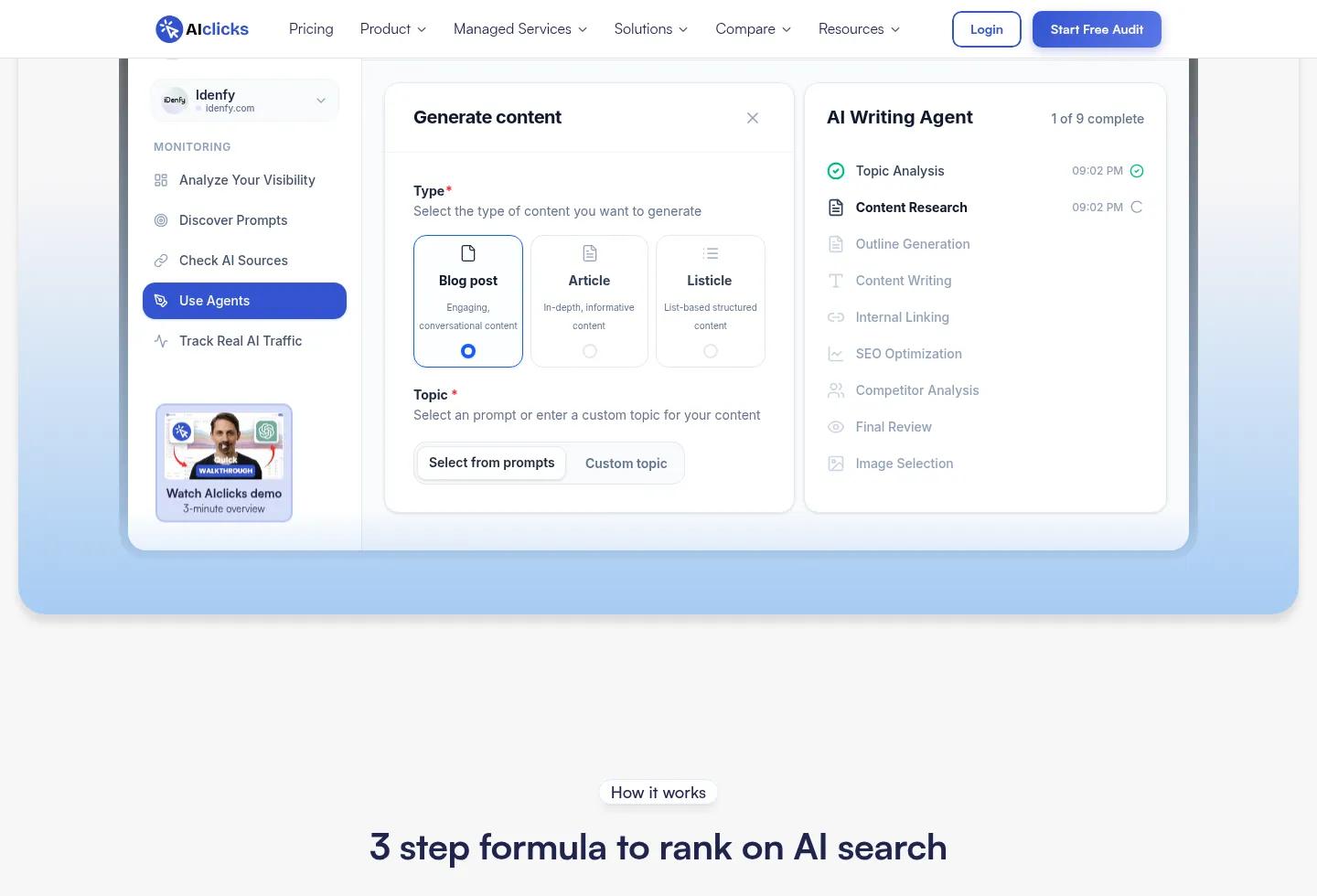
For other teams, the article count matters less than data provenance, research quality, approvals, and maintenance. A useful trial test is to give AIclicks and Peec the same losing buyer prompt, check the original answer and citations in each, and ask for a draft or update plan that accounts for the source evidence and your existing page. A polished draft that ignores the real information gap isn’t a win.
Users often find the citation insights actionable and the reporting easy to manage, while some say prompt allowances run out quickly and the interface lags at times. One G2 reviewer singled out “the easy-to-see AI traffic dashboard that connects directly into GA4.”
Choose AIclicks over Peec when you value a defined content package and want to consolidate tools. If you already have a content stack and care most about diagnosis, reporting, and source investigation, stay with Peec.
Pricing
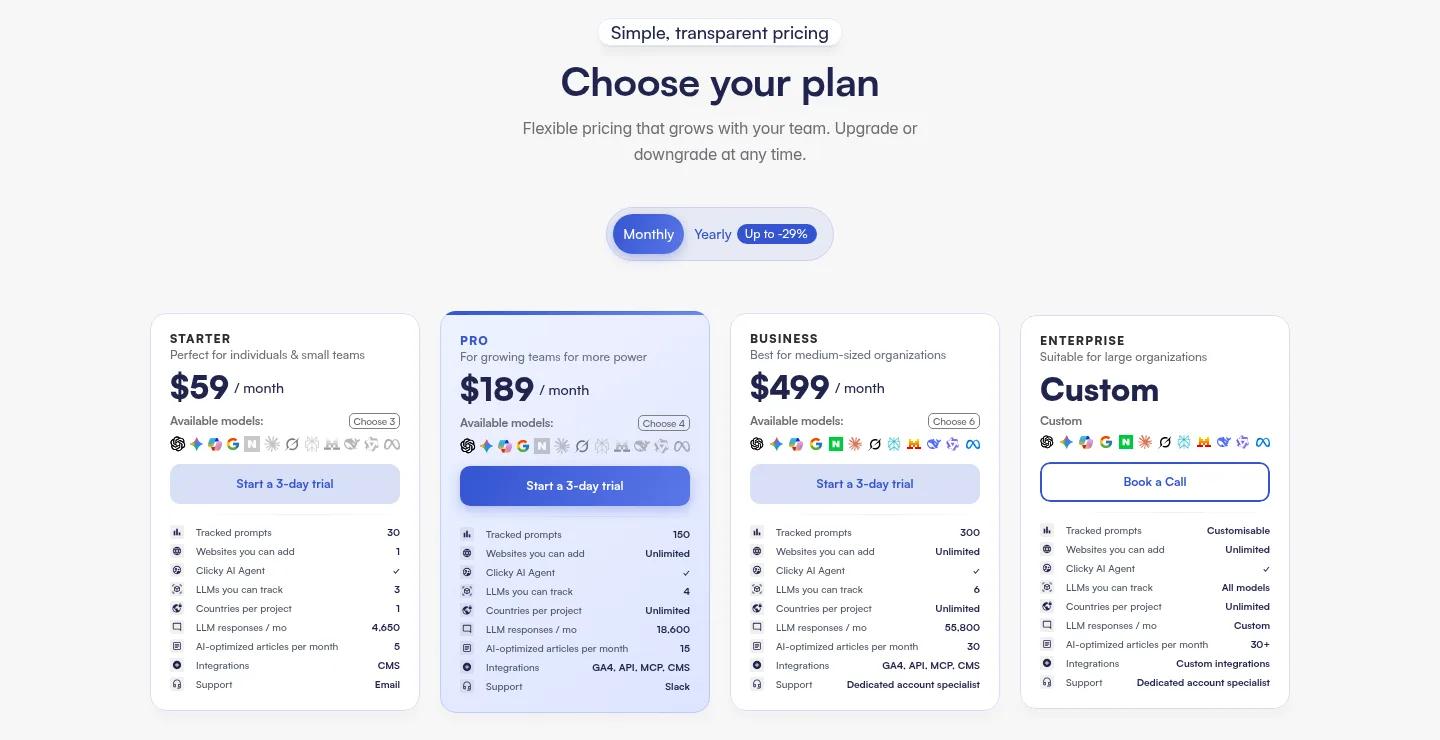
- Starter: $59/month ($1.97 per prompt). 30 prompts; three models; one website; five AI-optimized articles a month.
- Pro: $189/month ($1.26 per prompt). 150 prompts; four models; 15 articles a month; GA4, API, MCP, and CMS integrations.
- Business: $499/month ($1.66 per prompt). 300 prompts; six models; 30 articles a month.
Pros
- A clear content allowance on every paid tier.
- Useful integrations from Pro.
- Makes the monitoring-to-writing use case easy to grasp.
Cons
- Thirty prompts at entry is too few for a broader campaign.
- Generated articles still need editorial review.
- An article allowance doesn’t mean published, ranking, or cited content.
AthenaHQ: best for broad engine choice with credit-based billing
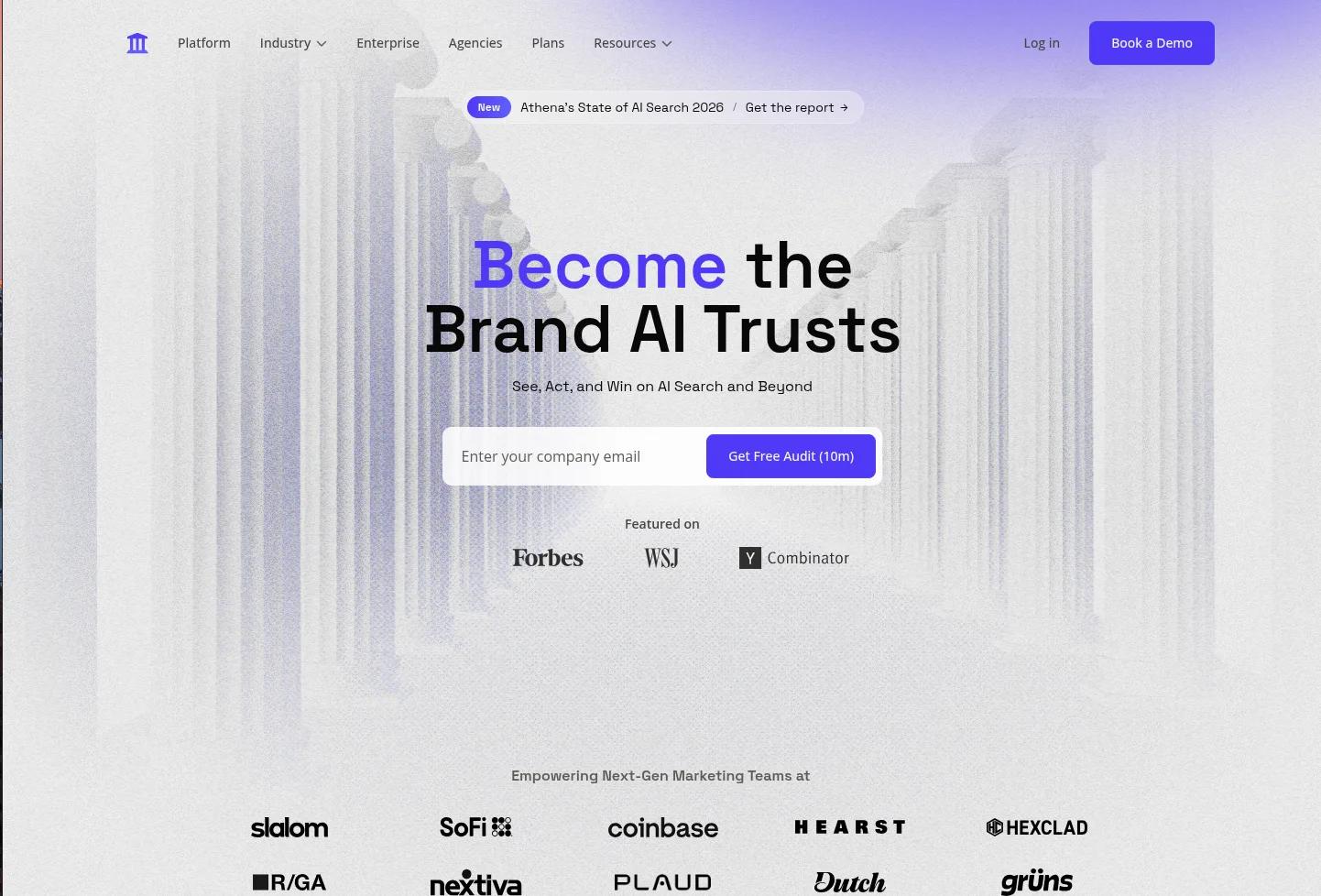
AthenaHQ gives you a wider set of engines than Peec, with nine model choices on Starter, plus content optimization workflows, source and competitor analysis, exports, and on-page and off-page recommendations. Its Enterprise tier adds controls and claim review, so it’s a mistake to treat it as a tracker with nothing to act on.

The trade is budgeting. One credit buys one AI response, so tracking 50 prompts on three engines every day takes about 4,500 responses a month, more than Starter’s credits cover. If you want to test many engines on a small set of high-value questions, that credit model works in your favor, while a large daily panel means managing consumption every month.
Users often find the recommendations actionable and the support responsive, while the recurring complaint is credits running out sooner than expected. One reviewer liked being able to inspect competitor responses and citations for a topic “before a page exists.”
Choose AthenaHQ over Peec when access to more models matters more than daily sampling depth. If a fixed three-model panel on a predictable schedule fits your rhythm better, stay with Peec.

Pricing
- Essential: free. 300 response credits.
- Starter: $295/month (credit-based, about $0.08 per response). 3,600 response credits; nine model choices; content optimization and recommendations; API and extra credits sold separately.
- Enterprise: custom. Controls, claim review, and negotiated capacity.
Pros
- Broad model choice.
- A free tier for exploration.
- Optimization workflows built in.
Cons
- Credit budgeting adds work to every report.
- API access and extra credits cost more.
- A large daily panel outgrows Starter quickly.
Ahrefs Brand Radar: a Peec AI alternative for search-backed discovery
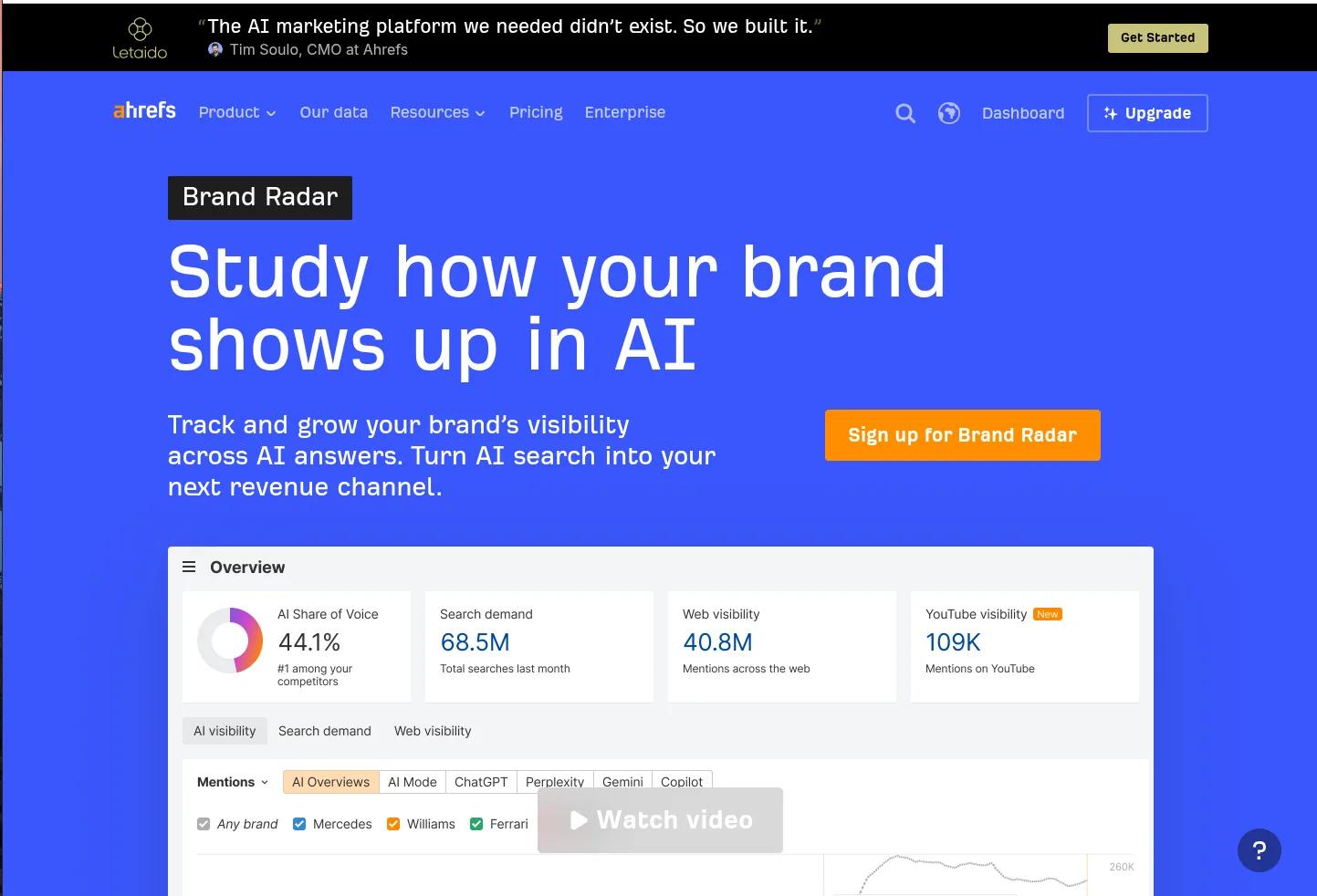
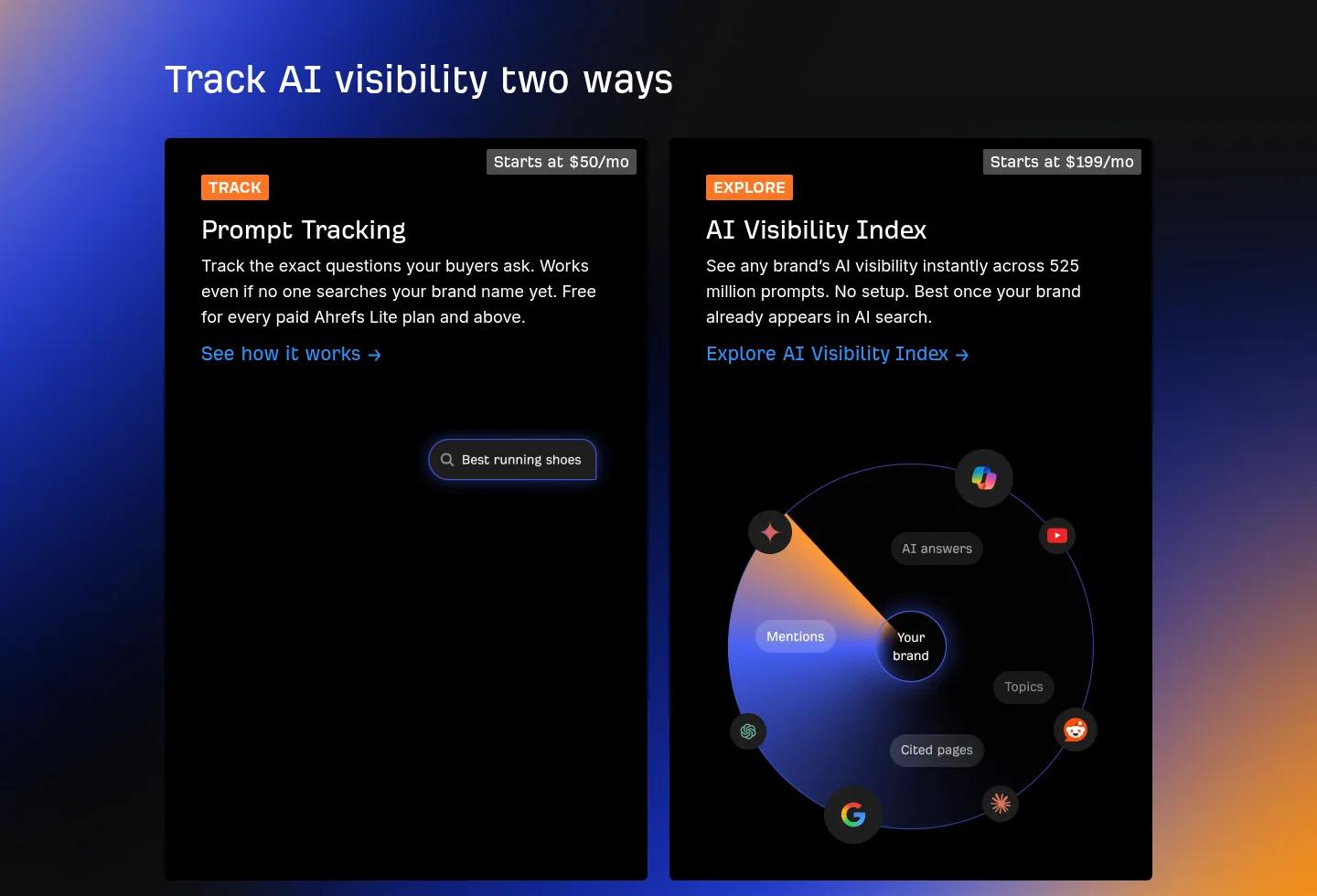
Ahrefs gives you two different tools here. Custom prompt tracking monitors the questions you choose, billed in checks, while the AI Visibility Index is a pre-collected, search-backed dataset for exploring a category and spotting competitors. The index answers “which brands dominate this topic, including questions I didn’t know to track?”, and a custom panel answers “are we being recommended for these 35 buying situations every week?” Many programs need both, but pricing one against the other’s capabilities gives you the wrong answer.
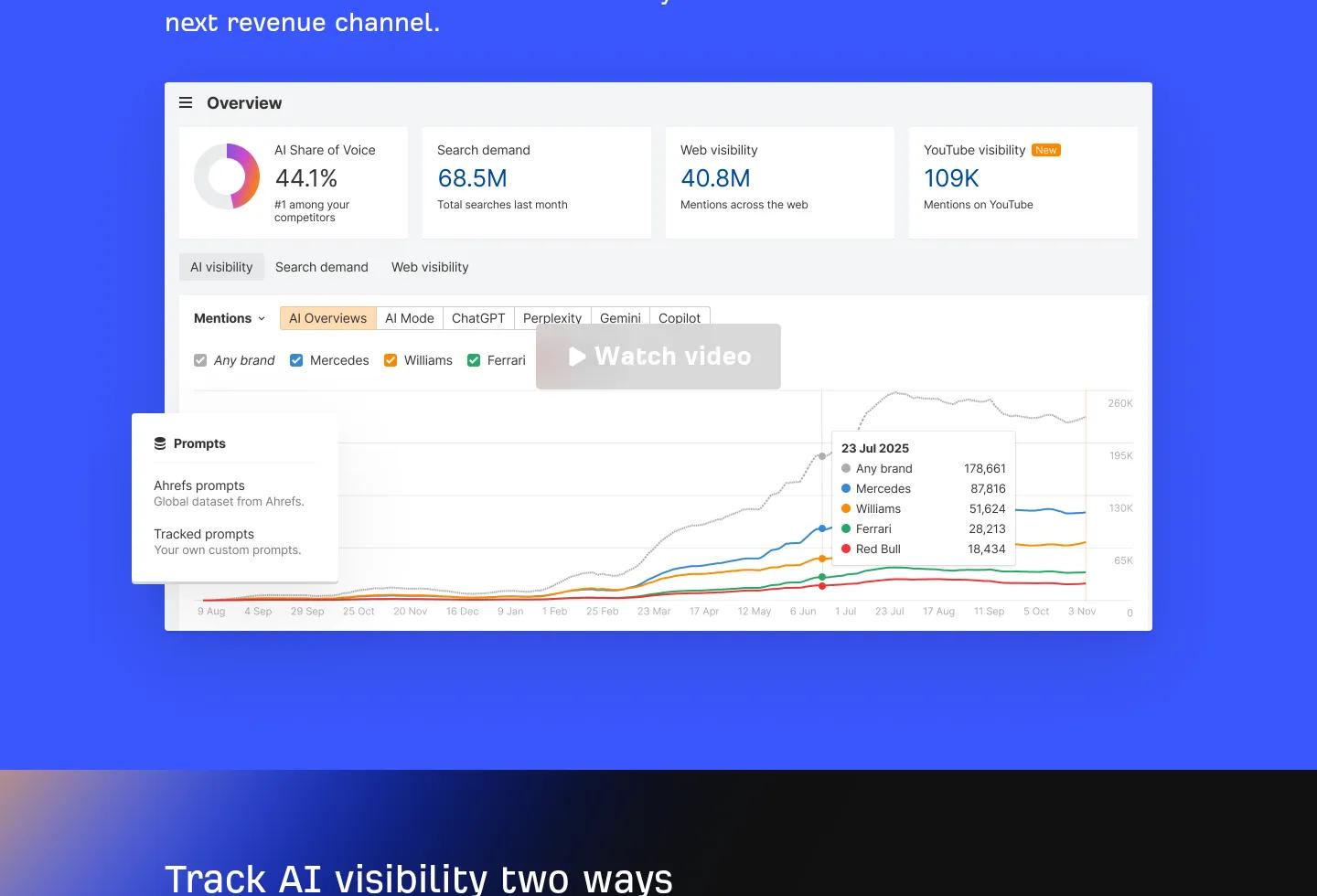
The index also has history, so you can see how a brand’s visibility moved before you signed up, and it tracks YouTube, Reddit, and TikTok alongside AI answers. The catches are that its chatbot data refreshes monthly, Claude runs only through custom prompts at a higher check cost, and an index built from search data won’t match every real conversation, especially in categories where people ask assistants things they’d never type into Google.
Users who already work in Ahrefs often say the learning curve is minimal and the integration is the reason they stay, while reviewers on G2 and Capterra complain about unexpected charges from the check structure.
Choose Ahrefs over Peec when your main question is market-wide demand and competitive discovery tied to SEO. If you already know your buying prompts and want a focused monitoring-and-action program around them, Peec is the better fit.
Pricing
- Custom Prompts Basic: $50/month (check-based, about $0.60 per prompt per platform, daily). 2,500 checks.
- Custom Prompts Growth: $100/month. 7,000 checks.
- Custom Prompts Scale: $250/month. 25,000 checks.
- AI Visibility Index: from $199/month for one platform’s index, or $699/month for all platforms.
- Existing Ahrefs plans include small prompt allowances.
Pros
- SEO context and historical market data.
- Custom tracking can be bought on its own.
- A natural fit for teams already working in Ahrefs.
Cons
- The index and custom prompts have different scopes and prices.
- Check-based quotas need planning, especially for Claude.
- Collaborative action workflows are thinner than Peec’s.
Profound: the enterprise alternative to Peec AI
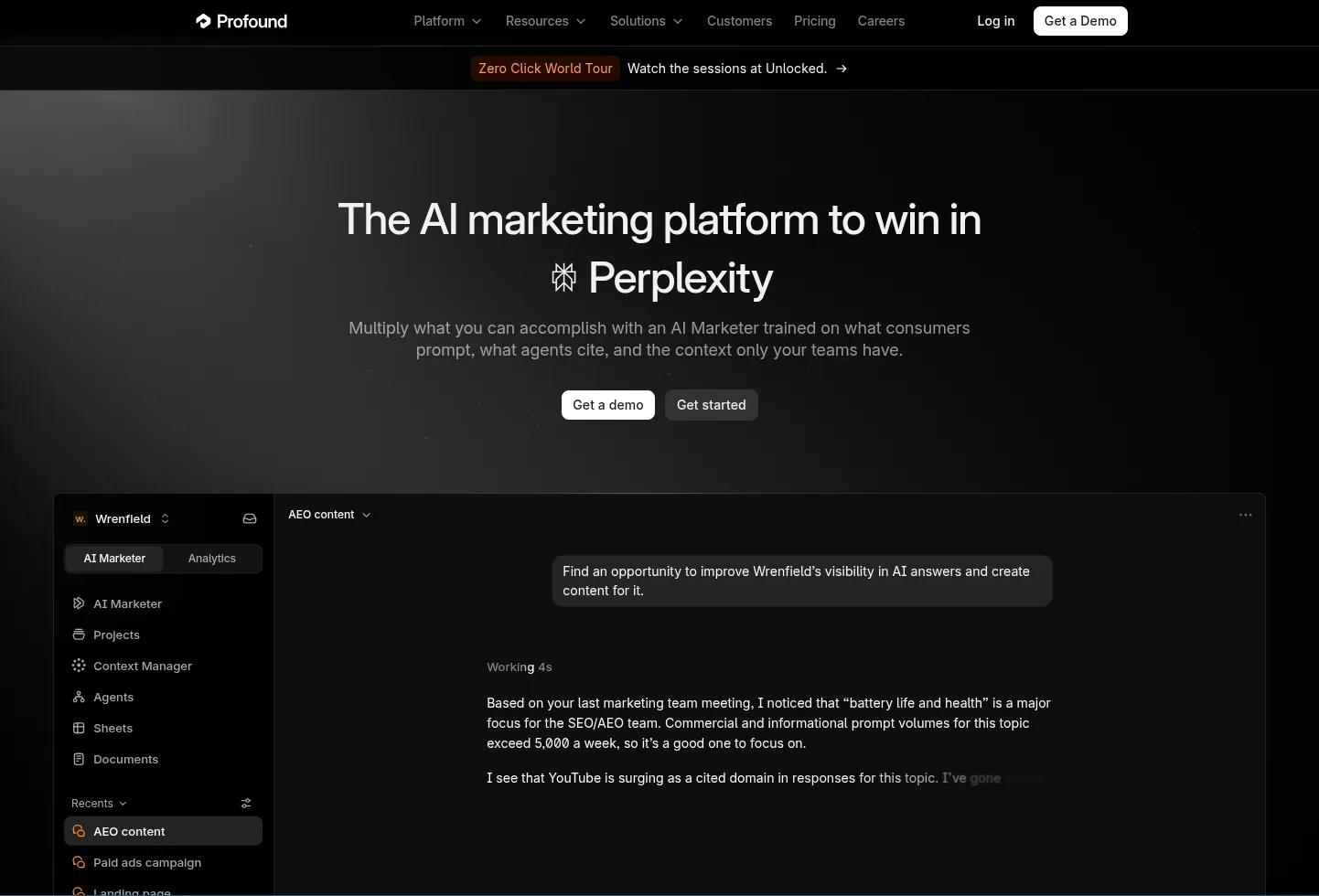
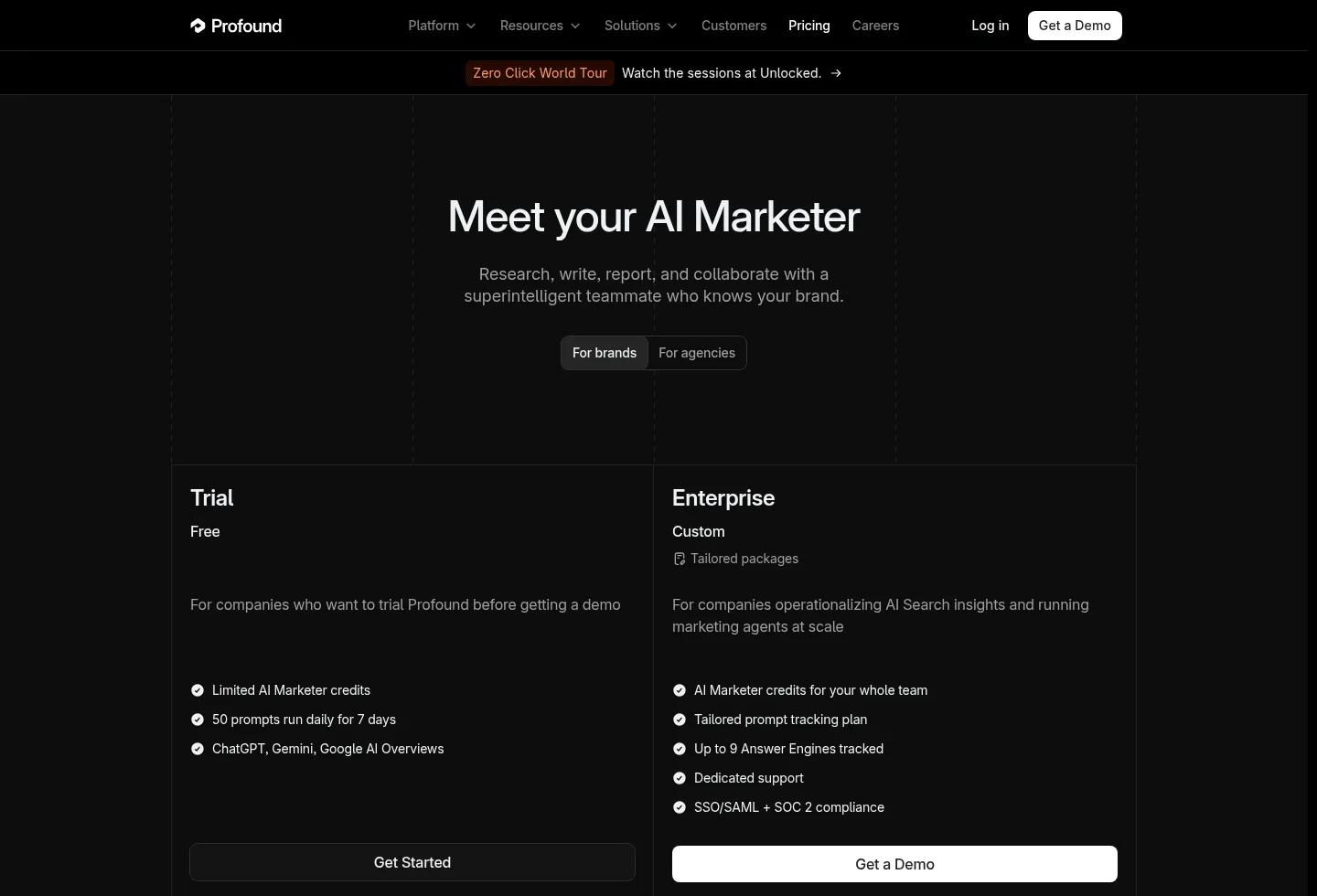
Profound is built for large organizations buying a cross-functional AI search capability with governance, support, research, shopping, and agents. Its brand offer is now a seven-day free trial and a custom Enterprise contract, which comes with tailored prompt tracking on up to nine answer engines, enterprise controls, and AI Marketer credits. Older comparisons still quote self-serve brand plans that Profound’s pricing page no longer shows.
The platform goes well past a specialist dashboard, with answer engine insights, prompt research, source analysis, shopping, agent analytics, and agents for marketing work, and the company raised $180 million in October to keep building it. If you evaluate Profound, ask for a full proposal: engines and markets, data access, historical depth, response retention, security commitments, and the real scope of the agent program.
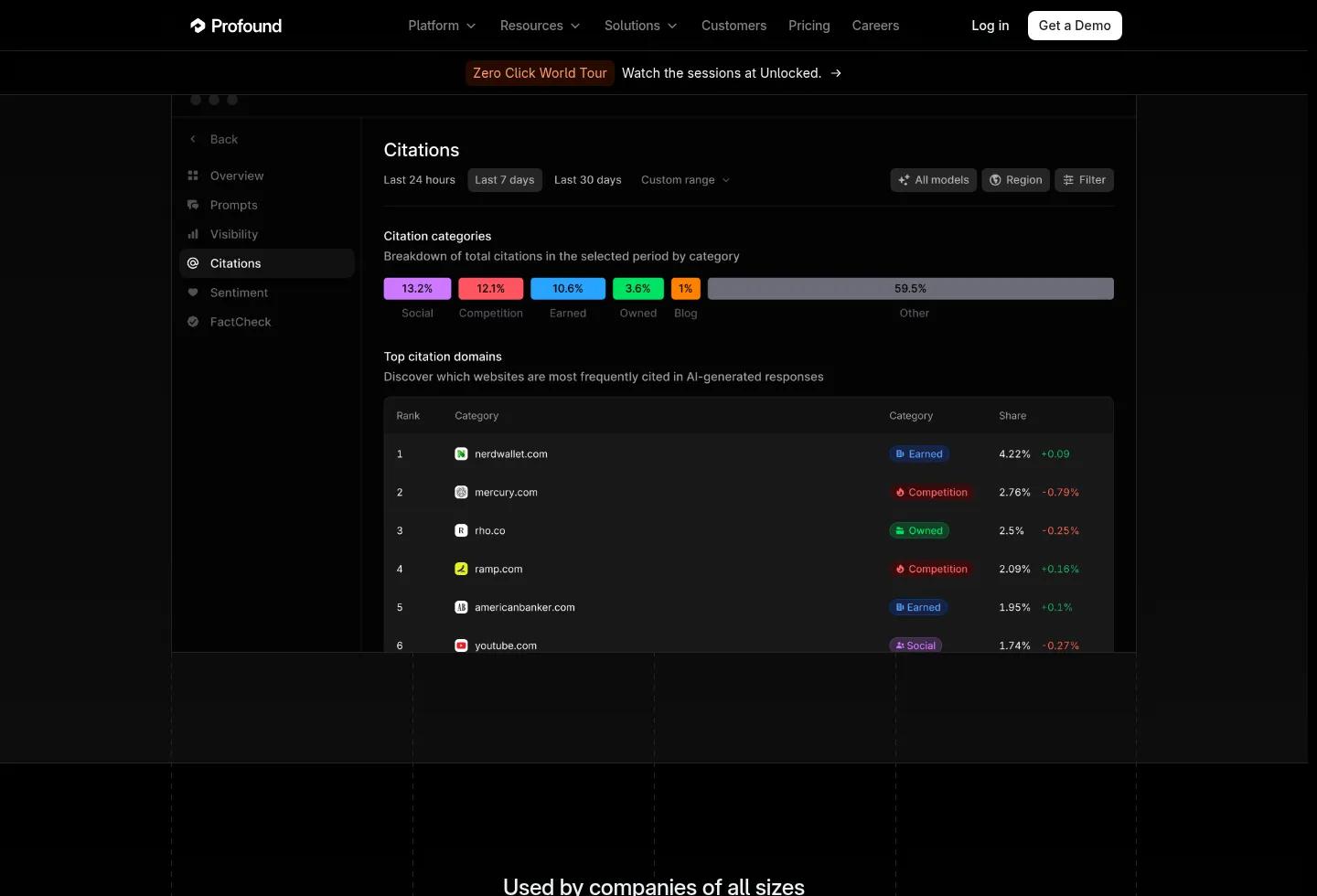
Users often find the data depth worth the learning curve, though cost and onboarding come up again and again. One G2 reviewer compared it to “a luxury car that was amazing to drive,” with a few controls they never figured out.
Choose Profound over Peec when you’re buying an enterprise-wide system and the support, controls, and cross-team adoption are worth more than a public subscription. If a smaller team needs straightforward access and known prompt allowances, Peec is the simpler buy, and if you’re coming from Profound, we compared the best Profound alternatives separately.
Pricing
- Trial: free. 50 prompts daily for seven days on ChatGPT, Gemini, and Google AI Overviews.
- Enterprise: custom.
Pros
- Enterprise research scope and governance.
- Strong support options.
- A broad AI search platform with agents.
Cons
- No public paid price.
- Implementation and procurement can outweigh the value for a small team.
- The trial runs a fixed prompt set.
Pricing reality check: what 50 prompts cost on each Peec AI alternative
Most comparison articles put $29, €49, $59, $95, and $295 in one column as if they bought the same thing. Say a marketing team tracks 50 commercial prompts on three engines every day for 30 days in one market. That’s 4,500 prompt-engine runs, a planning unit we’re using here because every vendor bills and samples differently.
| Provider and plan | Can the entry offer cover this? | Why |
|---|---|---|
| Peec Starter, $95/mo | Yes | 50 prompts on three active models, daily |
| Quotable Starter, $99/mo | Yes | 100 prompts per model across three models, daily |
| Otterly Lite, $29/mo | No | 15 prompts; Standard lists 100 for $189/mo |
| LLM Pulse Starter, €49/mo | Not at daily cadence | 50 prompts on five models weekly; daily tracking is listed at €79/mo |
| AIclicks Starter, $59/mo | No | 30 prompts; Pro lists 150 for $189/mo |
| AthenaHQ Starter, $295/mo | Not fully | 3,600 response credits against about 4,500 runs |
| Ahrefs Custom Prompts Basic, $50/mo | No, at one check per run | 2,500 checks; Growth lists 7,000 for $100/mo |
| Profound | Quote required | The trial lasts seven days and Enterprise is tailored |
This isn’t a value ranking, since the platforms differ in sampling, geography, engines, research, reporting, and execution. Check whether some engines consume more than one check, whether a prompt is allocated per model or shared, and whether adding a country uses up more allowance.
A second scenario: a five-client agency
Say an agency monitors 25 buyer prompts for each of five brands on three engines every day. That’s 125 client prompts and about 11,250 prompt-engine runs a month. Peec’s agency plans share credits across client projects, with one prompt on one model for one day counting as one credit, so this setup needs about 11,250 credits, above the 10,000 in its Essential agency pool. The agency would need more capacity, fewer prompts or models, or a slower cadence.
On Quotable, five brands need the Business plan, since Pro covers three, and Business’s 600 prompts per model cover the panel several times over. For any tool, ask about client access, data isolation, exports, branding, and permissions, because a cheap single-brand plan can make a poor agency plan.
A third scenario: an ecommerce brand with thousands of SKUs
A retailer needs to know which exact product gets shown, whether the variant is right, which merchants appear, and whether the price is current for the market. A brand can win AI share of voice and still lose the product recommendation that converts. Peec offers catalog ingestion and SKU-level shopping metrics, and Quotable’s AI Shopping tracks product-level visibility too, so for both, ask for a live demo on your catalog. Check SKU mapping, merchant attribution, country support, card versus text coverage, and whether you can export historical product appearances.
How to test a Peec AI alternative in a seven-day trial
A fair test doesn’t need 1,000 prompts or a statistical study. It needs a representative set of decisions and enough evidence to see why a number changed.
- On day one, build a buyer-centered prompt set with category discovery (“best X for Y”), direct alternatives (“X vs Y”), constrained purchases (“X that integrates with Z under budget B”), and trust questions (“is X compliant with Z?”), branded and unbranded, in one fixed market and language.
- On day two, open the same prompt across two or three engines and confirm the full answer, date, engine, citations, retrieved URLs where available, competing brands, and how the visibility score is calculated. If a vendor can’t explain the denominator, the score is hard to trust.
- On day three, separate prominence from preference. Record whether your brand is presented as the best fit, an option, an example, or something to avoid, and check whether sentiment scores trace back to the response that produced them.
- On day four, take one prompt where a competitor wins, find the cited or retrieved pages that could plausibly shape the answer, and ask the platform for the evidence behind any recommended action.
- On day five, test an inaccurate claim. Set a verified fact, such as your starting price or a specific integration, and check whether the platform separates contradicted, supported, inconclusive, and uncovered claims.
- On day six, run one workflow end to end, such as a content brief or a technical issue list built from the same evidence, and note how much manual work remains and what needs approval. If you’ll be working across dozens of pages, test batch execution.
- On day seven, export the data, share a stakeholder report, and check whether definitions stay stable over time and what happened when an underlying source changed.
Score each tool on evidence traceability, relevant engine coverage, cost at your real prompt volume, ability to act, team fit, and confidence in the method. The highest visibility score or the longest list of models doesn’t win by default.
Which Peec AI alternative should you choose?
| Your buying situation | Shortlist | The deciding question |
|---|---|---|
| A 10 to 15 prompt pilot on minimal spend | Otterly, Peec trial | Is a small panel enough to learn anything useful? |
| 50 prompts across several engines without an enterprise suite | LLM Pulse, Peec, Quotable | Which engines and refresh frequency come with the plan? |
| Automated work across many prompts or pages | Quotable, Peec, AIclicks | Can the tool turn answer evidence into a reviewable workflow? |
| Broad assistant coverage, even with fewer checks per engine | AthenaHQ, Ahrefs Custom Prompts | What does it cost at your real response or check volume? |
| Demand and competitors beyond your own prompts | Ahrefs Brand Radar, Peec | Is the dataset relevant to your category and markets? |
| Five or more client brands | Quotable, Peec agency plans, AIclicks | Can you budget usage, access, reporting, and approvals per client? |
| Consumer products with shopping cards and variants | Peec, Quotable, Profound | Can the platform show accurate SKU and merchant mapping? |
| Procurement, governance, and custom research | Profound, Peec Enterprise, AthenaHQ Enterprise | Can the vendor meet your security, data, and operating requirements? |
A founder who needs an affordable baseline and an ecommerce director managing product variants are both searching for “Peec AI alternatives,” and they don’t need the same software.
When Peec AI beats the alternatives
Peec is the sensible choice if three engines cover your market, your prompt set fits its tiers, and the features you need are already there, whether you’re buying for the first time or already a customer. It has Actions, an agent, brand perception, fact-checking, shopping analysis, source tracking, and crawler data, with unlimited users on its brand tiers and separate agency plans.
If you’re already a customer, switching is rarely just a subscription decision. You’ll need to rebuild prompt groups and market settings, re-establish baselines, explain changed metric definitions, recreate integrations, and retrain stakeholders, and reports from two sampling methods shouldn’t be read as one continuous trend.
For a current customer, the right reason to leave is a demonstrated mismatch in engines, usable prompt capacity, price at scale, workflow, evidence quality, or team operations. For a new buyer, the right pick is whichever tool handles your own prompts best in a trial. A newer product isn’t automatically a more advanced one, and I’d rather you pick Peec than choose us for the wrong reason.
How we researched this comparison
I ran a free trial on every platform that offers one and tested them hands-on, reviewed vendor pricing pages, product documentation, and release notes on November 3, 2026, read the leading comparison pages in Google’s US results to see what they leave out, and used public reviews for the user perspective. This isn’t a statistical benchmark of response accuracy across the seven vendors, and prices can differ with annual billing, location, tax, add-ons, or sales contracts. Quotable builds software in this category and has a commercial interest in your decision, which is why this guide says plainly where Peec or another tool is the better buy.
Primary sources
- Peec AI: pricing and feature matrix, agency pricing, changelog, Brand Perception, Shopping, Agent, Agent Analytics docs.
- Otterly.AI pricing.
- LLM Pulse: pricing, FAQ, billing and tracking frequency.
- AIclicks pricing.
- AthenaHQ plans.
- Ahrefs: Brand Radar and pricing.
- Profound pricing.
- User reviews on G2: Peec AI, Otterly.AI, AIclicks, Profound.
Frequently asked questions
What are the best Peec AI alternatives in 2026?
Quotable for investigation and repeatable workflows, Otterly.AI for a small paid pilot, LLM Pulse for five models per prompt on weekly tracking, AIclicks for tracking with an article quota, AthenaHQ for broad engine choice on credits, Ahrefs Brand Radar for search-backed discovery, and Profound for enterprise programs. The best fit depends on your prompts, engines, and workflow.
How much does Peec AI cost?
Peec's brand plans are $95 a month for Starter with 50 prompts, $245 for Pro with 150, and $495 for Advanced with 350, each with three active models and daily tracking. Enterprise and agency pricing is custom.
Does Peec AI support AI Shopping and SKU-level tracking?
Yes. Its plan matrix includes catalog ingestion, SKU-level tracking, merchant views, shopping query fan-outs, and source analytics. Check which shopping surfaces and markets it covers for your catalog.
Does Peec AI have an AI Agent and action recommendations?
Yes. Peec has an agent, prioritized Actions, and an in-app content optimizer. When you compare alternatives, look at workflow depth, integrations, approvals, bulk execution, and the evidence behind each recommendation.
Can I track four AI engines on Peec's Starter plan?
Not on the base subscription. Starter runs three active models, and extra models are add-ons, so confirm that the engines you need are available and what a fourth one costs before you buy.
What is the cheapest alternative to Peec AI?
Otterly Lite has the lowest entry price at $29 a month, but it covers only 15 prompts. Quotable starts at $99 and has the lowest cost per prompt tracked daily, and LLM Pulse starts at €49 with five models per prompt on weekly tracking. Compare the cost at the prompt count and refresh frequency you actually need.
Is Ahrefs a good alternative to Peec AI?
For some jobs. Ahrefs combines custom prompt tracking with a broader AI Visibility Index built on search data, while Peec centers on a configured monitoring program with brand, source, shopping, and Actions workflows. They overlap, and they aren't interchangeable.
Is there a free alternative to Peec AI?
Not one that replaces it for ongoing tracking. AthenaHQ's Essential tier is free with 300 response credits, which is enough to explore but not to monitor a panel every day, and Profound offers a free seven-day trial on a fixed prompt set. Most paid tools here also offer short trials, which is the better way to test a Peec AI alternative on your own prompts.
Can any AI visibility tool prove that a content change caused more AI recommendations?
Not from a before-and-after chart alone. Answers vary by assistant, model, sampling, market, and time, so a credible analysis needs a stable observation design, evidence of the specific change, and care with everything else that happened in the same period. Treat any platform's lift estimate as a signal until the design supports more.
Written by