The 10 Best AI Visibility Tools in 2026

The best AI visibility tools in 2026 depend on the job: Quotable for tracking plus optimization, Profound for enterprises, Peec AI for source analysis, Otterly.AI for small budgets, Semrush or Ahrefs for SEO teams, AIclicks for content, Scrunch AI and AthenaHQ for audits and fixes, and Rankscale for flexible credits.
Your brand now gets described, compared, and recommended inside answers you never see unless you go looking. Ask ChatGPT or Gemini which tool to buy and it might name your competitors, repeat a description of your business you retired a year ago, or cite a review site instead of your own pages. And because none of that shows up in a rank tracker, plenty of teams only find out when a prospect repeats it back to them on a sales call.
AI visibility tools exist to close that gap. They run the questions your buyers ask, record which brands appear and which sources get cited, and show how that picture moves over time. But they differ far more than their homepages suggest, both in how they collect the answers and in how much they help once you’ve seen them.
To build this list, we ran a free trial on every platform that offers one and tested them hands-on, went through each one’s pricing page, help center, documentation, and changelog, and then read through user reviews on G2 and other review sites to see where the marketing and the day-to-day experience part ways. The differences that matter tend to hide in the details: whether answers come from the real chat apps or from an API, which engines the entry plan actually includes, who owns the company now, and how much of the follow-up work the tool does for you.
This isn’t a ranking from best to worst. Each tool here is the strongest choice for a particular kind of team or problem, which is why every section is labeled with the use case it fits best. The goal is to help you find the one that matches yours, not to crown a single winner.
AI visibility tools by use case
- For tracking and improving AI visibility in one platform, start with Quotable.
- For enterprise AI search intelligence with governance requirements, look at Profound.
- For competitive source analysis, start with Peec AI.
- For tracking plus AI-assisted content creation, compare AIclicks.
- For technical and content audits alongside monitoring, look at Scrunch AI.
- For turning AI search insights into optimization work, look at AthenaHQ.
- For affordable daily monitoring on a small budget, start with Otterly.AI.
- If your team already works in Semrush, Semrush AI Visibility is the natural extension.
- For market-level brand and competitor research, look at Ahrefs Brand Radar.
- For flexible, credit-based monitoring, compare Rankscale.
Full disclosure: Quotable publishes this guide and is one of the tools in it, so we’re biased, and you should read our own entry with that in mind. To keep that in check, every tool, ours included, is held to the same standard, and each one’s drawbacks are listed as plainly as its strengths. We ran a free trial on every platform that offers one, tested them hands-on, and paired that with published documentation and what users report.
The best AI visibility tools at a glance
| Tool | Best for | Starting at | Entry-plan tracking | Entry-plan cost per prompt/mo | What stands out |
|---|---|---|---|---|---|
| Quotable | Monitoring and improving AI visibility in one platform | $99/mo | 100 tracked prompts per model; choose 3 models | $0.99 | AI Shopping, AI crawler analytics, workflow credits, API/MCP |
| Profound | Enterprise AI search intelligence | Free trial; Enterprise custom | Trial: 50 prompts daily for 7 days | Custom | Enterprise coverage and marketing agents |
| Peec AI | Brand and competitive AI search analysis | $95/mo | 50 prompts on Starter | $1.90 | Source analysis, topics, prompt research |
| AIclicks | Tracking with AI-assisted content production | $59/mo | 30 tracked prompts, 1 website | $1.97 | Content agent workflow and citations |
| Scrunch AI | AI visibility plus technical and content audits | $250/mo | 125 prompts; up to 5,000 responses | $2.00 | Site audits and agent-focused delivery |
| AthenaHQ | AI search insights that lead to optimization | $295/mo | 3,600 response credits on Starter | $2.46 | Action-oriented analysis and content optimization |
| Otterly.AI | Affordable daily AI search monitoring | $29/mo | 15 search prompts | $1.93 | Low entry price, GEO audits, prompt research |
| Semrush AI Visibility | Semrush users connecting SEO and AI search | $99/mo per domain | 25 daily custom prompts | $3.96 | SEO research alongside AI visibility |
| Ahrefs Brand Radar | Market-level brand and competitor discovery | $199/mo | AI index; custom prompts sold separately | $0.60 on Custom Prompts | Large research index plus custom tracking |
| Rankscale | Flexible, credit-based AI monitoring | $99/mo | 1,200 credits; up to 4,800 answers | $1.98 (3 engines) | Engine and region scheduling, brand dashboards |
What matters when choosing an AI visibility tool?
Coverage of the engines your buyers use. A long engine list on the homepage means little if the plan you’d actually buy includes three of them. Check the entry plan specifically, because Google AI Overviews and AI Mode behave differently, and Claude, Gemini, or AI Mode are often sold as add-ons.
How the answers are collected. Some tools drive the real chat apps the way a person would, while others call model APIs, which can return different answers and a different set of citations. Neither reproduces a logged-in buyer’s personalized session, so a CEO who types a prompt into their own phone can see something your dashboard never recorded. Treat tracked answers as a consistent sample to compare over time rather than a replica of what every buyer sees.
The full answer, not just a score. A visibility percentage tells you something moved, whereas the complete answer, the competing brands, and the cited URLs tell you where to start investigating. I gave extra weight to tools that make that jump easy.
Modeled demand versus real traffic. Prompt-volume estimates help you decide which questions deserve a tracking slot, but they aren’t logs of what every ChatGPT user typed, and more mentions don’t prove more revenue. A practical setup usually pairs AI visibility with GA4, crawler analysis, and conversion reporting.
The cost of your workload, not the headline allowance. Tracking 30 prompts on three engines every day means collecting about 2,700 answers a month, and vendors bill that work as prompts, answers, credits, or checks. That’s why the table above translates each entry plan into a cost per prompt, and why the number worth comparing is the bill for your own setup.
The 10 best AI visibility tools, reviewed
Best all-in-one AI visibility platform for tracking and optimization: Quotable
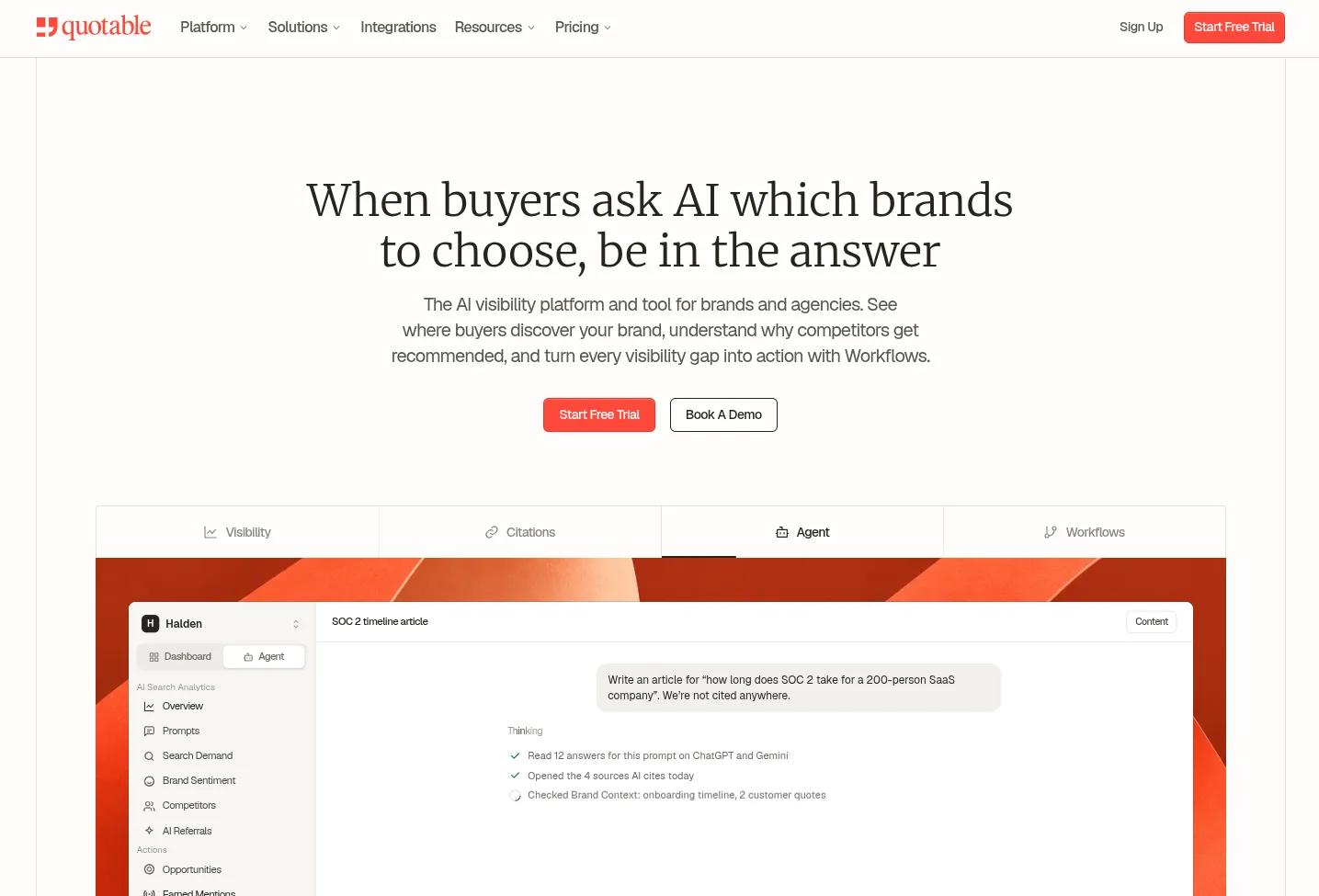
We built Quotable for teams that want monitoring to lead somewhere. You can watch how your brand is described across AI answers, open the competitors and cited sources behind each one, and move straight into the content, technical, or commerce work that answer points to, all without exporting anything into another tool.
The question I’d push every buyer to ask is how the answers get collected, and it’s the one we cared most about getting right. Quotable captures answers client-side from the AI apps themselves rather than calling model APIs, because the consumer apps browse, cite, and format differently from a raw API call, which means an API-only tracker can report citations your buyers never see. Prompt Volumes then attaches search-volume estimates to prompts, so you can spend tracking slots on the questions people actually ask instead of the ones you guessed.
Where it departs most from a dashboard is what happens after the insight. Agents is a no-code workflow builder, with the Echo copilot to help you set workflows up, and Tables runs those workflows across many rows at once, which is handy when you want briefs for every prompt where a competitor wins or a refresh of a whole set of comparison pages. Context Manager keeps a governed record of your brand facts for those workflows to draw on, so drafts stay consistent with your positioning. And Agent Analytics, AI Shopping, and ChatGPT Ads tracking cover crawler activity, product listings, and paid placements inside answers.
The fair test is a trial on your own prompts. If all you need is a fifteen-prompt dashboard, you’ll be paying for capabilities you won’t use. And no visibility tool, ours included, can prove that a specific edit caused a model to cite you, even when it surfaces a strong correlation.
Pricing
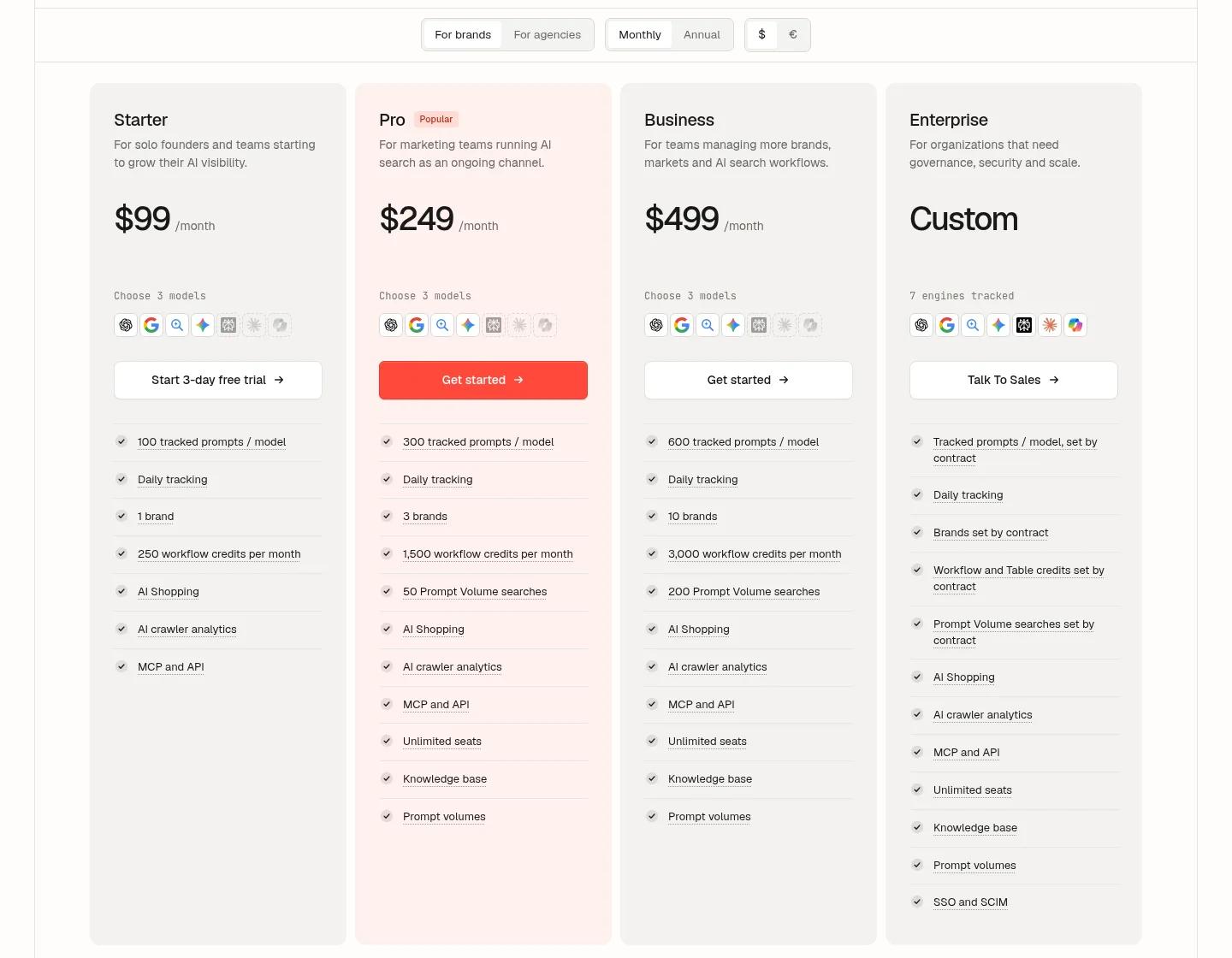
- Starter: $99/month ($0.99 per prompt). One brand; three models of your choice; 100 tracked prompts per model; daily tracking; 250 workflow credits a month; AI Shopping, AI crawler analytics, API and MCP. Three-day trial.
- Pro: $249/month ($0.83 per prompt). Three brands; three models; 300 tracked prompts per model; 1,500 workflow credits a month; 50 Prompt Volume searches; unlimited seats and knowledge base.
- Business: $499/month ($0.83 per prompt). Ten brands; three models; 600 tracked prompts per model; 3,000 workflow credits a month; 200 Prompt Volume searches; unlimited seats and knowledge base.
- Enterprise: custom. Seven tracked engines; contractual brand, prompt, and workflow allocations; SSO and SCIM; enterprise controls.
Pros
- Tracking, citation analysis, AI Shopping, and crawler analytics come in one subscription instead of separate purchases.
- API and MCP on the entry paid plan, where several competitors gate integrations behind bigger plans.
- Clear per-model prompt allowances and brand limits on every self-serve tier.
- Higher tiers add workflow capacity, prompt-volume research, and collaboration.
Cons
- Starter covers one brand; a second brand means moving to Pro.
- Choosing three models means you don’t track every available engine at once.
- Workflow credits and Prompt Volume searches are separate pools from tracked prompts.
Best enterprise AI visibility platform for large brands: Profound
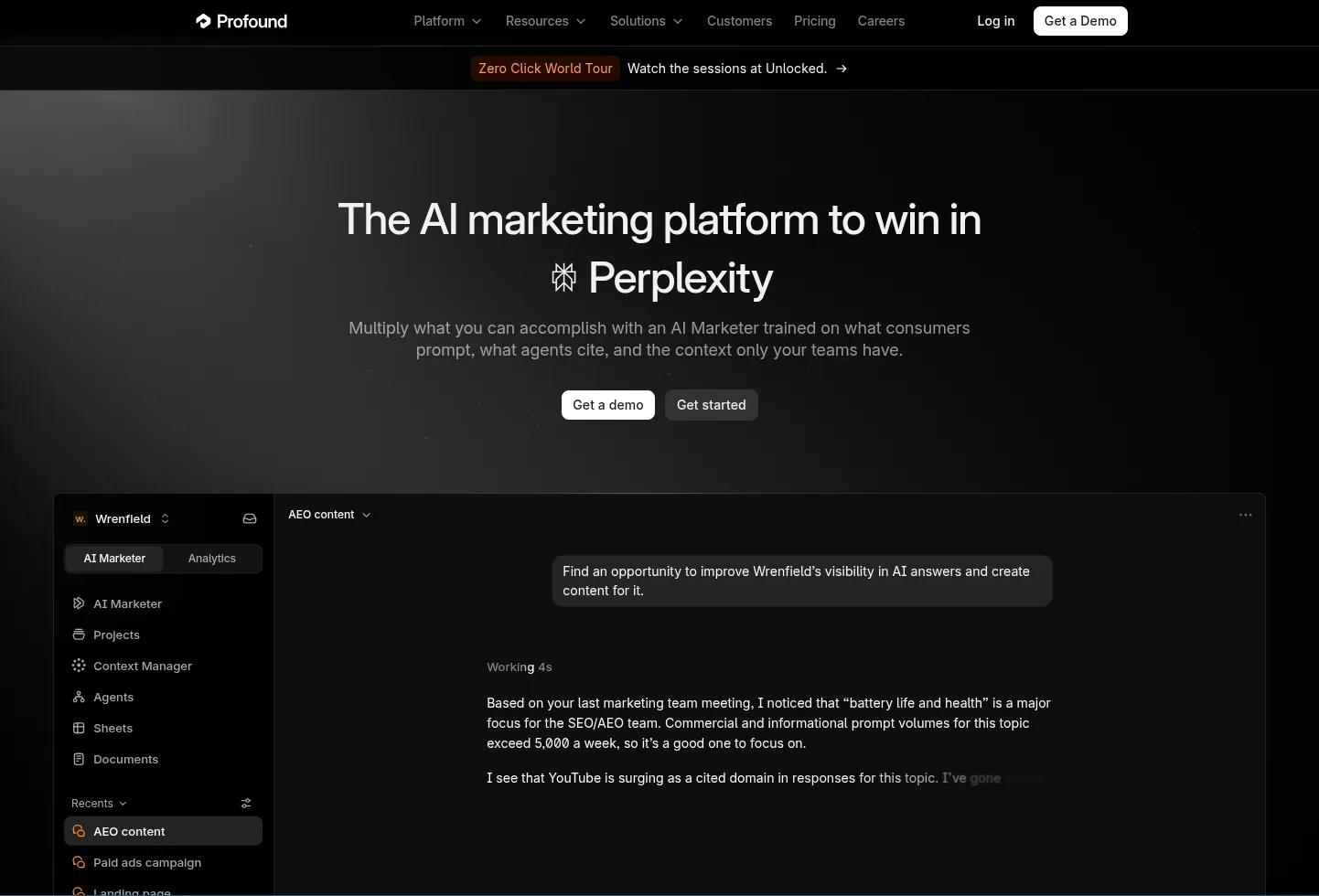
Profound is the name that comes up first in most enterprise conversations about AI visibility, and with more than 1,100 reviews on G2 it has a far larger user base than anyone else here. It’s also well funded after a $96M Series C at a $1B valuation in February 2026, which matters when you’re about to sign a multi-year contract.
What sets it apart is the data behind the dashboards. On top of scheduled prompt tracking, Prompt Volumes estimates real demand from licensed, opt-in consumer panels, so you can prioritize the questions people actually ask rather than the ones your team brainstormed in a meeting. Agent Analytics reads crawler activity from CDN and server logs, and Profound Agents turns findings into drafts that a person reviews before anything ships.
The part most comparisons skip is how you buy it. Profound has retired its self-serve paid plans for brands, so after the free trial every route runs through sales, and the trial itself runs a fixed prompt set without history, exports, or API access. In other words, it shows you the interface more than it tests your own questions, so I’d ask for a scoped pilot on real buying prompts before signing anything. If a sales-led contract rules it out, we compared the best Profound alternatives by price, engine coverage, and workflow.
Users often find the depth impressive and the support team excellent, but the same reviews keep coming back to cost and a steep learning curve. One G2 reviewer was refreshingly honest about it: “dashboards take weeks to learn, and we still don’t use most of them.” Others feel the optimization advice reads like general SEO best practice rather than something specific to their product. If you have an analyst or agency who will own the platform, that depth pays off, whereas a lean team without that owner will likely pay for a lot it never opens.
Pricing
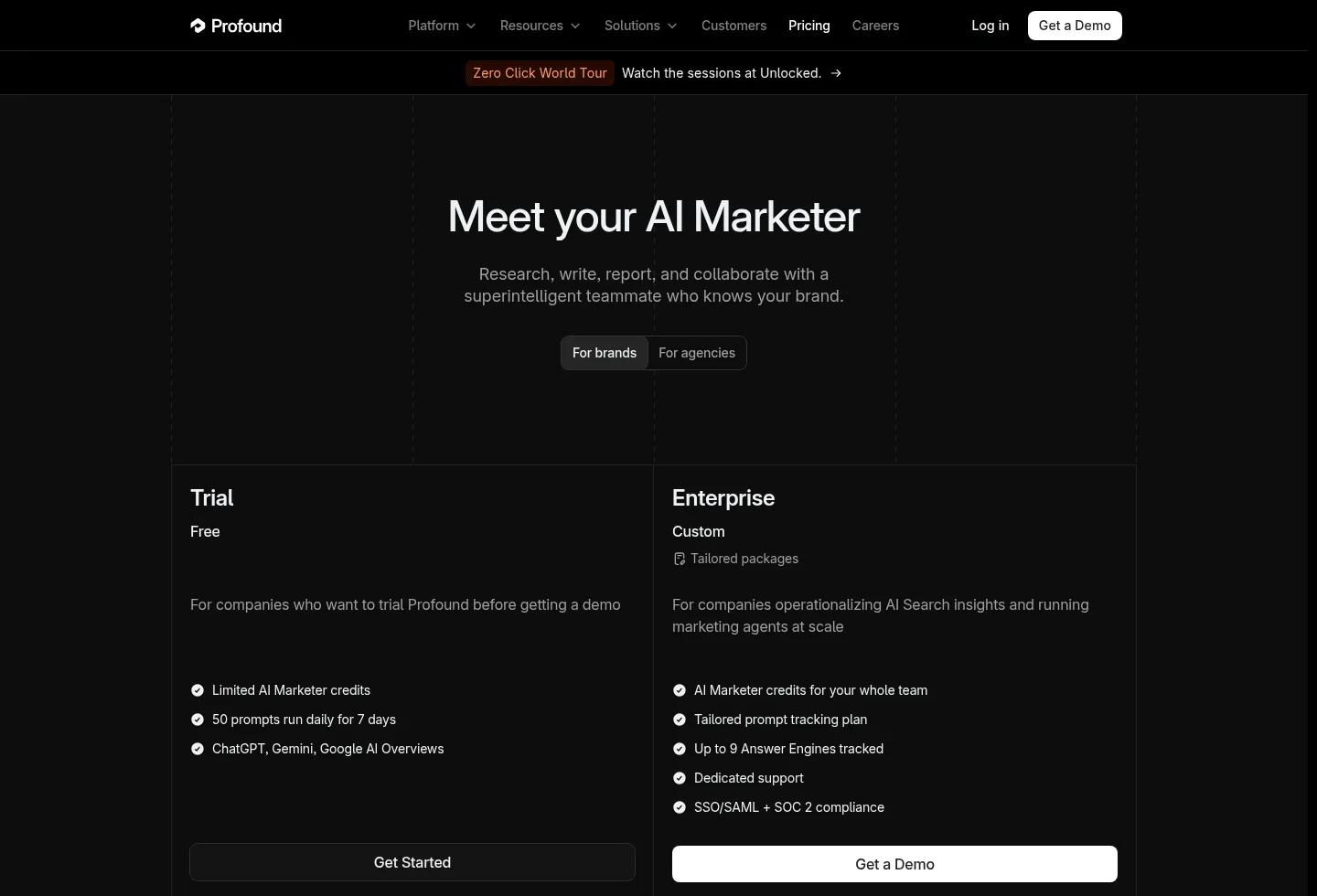
- Trial: free. 50 prompts daily for seven days across ChatGPT, Gemini, and Google AI Overviews.
- Enterprise: custom. Negotiated prompts, markets, engines, agent usage, and support.
Pros
- Broad, configurable enterprise coverage of AI search.
- Tight link between visibility analysis, research, and marketing agents.
- Fits teams with security, localization, and governance requirements.
Cons
- No public monthly Enterprise price for a direct comparison.
- Agent usage and monitoring draw on different allowances.
- A lean brand may not need an enterprise deployment.
Best AI visibility tool for competitive source analysis: Peec AI
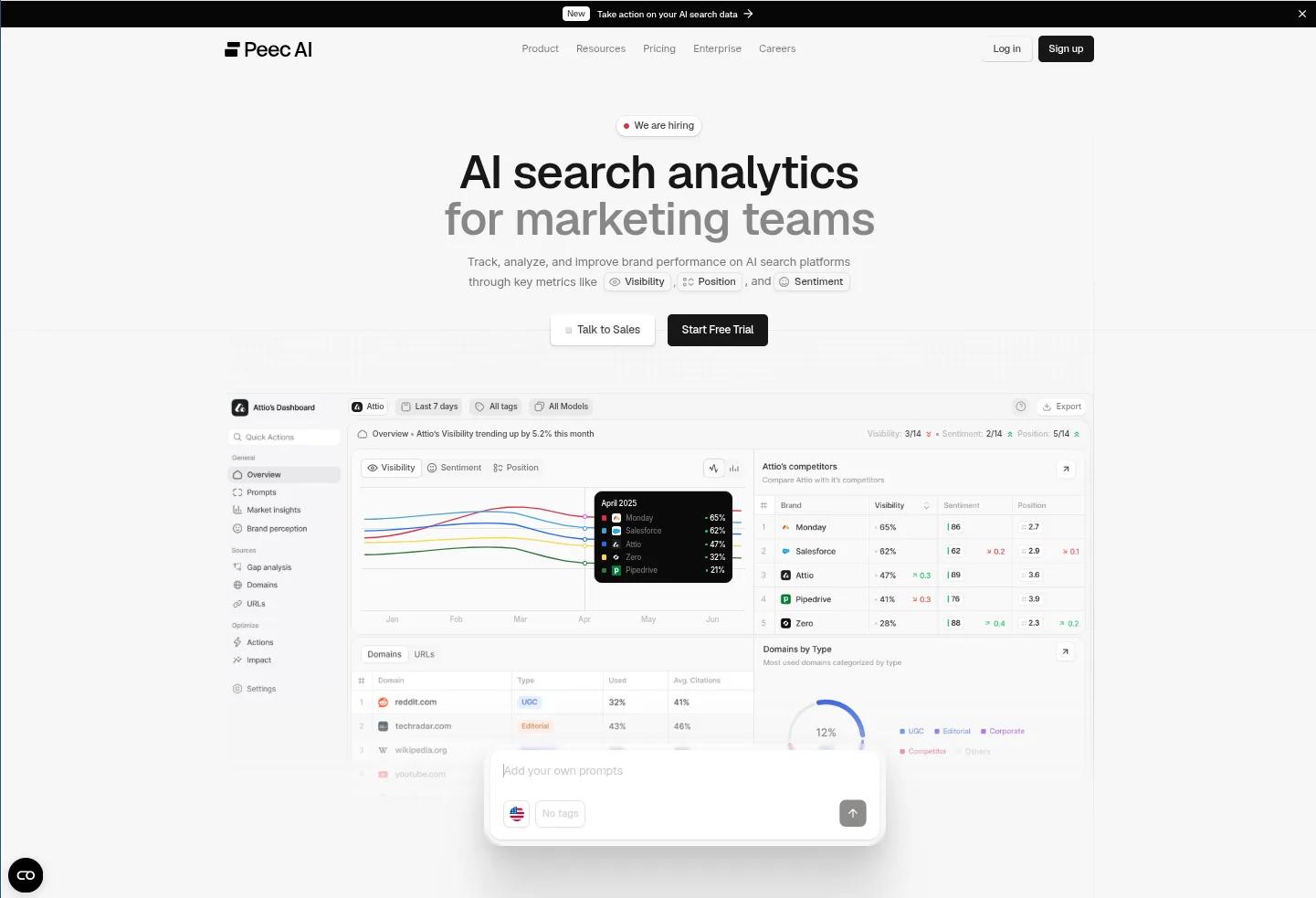
Peec is the tool I’d look at first if the question keeping you up is why the AI picked those sources and not yours. Its own docs explain that it runs prompts daily through the chat interfaces rather than through model APIs, precisely because API responses often differ from what users see. And its source reports separate the pages a model used from the pages it actually cited, which is the distinction a PR team needs to know where a placement would really count.
The newer Actions module goes a step further by turning that source data into a to-do list, such as earning reviews on a site the models keep citing, joining a specific Reddit thread, or pitching a publication that keeps appearing in your category. Keep in mind, though, that brand plans let you switch on three of the six default engines, while Claude, Grok, and DeepSeek are paid extensions, so it pays to decide which engines matter before onboarding rather than after. There’s no crawler or agent log analytics either, which means Peec can’t tell you whether AI bots are reaching your pages in the first place.
Users often find the interface the cleanest in the category and easy to hand to an executive, although several want clearer guidance on what to fix next, and some found heavy overlap in the prompts suggested during onboarding. As one head of growth put it in a G2 review, they’d like “more insights about how LLMs pick their sources.” The review base is still small, at around 20 reviews, so weigh the near-perfect rating accordingly.
Peec suits marketing teams and agencies that want to understand and report on competitive source data, and that already have the content and PR capacity to act on it. If you need API access or SSO, both sit on Enterprise. If it doesn’t fit, we compared the best Peec AI alternatives by pricing, model limits, and workflow.
Pricing
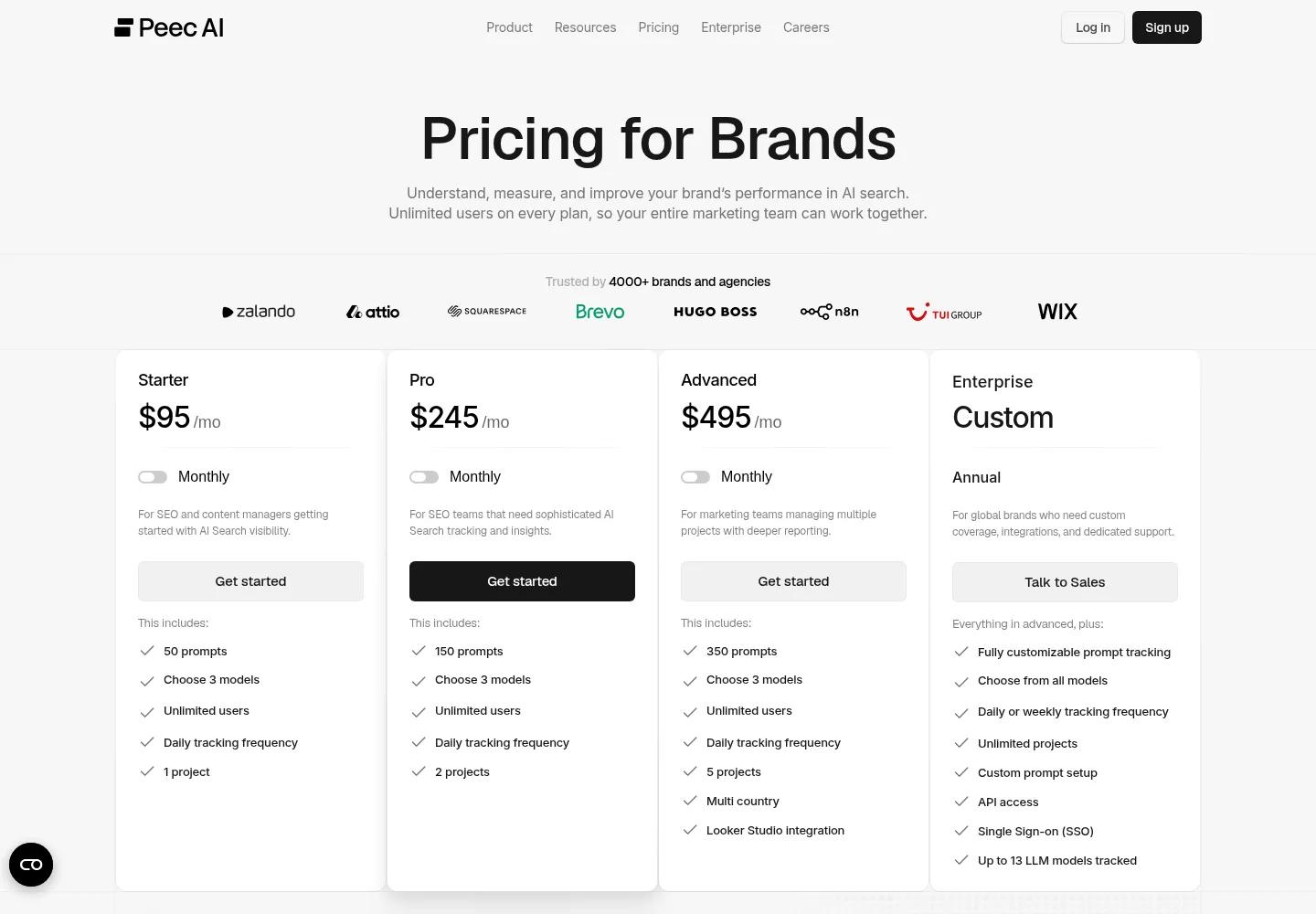
- Starter: $95/month ($1.90 per prompt). 50 tracked prompts and the entry brand-monitoring features.
- Pro: $245/month ($1.63 per prompt). 150 tracked prompts and expanded brand analysis.
- Advanced: $495/month ($1.41 per prompt). 350 tracked prompts and larger allowances.
- Enterprise: custom. Bespoke capacity and enterprise features.
Pros
- Strong on cited sources, competitor mentions, topics, and brand perception.
- Prompt discovery and reporting that help a marketing team build a GEO practice.
- Separate brand and agency offers for different buyers.
Cons
- Model selection, integrations, and advanced analytics depend on the plan.
- Each extra tracked model adds to the monitoring load.
- Some optimization work has to happen outside a monitoring-first product.
Best AI visibility tracker with AI-assisted content creation: AIclicks

AIclicks is built for teams that want the gap between spotting a problem and publishing a fix to be as short as possible. It pairs mention and citation tracking with source intelligence, recommendations, and a content agent that drafts AI-optimized articles, and the GA4 connection on Pro puts visibility right next to the AI referral traffic it produces. Agency users single that out as the feature that finally gets a client to accept the number.
It’s a young company, founded in 2024, and that shows in the evidence. The G2 rating is excellent, but it rests on a small number of reviews, and most testimonials you’ll come across are curated by the vendor. Its own case study is worth reading for a different reason, though, since it lays out the playbook AIclicks used to grow its own AI visibility, which leaned on review sites, listicle placements, and Reddit threads far more than on its blog. That’s a useful reminder that a content agent only covers part of the job.
Users often find setup fast and the daily refreshes reliable, while some say the dashboard feels busy at first and pages load slowly. One agency reviewer on G2 said it gives them “a clearer view of how brands are being discovered,” which captures the appeal well.
Generated articles save time, but they still need original expertise and fact-checking before they go live, so budget editorial hours alongside the subscription. And if you also need classic rank tracking or backlink analysis, you’ll have to keep another tool around, because AIclicks doesn’t do either.
Pricing
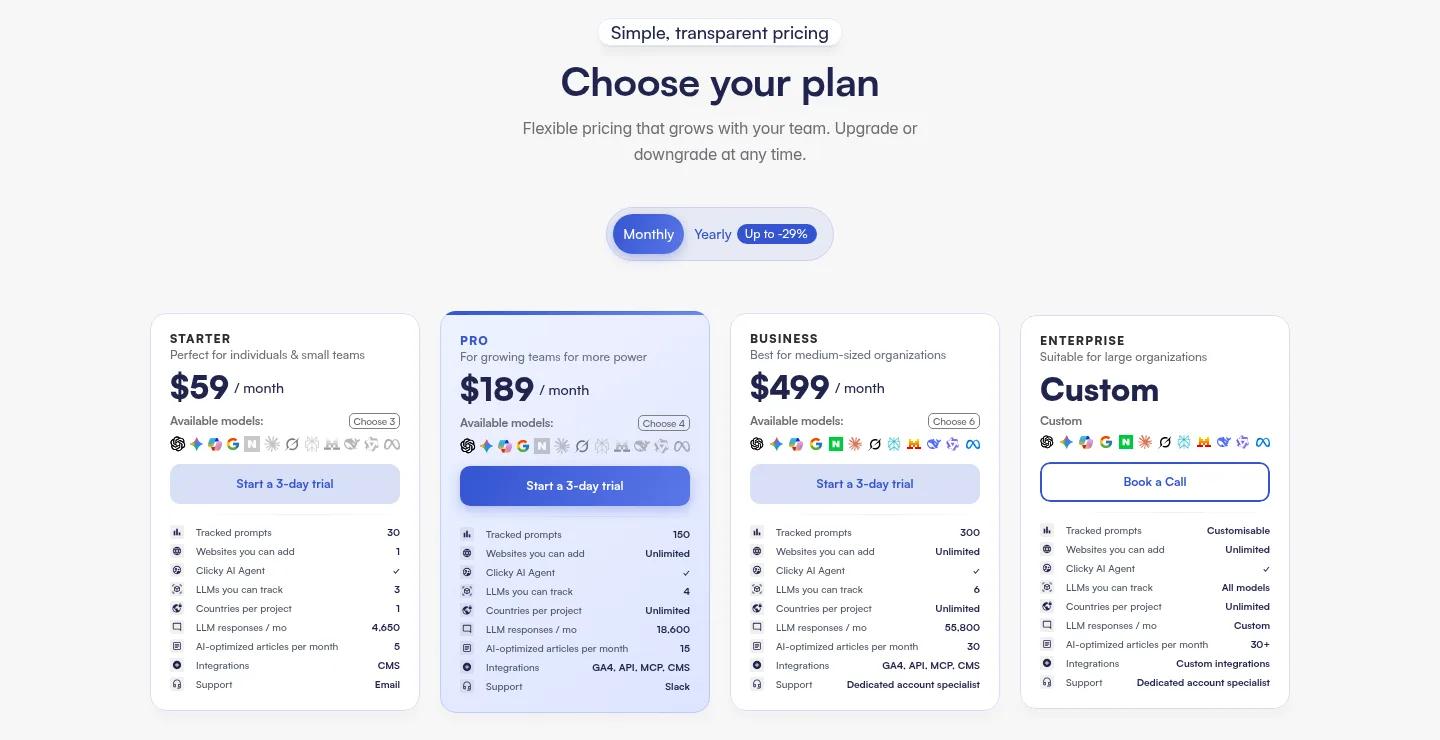
- Starter: $59/month ($1.97 per prompt). 30 prompts; one website; three selectable engines; up to 4,650 responses a month; five AI-optimized articles.
- Pro: $189/month ($1.26 per prompt). 150 prompts; unlimited websites; four engines; up to 18,600 responses; fifteen AI articles; GA4, API, and MCP.
- Business: $499/month ($1.66 per prompt). 300 prompts; six engines; up to 55,800 responses; thirty AI articles.
- Enterprise: custom. Larger monitoring and content allowances.
Pros
- Direct line from visibility gaps to AI-assisted content work.
- Published prompt and article allowances that are easy to compare.
- API, MCP, and GA4 on Pro.
Cons
- Starter is limited to one website.
- Generated content still needs human editorial review.
- Prompt limits and response caps have to be read together.
Best AI visibility platform for technical and content audits: Scrunch AI
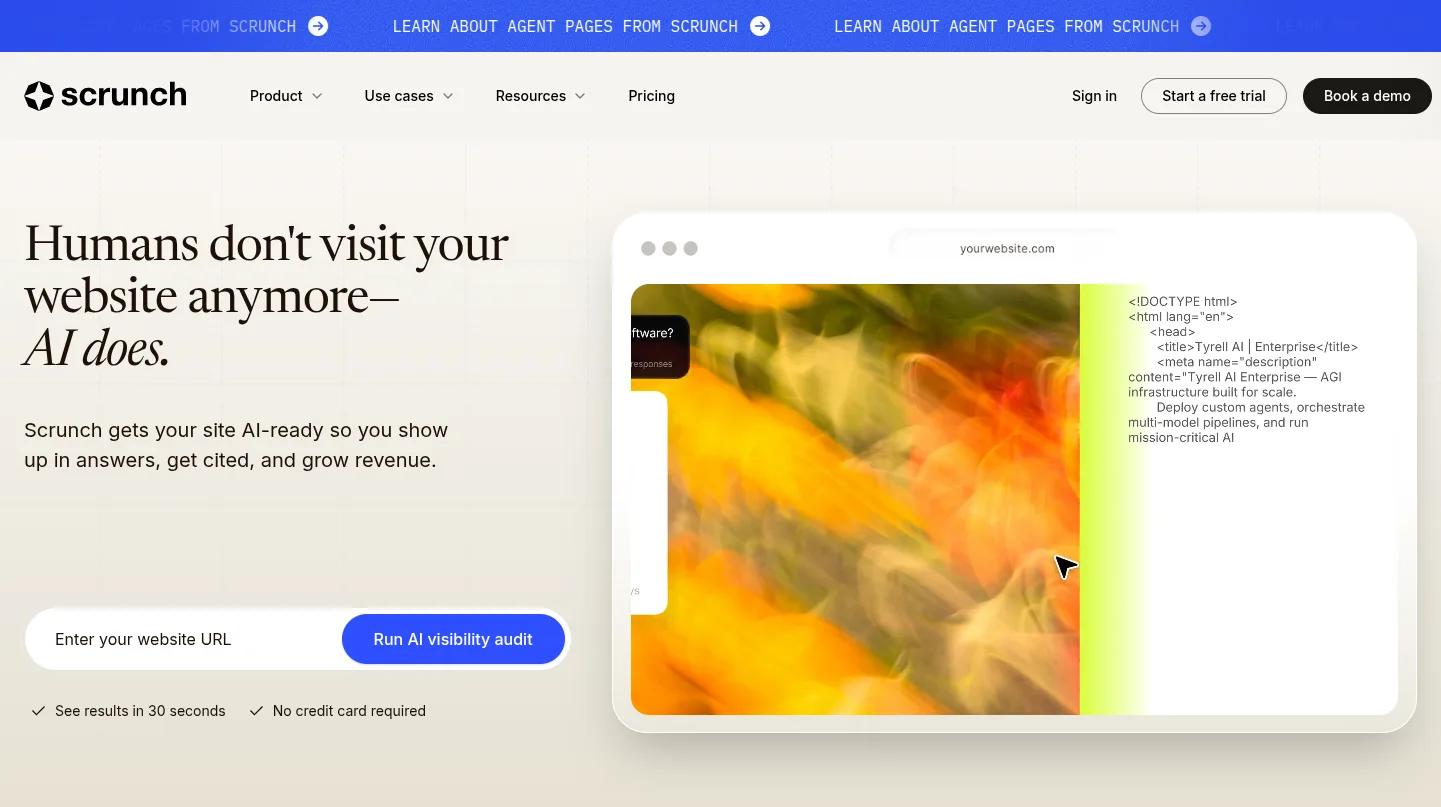
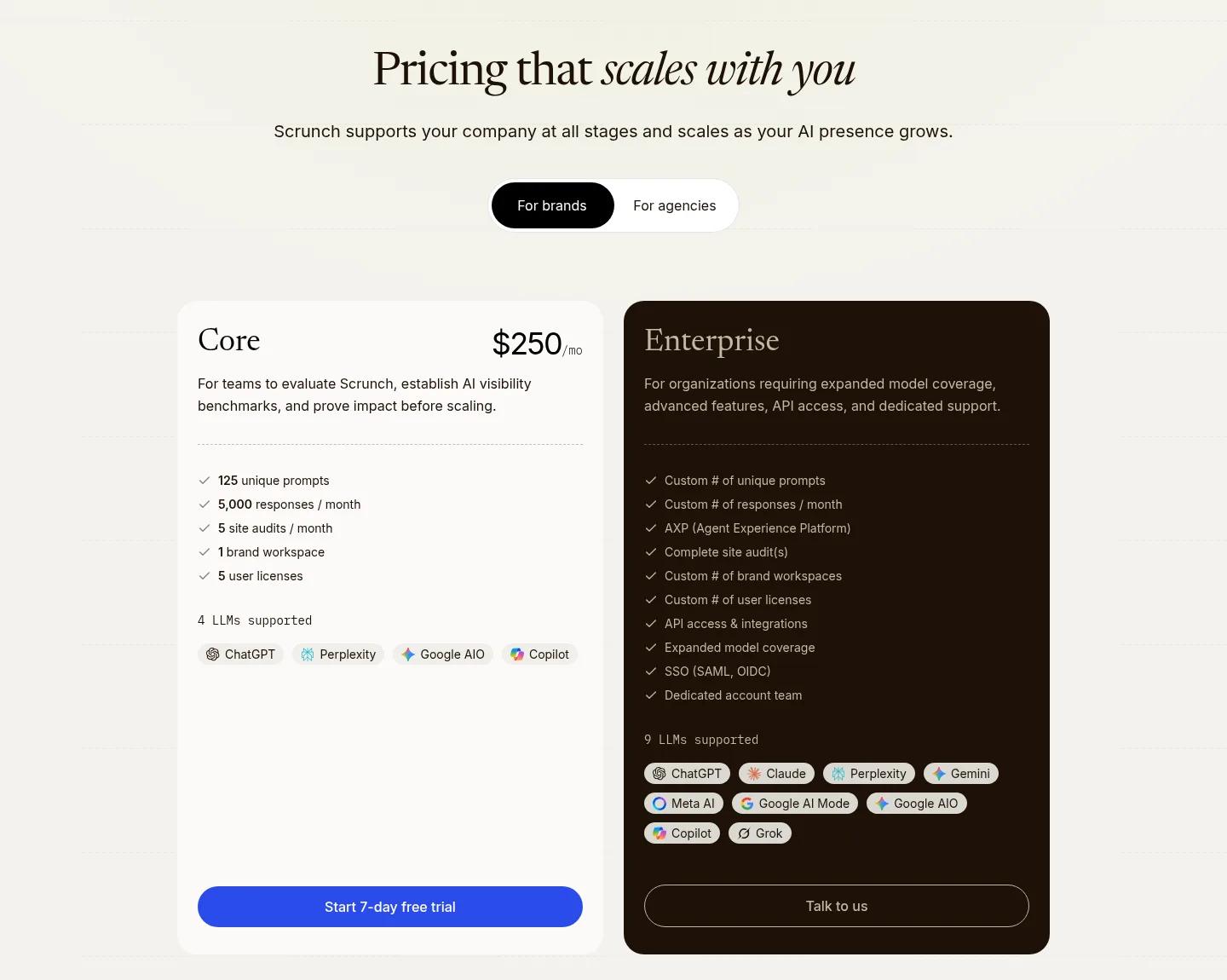
Scrunch is the tool to look at when you suspect AI systems are misreading your website. It pairs prompt monitoring with page audits and crawler analytics fed by real CDN and server logs, through integrations like Akamai, Cloudflare, and Vercel, so you can confirm whether an AI crawler actually reached a page instead of guessing from citations. Keep in mind that Core tracks four engines, while Claude, Gemini, and Grok sit on Enterprise.
The bigger story is ownership. Sitecore announced in June 2026 that it had acquired Scrunch, reportedly for around $225 million, and Scrunch says it will keep selling the platform standalone. That’s great news if you already run Sitecore, since AI visibility will be wired into a CMS you know, whereas teams on a rival platform should ask how the roadmap will treat them. The Agent Experience Platform (AXP), which serves AI crawlers a machine-readable version of your site, is the most ambitious idea in this whole category, but it’s an Enterprise capability, and independent reviewers still described it as a limited pilot in September 2026.
Users often praise the audits, the crawler data, and the onboarding, while the recurring complaint is getting data out on lower tiers, since the Data API is Enterprise-only. One G2 reviewer went as far as saying its “GA4 integration for AI referral traffic is better than anything else we evaluated.” The numbers seem to hold up, too, as one hands-on test found a manual check of 45 answers landed within 1.4 points of what Scrunch reported.
Scrunch makes the most sense when the problem looks technical and you have people who can act on audit findings. If you need broad engine coverage without an enterprise contract, or vendor independence matters to procurement, compare alternatives first.
Pricing
- Core: $250/month ($2.00 per prompt). 125 unique prompts; up to 5,000 responses; five site audits; one brand workspace; five users; four AI platforms.
- Enterprise: custom. Wider model coverage, custom workspaces, deeper audits, integrations, and AXP.
Pros
- Connects answer monitoring to technical and content fixes.
- Site audits and page-level investigation give a next step beyond a score.
- Enterprise AXP addresses how AI agents experience your website.
Cons
- Core is limited to one brand workspace and a fixed set of AI platforms.
- Agent-delivery features need an enterprise contract.
- High entry price if you only need monitoring.
Best AI visibility platform for turning insights into action: AthenaHQ
AthenaHQ is for marketers who want a next step after the chart of mentions. Its Action Center turns gaps into specific pages to create or update, with the reasoning attached, and users like being able to inspect competitor responses and citations for a topic before they write a word. Its Shopify integration and attribution also get singled out, which makes it a closer fit for ecommerce brands than most trackers on this list.
The thing to understand before you start is the credit pool. One credit buys one AI response, so every engine you switch on multiplies the cost of each prompt, and the AI chat feature draws from the same pool as monitoring. Collection is also mostly API-based with a daily refresh, which is worth weighing against how your buyers actually use these assistants.
Users often find the recommendations actionable and the support responsive, while the most common complaint is credits running out sooner than planned. As one verified G2 reviewer admitted, “We burned through credits faster than expected the first month.” Others say suggestions sometimes miss industry context.
My advice is to start with a narrow prompt set on the engines that matter most, then widen it once you know your burn rate. If you need predictable monthly costs, or API access without an add-on, a flat-allowance tool will be easier to live with.

Pricing
- Essential: free. 300 response credits for initial exploration.
- Starter: $295/month (about $0.08 per response, or $2.46 per prompt tracked daily on one model). 3,600 response credits; unlimited configured topics and prompts, limited by response usage; content recommendations; CSV export; API and extra credits sold separately.
- Enterprise: custom. Negotiated capacity, governance, advanced analysis, and BI.
Pros
- Visibility analysis connects to recommendations and optimization work.
- Broad model coverage on the paid plan, with clear response-credit accounting.
- Enterprise covers complex governance and reporting needs.
Cons
- $295 buys 3,600 responses, not 3,600 prompts tracked daily.
- API access and extra credits cost more on Starter.
- Enterprise-only features aren’t part of the entry plan.
Best affordable AI visibility tracker for small teams: Otterly.AI
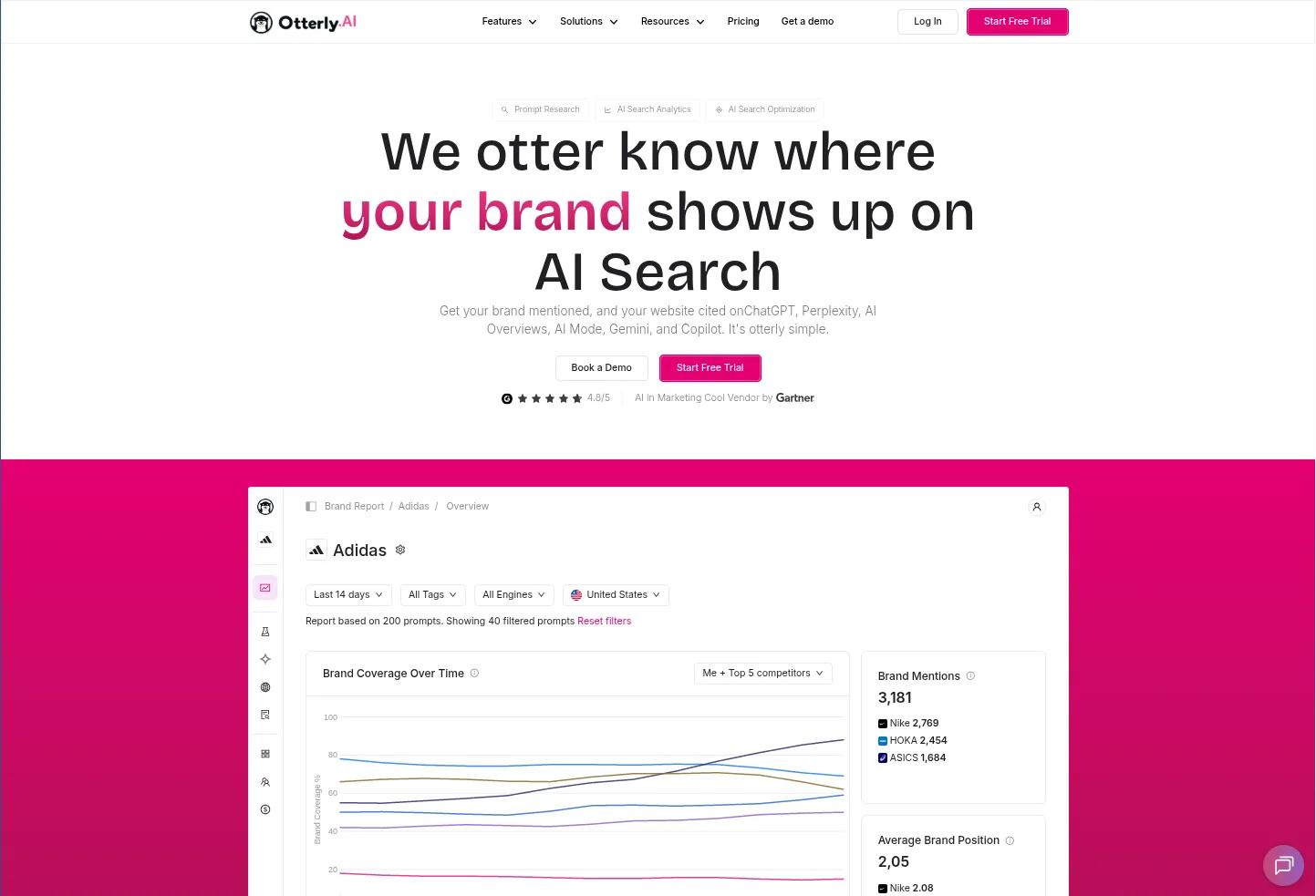
Otterly makes sense if you want to start monitoring AI search without a big commitment, and the onboarding is built for exactly that. An AI-assisted setup picks niches, prompts, and competitors for you, so most users see real data within about 15 minutes. Every prompt runs on the same daily cadence, and beyond monitoring you get GEO audits, Agent Analytics on real crawler events, and ChatGPT Shopping and ads tracking.
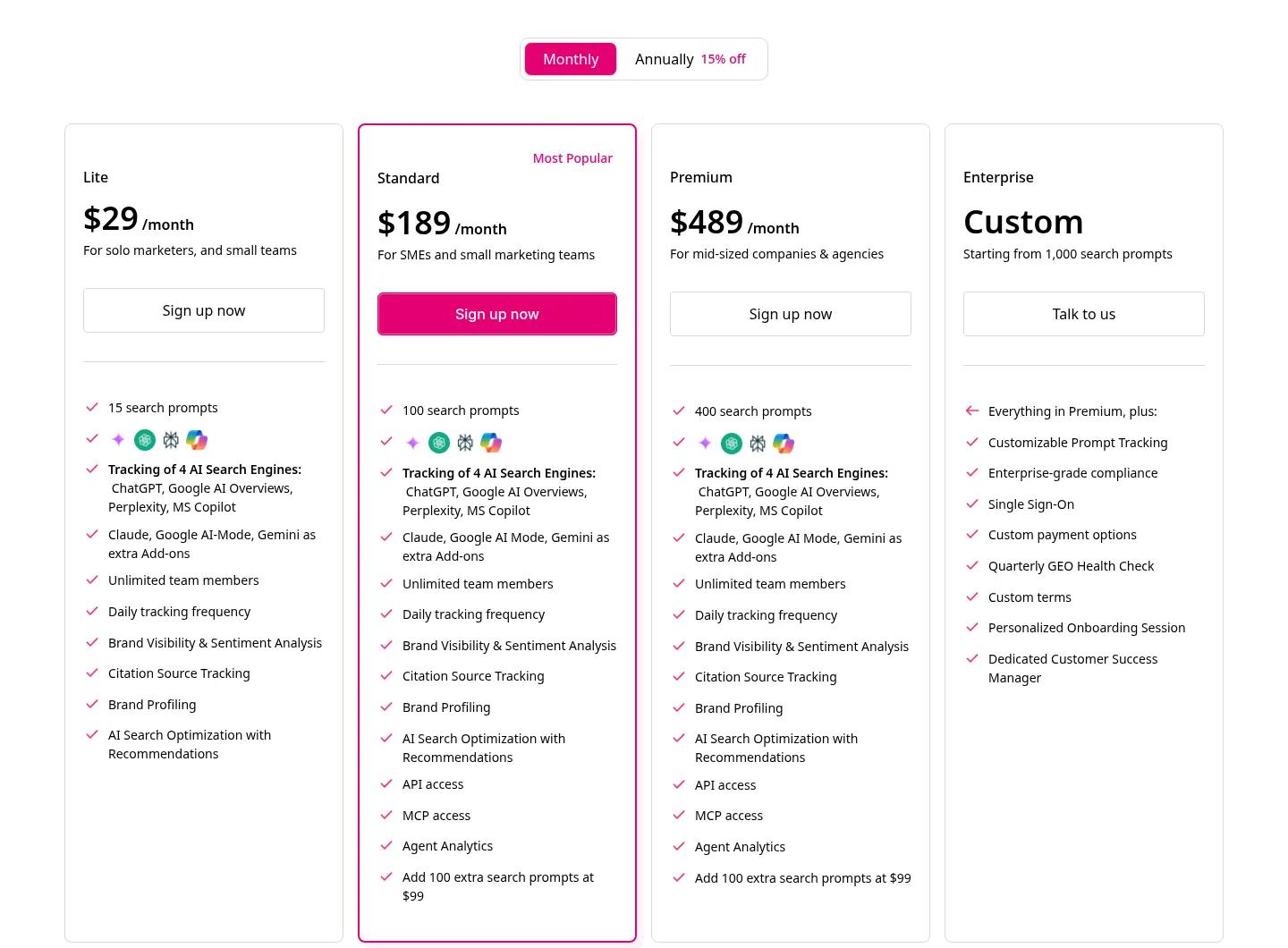
Two details change what you’re really covering, though. Only four engines come with the base plans (ChatGPT, Google AI Overviews, Perplexity, and Copilot), whereas Google AI Mode, Gemini, and Claude are paid add-ons per engine. Prompts also count per country, so a multi-market program burns through its allowance much faster than the headline number suggests.
Users often find Otterly easy to use and the support quick, while the recurring criticisms are limited filtering and reporting, plus a sentiment classifier that some say tags neutral mentions as negative. One G2 reviewer summed up the gap nicely: “it’s not always clear what specific actions should be taken based on the findings.”
It’s a sensible first purchase for a small team or agency testing the channel. Just hand-check sentiment before it reaches a client report, and if Claude or Gemini visibility matters to you, price the add-ons before comparing Otterly with anything else.
Pricing
- Lite: $29/month ($1.93 per prompt). 15 daily prompts; four default engines; core brand and citation reporting.
- Standard: $189/month ($1.89 per prompt). 100 prompts; broader optimization and integrations.
- Premium: $489/month ($1.22 per prompt). 400 prompts and higher usage limits.
- Enterprise: custom. Custom tracking and terms.
Pros
- Low paid entry point for small teams.
- Daily monitoring, prompt research, citation analysis, and GEO audits in one focused product.
- Clear path to larger prompt allowances.
Cons
- 15 prompts may be too few for broad categories or several product lines.
- Some engines and features are add-ons or tied to higher plans.
- Standard and Premium cost far more than Lite.
Best AI visibility tool for existing Semrush users: Semrush AI Visibility
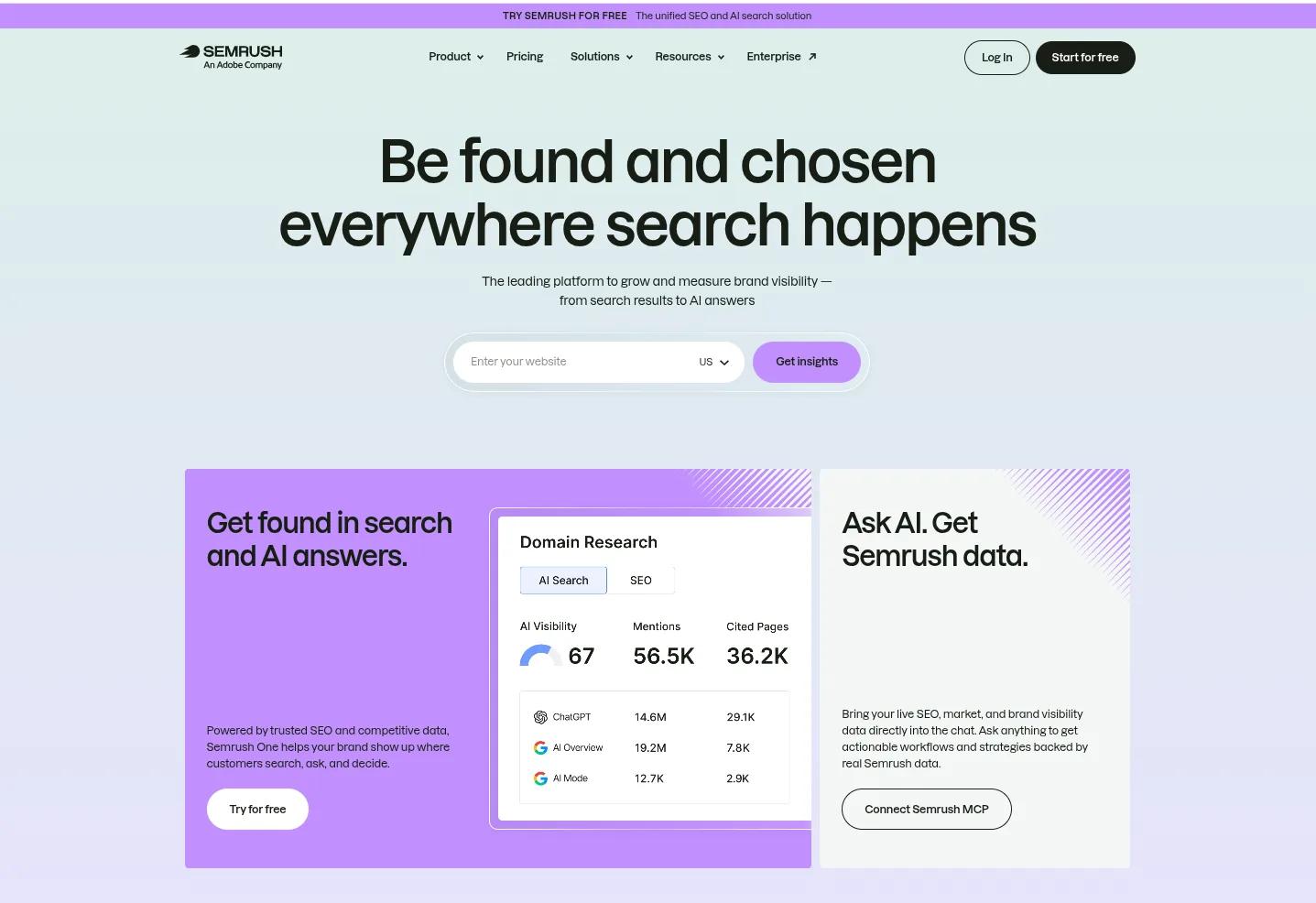
Semrush is the obvious pick if your SEO work already lives there, because AI visibility then sits next to your keyword, audit, and backlink data in reports your team already reads. Its research database is huge, too, with more than 317 million prompts drawn from AI search clickstream data and Google’s AI Overviews keyword data, refreshed daily on a rolling basis.
That said, read Semrush’s own help docs before you assume coverage. The research reports span ChatGPT, Gemini, AI Overviews, and AI Mode, but daily Prompt Tracking for your own custom prompts runs on ChatGPT and Google AI Mode only. Access is licensed per person as well, since each user needs their own toolkit subscription and it can’t be shared through team limits. And with Adobe now owning Semrush and planning to feed its AI visibility data into Adobe’s Brand Visibility platform, it’s fair to ask how long the standalone toolkit will look the way it does today.
Users often find it easy to pick up if they already know Semrush, while the common complaints are add-on costs that pile up and recommendations that stay general. A founder who ran it on their own brand put it simply: “Recommendations can feel generic rather than brand-specific.” A few reviewers also mention friction when cancelling, so read the terms before you commit.
If AI tracking is the main job rather than an extension of your SEO stack, a dedicated tool will usually cover more engines for your own prompts.
Pricing
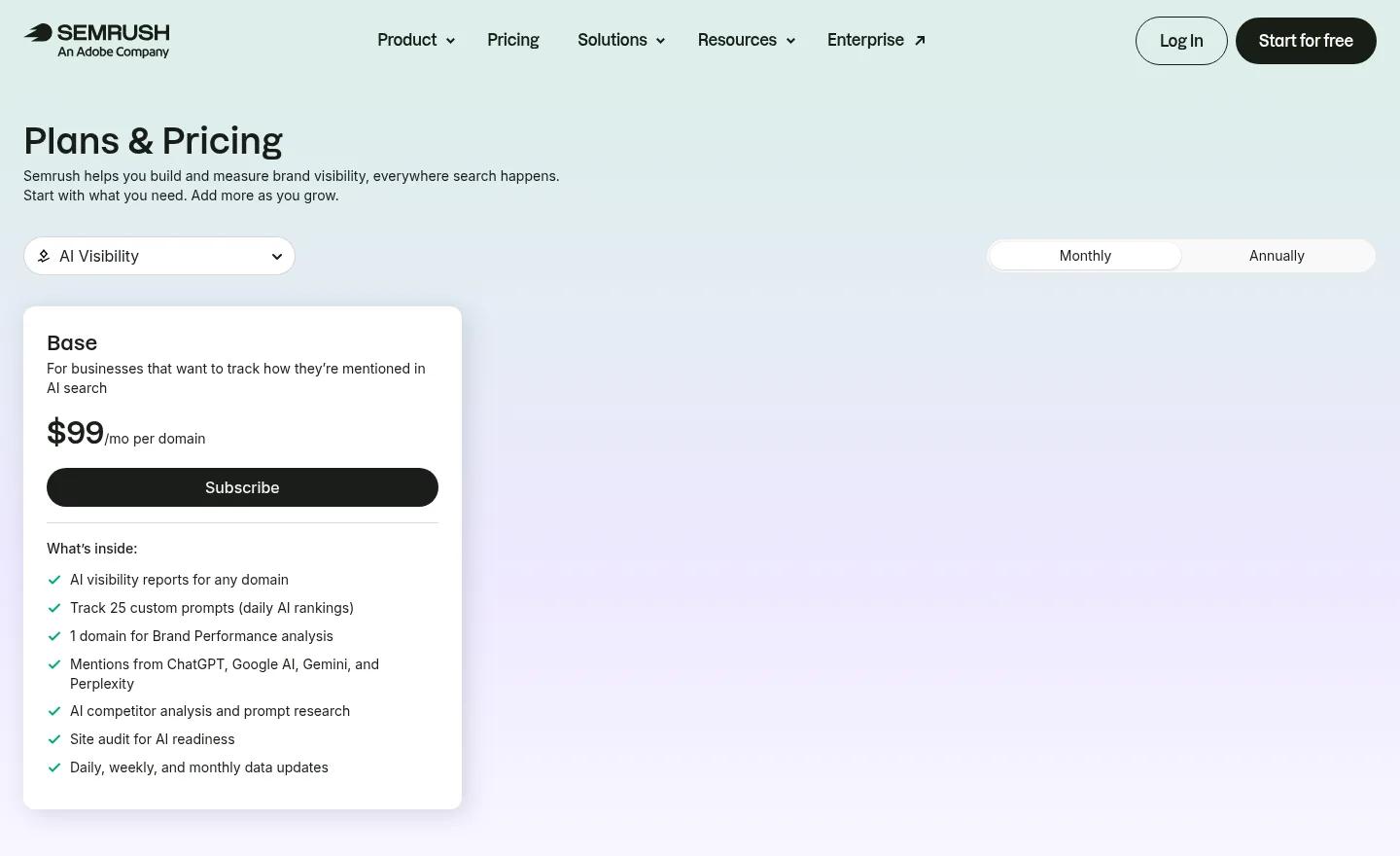
- AI Visibility Base: $99/month per domain, billed annually ($3.96 per prompt). 25 daily custom prompts and AI research and reporting tools.
- Pro Report add-on: $20/month. Advanced branded reporting and integrations.
- Semrush One and SEO + AI plans. Separate combined subscriptions with different SEO allowances.
- Enterprise: custom. Large-scale AI monitoring and governance.
Pros
- AI visibility sits next to established SEO research and site auditing.
- Competitor and prompt research inside workflows the team already knows.
- Combined plans for teams that need traditional and AI search together.
Cons
- Per-domain pricing climbs fast across several brands.
- The advertised Base price requires annual billing.
- Advanced report customization costs extra.
Best AI search market intelligence tool: Ahrefs Brand Radar
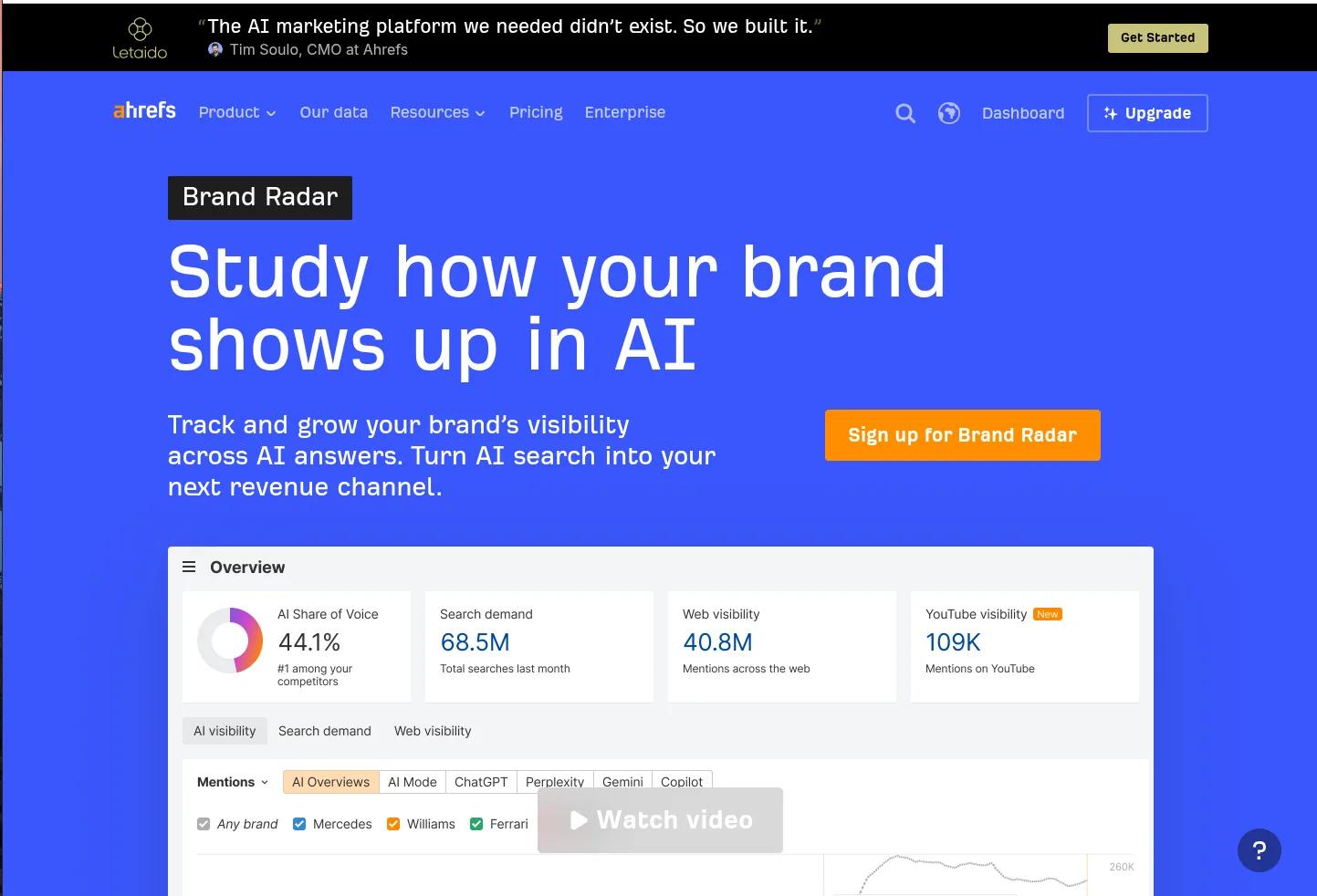
Ahrefs comes at AI visibility from two directions, and they answer different questions. The AI Visibility Index is observational: Ahrefs takes People Also Ask questions from its keyword index and runs them through each chatbot’s web interface without personalization. Because that dataset already exists, you can see how any brand’s visibility moved before you ever signed up, which most dedicated trackers can’t offer, since they only start collecting on day one. Custom Prompts, on the other hand, monitors the exact questions you choose.
The catches are freshness and coverage. According to Ahrefs’ own documentation, the chatbot indexes refresh monthly, so daily monitoring means paying for custom prompts. Claude isn’t in the index at all and is tracked only through custom prompts, run via API with web search, which is why each Claude run consumes eight checks. Grok collection is paused after a policy change, and brands with little search volume get thin index coverage, so niche brands should lean on custom prompts. On the plus side, Brand Radar also tracks YouTube, Reddit, and TikTok alongside AI answers, which few AI visibility tools do, and Ahrefs’ own research found that YouTube mentions correlate with AI visibility more strongly than backlinks.
Users who already live in Ahrefs often describe the learning curve as minimal and the integration as the reason they keep it, while reviewers on G2 and Capterra complain about unexpected charges from the check structure. What’s telling is the Reddit chatter, which is mostly people asking how Brand Radar compares with Semrush and dedicated trackers rather than reporting long-term use, so the verdict from day-to-day users is still forming.
My advice is to use the index for patterns and competitor benchmarks, and to spend custom checks only on the buyer questions that map to pipeline rather than on brand queries you already win.
Pricing
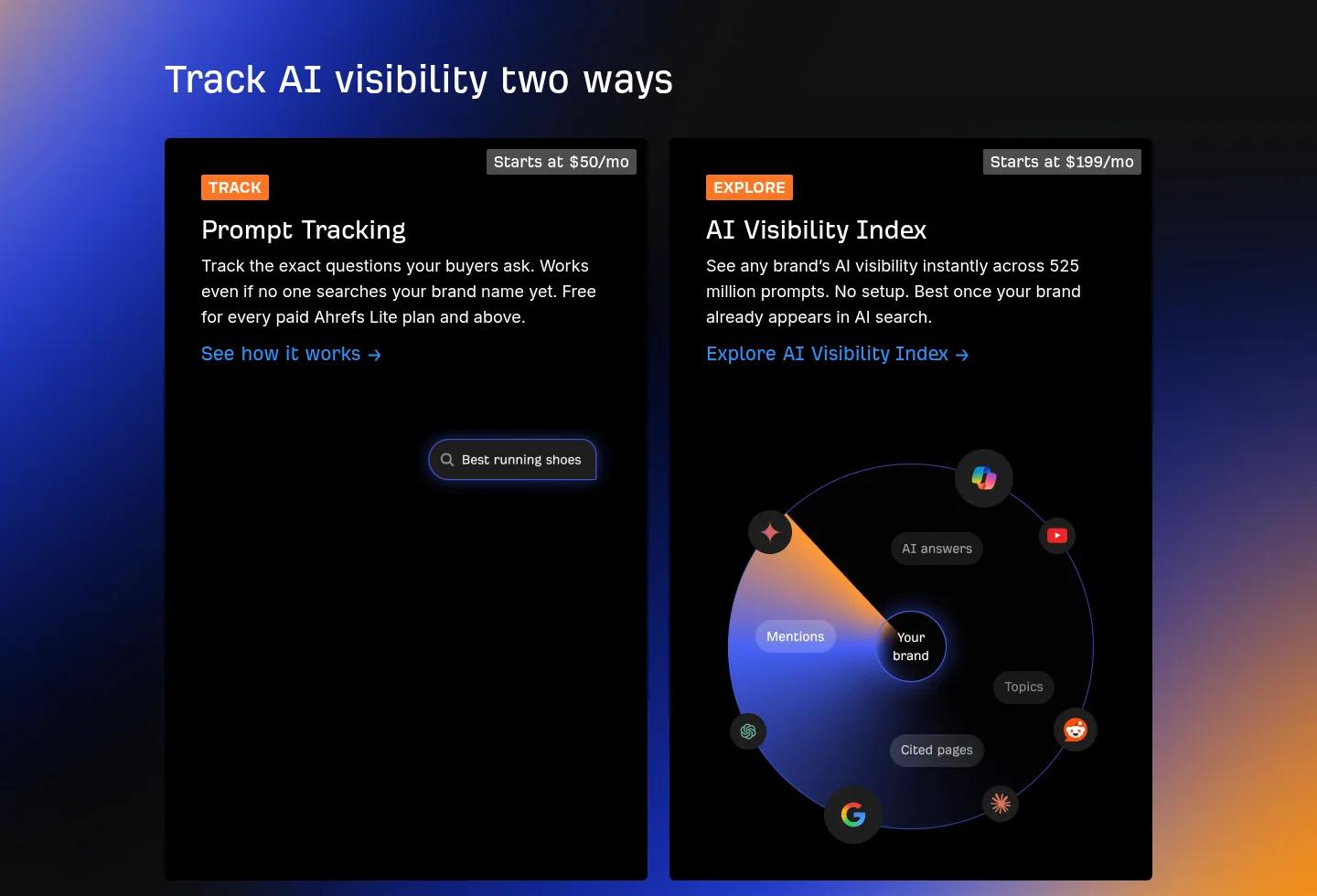
- AI Visibility Index: from $199/month (not priced per prompt). Market-level AI visibility research across the indexed dataset.
- Custom Prompts Basic: $50/month (about $0.60 per prompt per platform; $4.80 on Claude). 2,500 checks a month; extra checks billed by usage.
- Custom Prompts Growth: $100/month (about $0.43 per prompt per platform). 7,000 checks a month.
- Custom Prompts Scale: $250/month (about $0.30 per prompt per platform). 25,000 checks a month.
- Existing Ahrefs plans. Lite, Standard, and Advanced include smaller check allowances.
Pros
- Clear split between market research and exact-query monitoring.
- Sits next to Ahrefs’ existing SEO and competitor data.
- Custom prompt tracking can be bought without the full AI index.
Cons
- Index access and custom prompt checks are billed separately.
- Multi-platform tracking burns checks faster, Claude most of all.
- A large research dataset may hold little for niche brands with limited indexed visibility.
Best flexible credit-based AI visibility monitor: Rankscale
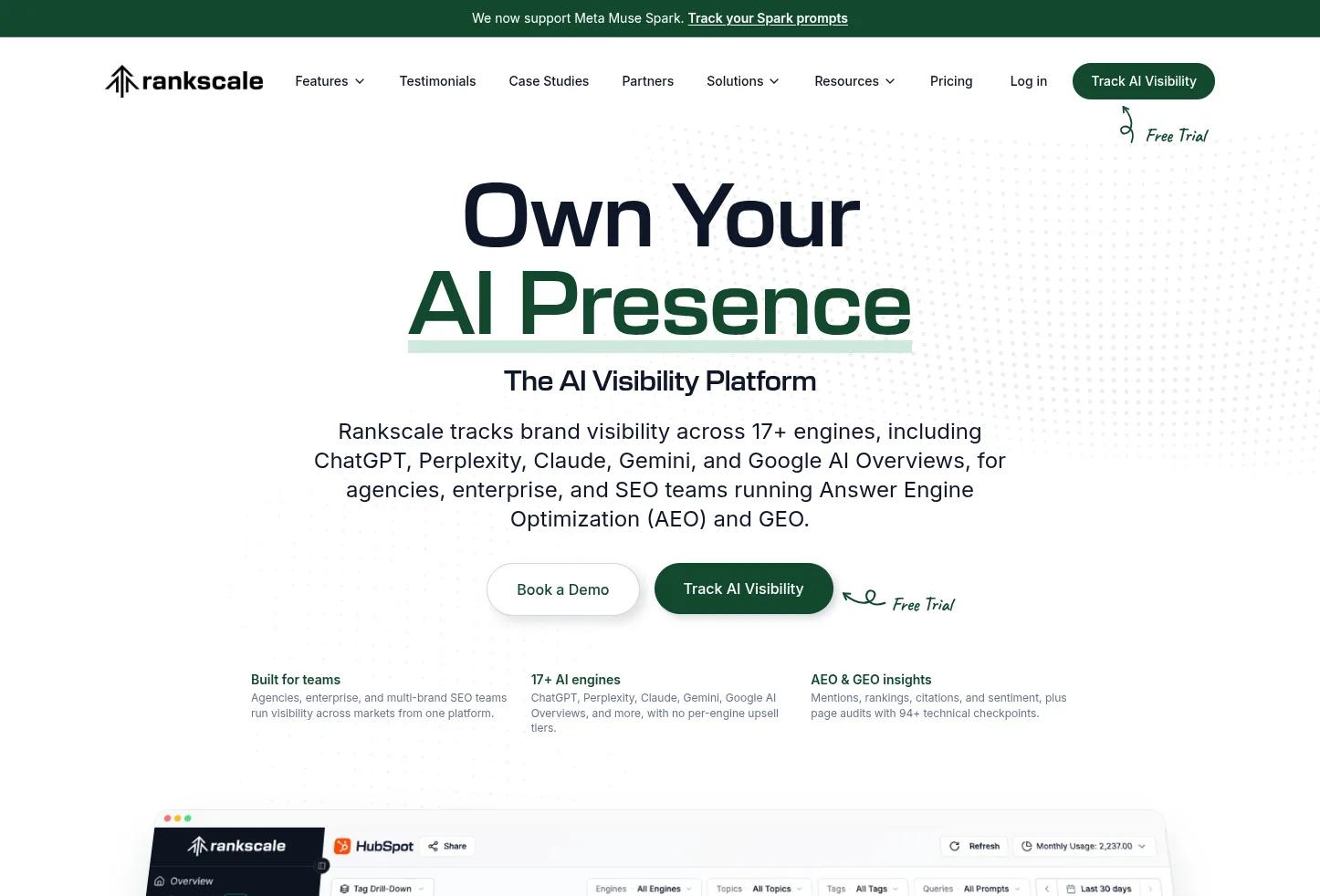
Rankscale is for technical operators who want control over which engines run, how often, and at what cost. It lists more than 17 engines on every tier, so you pay by usage rather than unlocking engines plan by plan, and unused credits roll over instead of expiring, a nice touch for teams with seasonal campaigns. That flexibility lets a fast-moving launch run daily on several engines while a stable comparison topic checks in weekly on one.
The distinction to understand is interface versus API. Engines that Rankscale queries through their consumer interfaces cost a fraction of a credit per run, whereas API-based engines like Claude cost several times more, so the same prompt set can drain credits at very different speeds depending on what you switch on. Beyond mentions, it analyzes shopping cards, sponsored ads, and the sources box inside answers, and its page audits are prescriptive enough for quick fixes, although they work page by page rather than across a whole site.
Users often praise the engine coverage, the MCP integration, and the support, while the complaints center on a dense interface and credits that drain fast once heavier engines are on. One reviewer on OMR Reviews admitted that “when it comes to citations, I prefer Peec.ai,” which is a fair read of where Rankscale is strongest and where it isn’t. The public review base is small, at roughly two dozen reviews, so treat the ratings as early signals.
If you’re comfortable doing a bit of usage math, Rankscale gives you a lot of control for the money. If you’d rather have a fixed allowance you never need to forecast, a prompt-based plan will be easier to live with.
Pricing
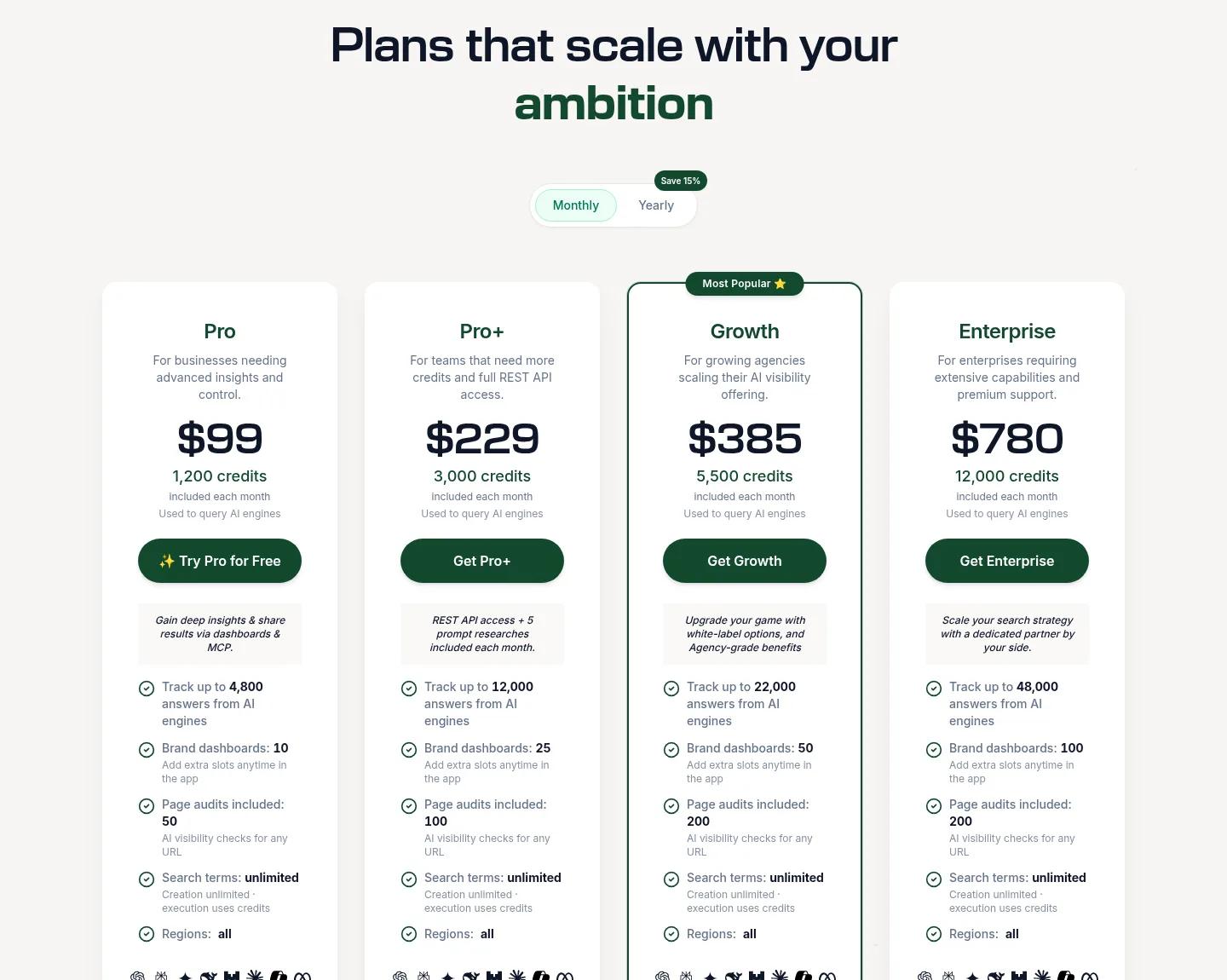
- Pro: $99/month ($1.98 per prompt with three engines). 1,200 credits; up to 4,800 answers; ten brand dashboard slots; MCP.
- Pro+: $229/month (about $1.83 per prompt with three engines). 3,000 credits; up to 12,000 answers; REST API.
- Growth: $385/month (about $1.68 per prompt with three engines). 5,500 credits; up to 22,000 answers; more brand capacity and agency features.
- Enterprise: $780/month (about $1.56 per prompt with three engines). 12,000 credits and expanded capacity.
- Essentials. Annual-only, so it’s left out of the monthly starting-price comparison.
Pros
- Configurable engines and refresh frequency.
- Brand dashboards, page audits, and integrations.
- Credits let technical teams budget different monitoring priorities.
Cons
- Real response capacity depends on the model and query method.
- Advertised maximum answer counts assume low-credit runs.
- REST API and extra brand or workflow capacity depend on tier.
Which AI visibility tool should you choose?
Honestly, getting everything you want right now may mean using more than one AI visibility tool, and even then you’re measuring a sample of answers from systems that don’t share their data. Still, the choice gets a lot easier once you know which problem you’re solving.
If you’re a small team checking a handful of commercially important questions, Otterly.AI is an easy place to start, whereas Peec AI is the better fit when your main question is why competitors keep getting cited. If your SEO work already happens in Semrush or Ahrefs, extending a tool you know can beat adding a new workflow, as long as you check which engines its prompt tracking actually covers.
Enterprise programs with complex markets and governance should look at Profound, Scrunch, and AthenaHQ’s higher tiers, keeping in mind that Scrunch now belongs to Sitecore and Semrush to Adobe. AIclicks fits teams that want tracking and AI-assisted content in one purchase, while Rankscale rewards teams that want fine control over usage and don’t mind the math. And Quotable fits best if you want tracking, AI Shopping, crawler analysis, and workflows that act on the findings in one product, with answers captured from the AI apps themselves.
Whatever AI visibility tool you pick, run a small pilot with prompts that reflect real buying decisions, and check whether it shows the full answer and its sources, how it handles competitors, and what it makes easier to do the next day. It’s messy and imperfect, but waiting for perfect data means letting AI describe your brand without you for another quarter.
Written by