Generative engine optimization (GEO): a practical guide to AI search visibility

Generative engine optimization (GEO) is the work of making a brand, product, or page easier for AI search to find, understand, verify, cite, and recommend when it fits. In practice: choose the buying situations that matter, check how assistants answer them, find where your brand or evidence drops out, fix the missing information, and retest on the same prompts.
A customer asks ChatGPT which support software to buy. It recommends three products, walks through their trade-offs, and links to two comparison pages and a documentation site. Your product would have met every requirement in the question, and it never comes up.
The usual reflexes are to publish another “best tools” article, add schema, or try to get the model to “remember” the brand. I wouldn’t do any of those first. The first job is to find out where the chain broke: whether the assistant understood your category, found usable information about your product, trusted it enough to use it, and had a reason to pick you over the three it named.
That’s what I mean by generative engine optimization (GEO): improving how accurately and usefully your business, products, and content show up in AI-generated answers. There are four separate outcomes hiding in that sentence. You can be discovered, described correctly, cited when your content supports an answer, or recommended when you fit the buyer, and a brand can win one of those while losing the other three. I think blending them into a single score is the main reason so much GEO reporting is hard to act on.
Most examples here use one scenario, a help desk vendor trying to win ecommerce buyers who need multilingual support and a Shopify integration, and there’s a full worked example near the end. If you only read part of it, read the sections on diagnosis and measurement; the definitions at the top are there for completeness.
The short version: pick the buying situations that matter, check how assistants answer them, find where your brand or your evidence drops out, fix the missing information, and retest against the same prompts. Don’t optimize a metric until you know what it counts.
What GEO is, briefly
GEO is the ongoing work of making a brand, product, or piece of content easier for AI-assisted search to find, understand, verify, cite, and recommend when it fits.
A generated answer can blend facts from several sources into one response. The user might get a shortlist, a recommendation with caveats, or an explanation that never names a vendor. Being included can matter even if nobody clicks through, and a citation is a different thing from an endorsement: an assistant will happily cite your documentation while recommending a competitor.
The program has four parts. You research demand (which problems and buying situations bring people to assistants), diagnose visibility (what the assistants say and where you disappear), improve the information environment (technical access, factual errors, first-party material, third-party coverage), and measure like-for-like over time.
None of it guarantees a citation. Assistants get things wrong, prefer other products that also fit, retrieve incomplete sources, and give different answers on different days. What you control is the evidence available to them and how carefully you measure the result.
The term itself comes from an academic paper. Researchers from Princeton and IIT Delhi coined “generative engine optimization” in late 2023 and presented the work at KDD 2024, reporting that rewrites adding citations, quotations, and statistics raised a source’s visibility in generative answers by up to 40% on their benchmark, and by up to 37% on Perplexity. Then in 2025, C-SEO Bench, a NeurIPS benchmark that tested similar methods across more domains and with several competing sites adopting them at once, found most of them “largely ineffective, contrary to reported results in the literature,” while traditional SEO methods did better. The gains also shrank as more competitors used the same tricks. I’d keep both papers in mind the next time someone sells you a GEO tactic with a percentage attached.
GEO, SEO, and AEO
I don’t find the label debate very interesting. AEO and GEO usually describe the same work, and both sit on top of SEO. Google’s guide to optimizing for generative AI features, published in May 2026, says those features rely on its core Search systems and need no special markup to appear in AI Overviews or AI Mode (Google Search Central). Danny Sullivan, a director in Google Search, had already said it in five words at WordCamp US in August 2025: “Good SEO is good GEO” (Search Engine Land). So when someone tells you SEO is dead, or that AI needs a completely separate technical rulebook, ask for their evidence.
What changes is the question you ask of the data. A ranking tells you where a page stands for a query. GEO asks which information made it into a synthesized answer, whether your brand was recommended, and which decision the answer was helping someone make.
How an AI answer gets built
Say a support director at an ecommerce company asks an assistant:
“Which customer-support tools should an EU ecommerce business consider if it needs multilingual ticket routing and a Shopify integration?”
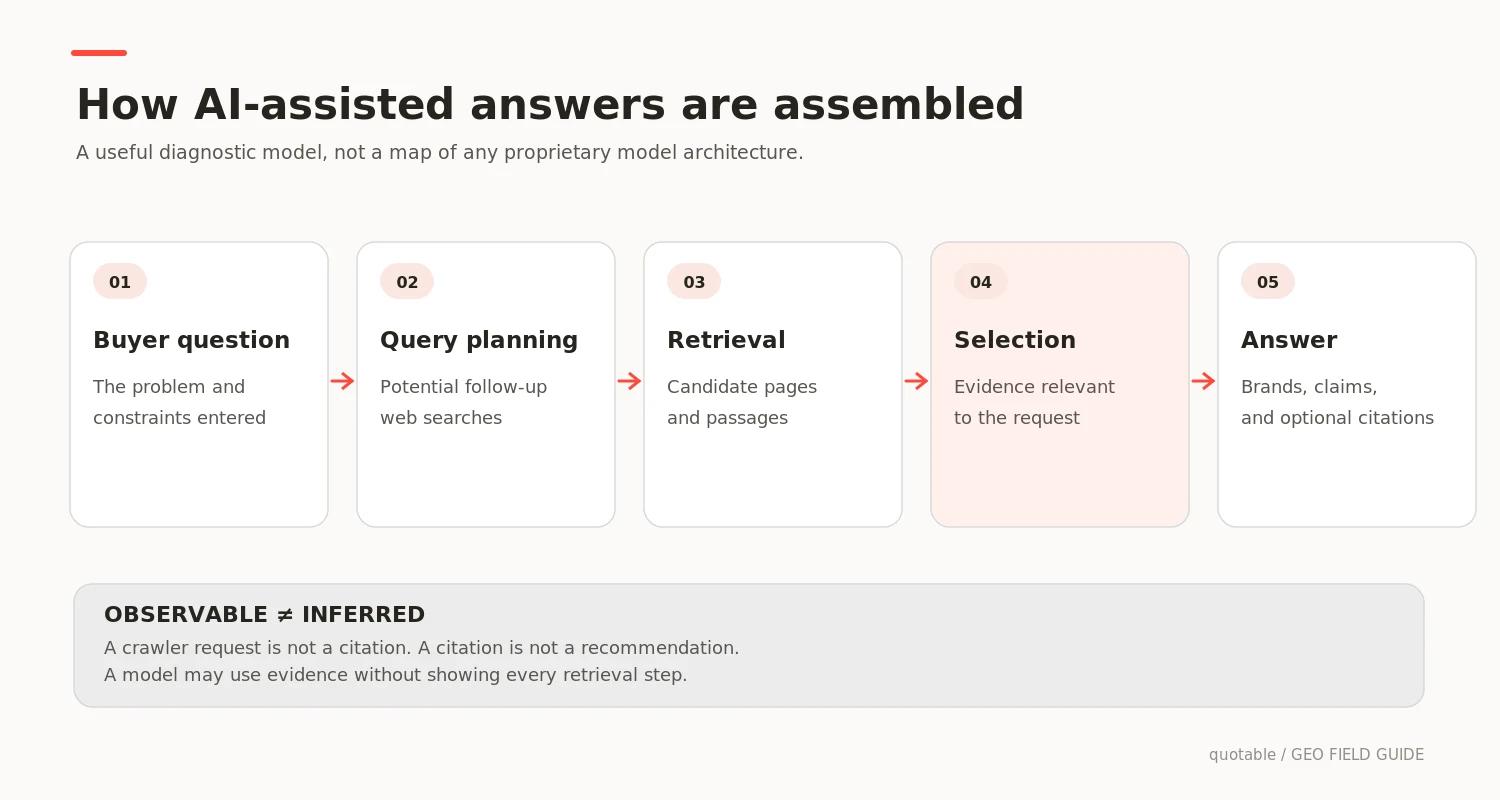
An assistant with retrieval may split that into smaller research tasks: find providers, check integration docs, look at language support, look into European data handling. Then it reads documents, picks passages, and drafts an answer, with or without links.
For diagnosis I use a rough sequence: question → query planning or fan-outs → retrieval → passage and source selection → generation → optional citations. Engines differ and most don’t expose every stage, so this is a model for thinking about failures. It is not a diagram of ChatGPT’s internals, and I don’t know how closely any given engine follows it.
Fan-outs
A query fan-out is an extra search the system runs while working on a request. Google described this openly when it launched AI Mode in May 2025, with Elizabeth Reid, its head of Search, explaining that the system works by “issuing a multitude of queries simultaneously on your behalf” (Google). The help desk question above could spin off searches like these (made up for illustration, not captured from a run):
- “multilingual customer support software Shopify integration”
- “EU data residency customer support platform documentation”
- “support ticket routing multiple languages ecommerce reviews”
Fan-outs tell you what evidence an assistant went looking for. Don’t treat them as extra user prompts or as demand data; nobody typed them.
When you can capture real fan-outs, save each exact query with the prompt that produced it, the engine, the date, the locale, and the resulting answer. If all you have is the cited URLs, report citations and leave the fan-out trace alone instead of reconstructing one from guesses.
The practical consequence is that one broad buyer question can expose gaps in several narrow pages at once. A help desk vendor’s general product overview won’t answer that Shopify question nearly as well as an accurate Shopify integration page would.
Retrieval, reranking, and citation
Retrieval systems usually pull a wide set of candidate documents or passages and score them for relevance before generating anything. Some mix lexical and semantic retrieval; some rerank with specialized models. That much is standard information retrieval. What commercial assistants actually use, and how they weigh it, mostly isn’t public.
This is how a page can rank well in Google and still not get cited. The passage may never have entered the candidate set. It may have been considered and lost to a document that answered the specific constraint more directly. Or the assistant used it and didn’t cite it, which you can’t detect from the outside.
I’m skeptical of tools that sell an “AI readiness” percentage. A score from an open-source reranker is useful for comparing your own passages against each other, but it is a local relevance test, and it says nothing reliable about the probability that ChatGPT cites your URL.
So the practical question is what you can observe. Crawler logs show requests, a retrieval trace (when you have one) shows queries and candidate sources, and the answer itself shows mentions and citations. Each supports a different conclusion, and I’d guess most bad GEO reporting comes from using one layer to make claims about another.
Cited, recommended, or neither
A brand can show up in three ways that look similar on a dashboard:
- The answer recommends your product but links only to an independent comparison page. That’s a recommendation with no first-party citation.
- The answer cites your integration docs while recommending other tools. That’s a citation with no recommendation.
- A crawler requested your pages, and your brand never appears in the answer. That’s a request and nothing else.
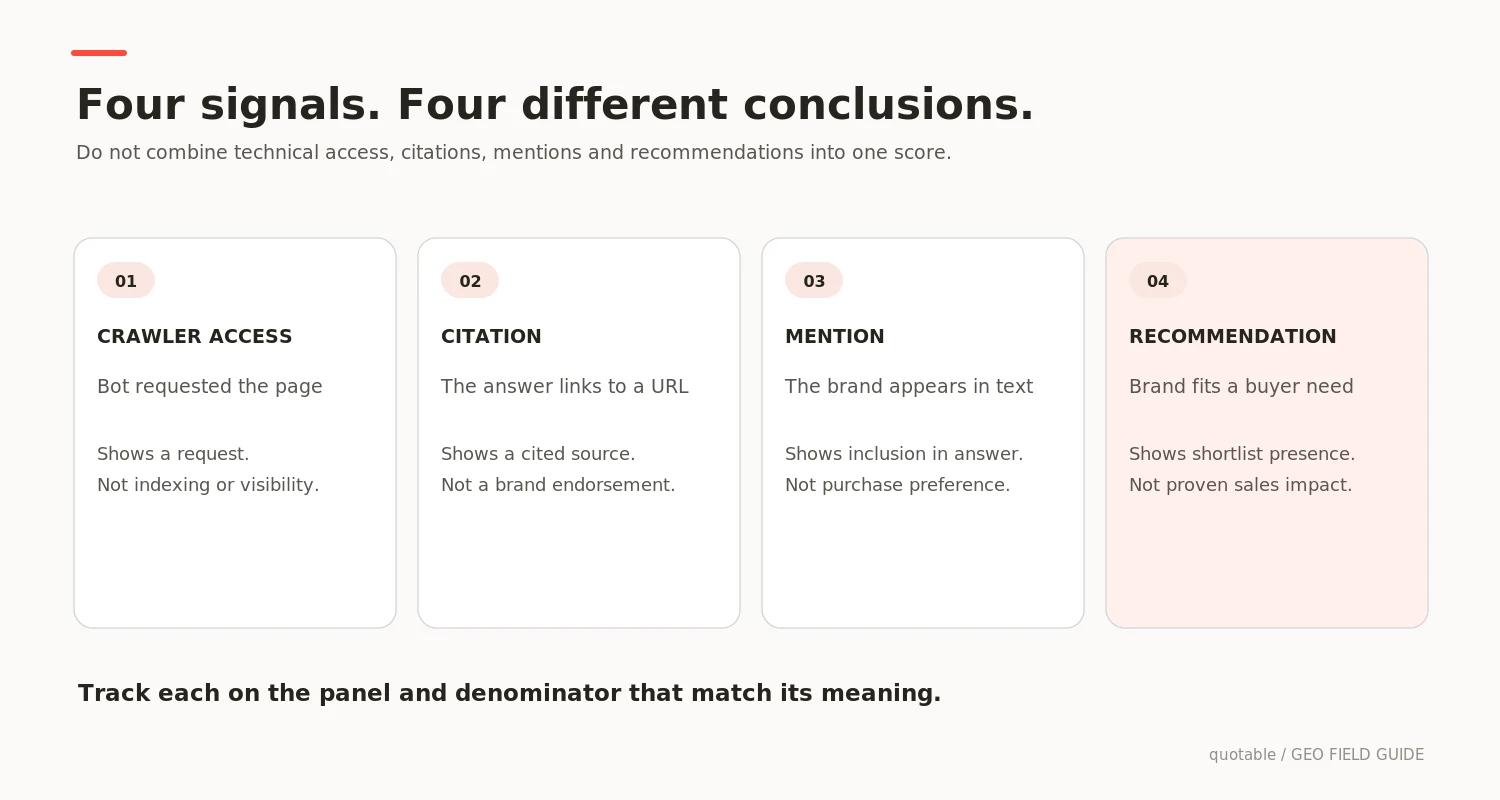
Fold those into one visibility score without the counts underneath and you won’t be able to tell which problem you have.
Start with buyers and categories
The most common flaw in GEO prompt lists is that every prompt already names the product category. Real buyers often start with a problem and don’t know what the product that solves it is called.
For a help desk vendor, one buyer might open with “our email and live-chat support is becoming impossible to manage,” while another is already asking for “the best help desk for Shopify.” Both can end at the same product, but they test different things, so it helps to sketch a category map first:
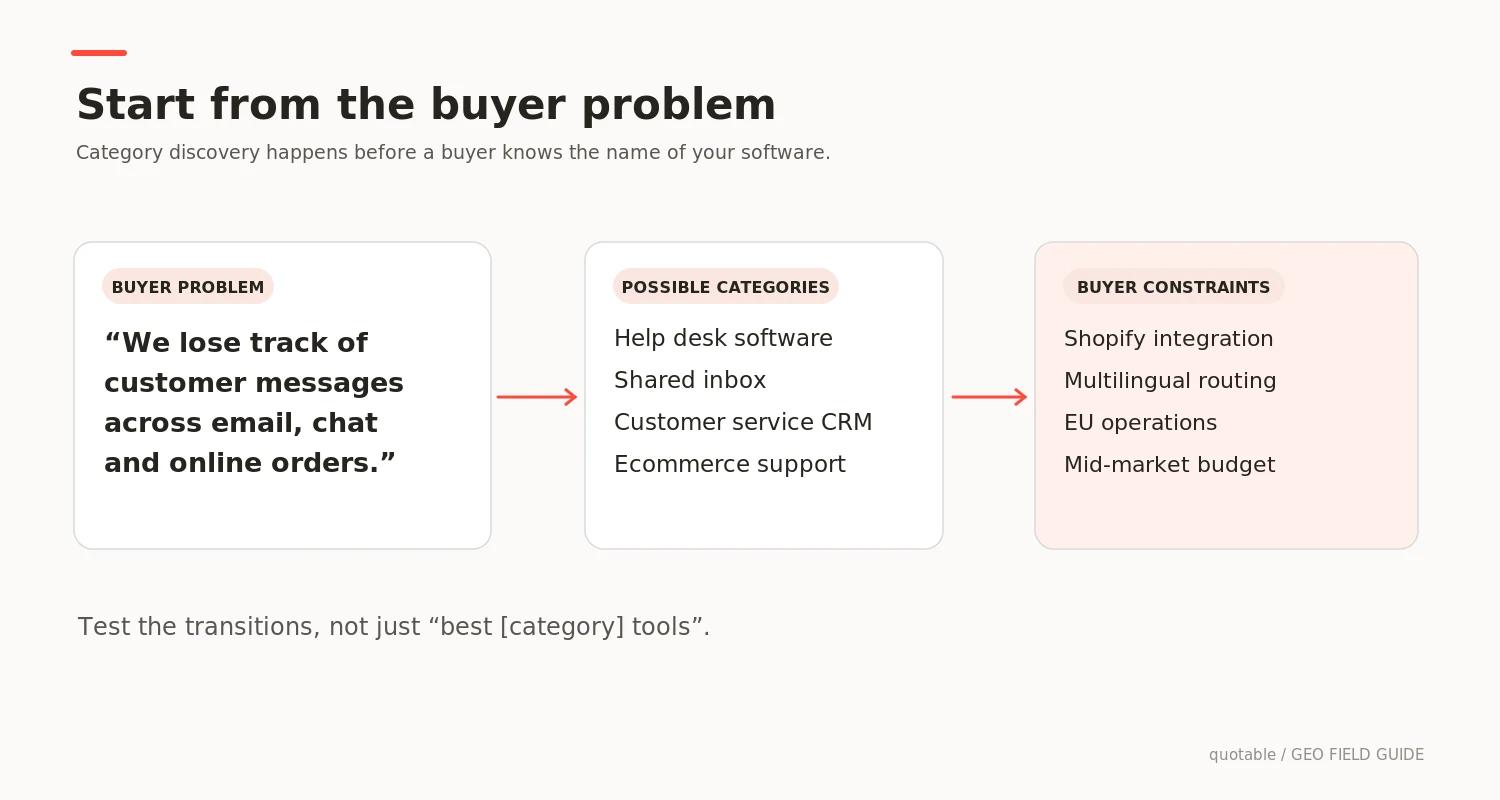
| Layer | Help desk example | Why it matters |
|---|---|---|
| Buyer problem | Customer conversations are scattered across channels | Tests whether AI identifies a useful solution direction |
| Job to be done | Route multilingual support tickets in one workspace | Tests whether AI understands the real need |
| Core category | Customer-support or help-desk software | Tests unbranded vendor discovery |
| Adjacent categories | CRM, shared inbox, live chat, ecommerce service platform | Reveals where recommendations might shift |
| Buying constraints | EU operations, Shopify, budget, multilingual routing | Tests real buyer fit |
| Verification requirements | Integration limits, supported languages, security documentation | Tests factual accuracy and evidence |
I wrote a separate guide to choosing AI visibility prompts, so I’ll keep the rest of this short. Two rules from it carry over directly.
The first is to label buying task and market status separately. Someone can ask “what is customer-support automation?” while planning a purchase, and someone else can compare two vendors for a school project. Tag the task (exploration, discovery, consideration, selection, validation) apart from your guess about whether the person is in market, and keep calling that second label a guess unless a real conversation backs it up.
The second is to keep unbranded discovery and branded accuracy apart. “Which support platforms work best for a multilingual EU ecommerce team?” tests whether a vendor gets found without being named. “Does [Brand] support multilingual ticket routing?” tests whether the model knows a fact about one. If a brand shows up in 4 of 20 unbranded answers and 18 of 20 branded ones, that’s a 20% discovery rate and a 90% knowledge rate, and averaging them hides exactly the problem you need to see.
Your first GEO audit
You don’t need a large monitoring project. You need a consistent sample you can actually review, and a record of what you saw. The steps below are the short version; how to conduct a GEO audit walks through each one in more detail.
Step 1: choose the buying situations that make you money
Pick two or three buyer segments you can really serve and write down, for each, the problem, the business context, the must-have constraints, and the category language they’d use. A help desk vendor might pick EU ecommerce support teams, multilingual SaaS support, and customer service agencies. A narrow, commercially meaningful sample will tell you more than a hundred prompts spread across every industry and country.
Step 2: build a small, balanced prompt panel
Twenty to thirty prompts is a manageable working sample for a first audit. It is not a representative study, and you shouldn’t present it as one.
| Segment | Example prompt | Expected answer |
|---|---|---|
| Problem exploration | “How can an ecommerce support team stop losing conversations across channels?” | Explanations and possible solution categories |
| Unbranded discovery | “Best customer support software for mid-sized ecommerce teams?” | Relevant product shortlist |
| In-market selection | “Which help desk should an EU retailer choose for multilingual routing and Shopify?” | Recommendation justified by constraints |
| Category variation | “Best shared inbox for an ecommerce service team?” | Observe whether category framing changes the shortlist |
| Branded validation | “Does [Brand] support Shopify and multilingual routing?” | Verifiable product claims |
| Comparison | “[Brand] or [another shortlisted tool] for an EU ecommerce support team?” | Specific trade-offs between the two |
Report branded, unbranded, and comparison results separately, and vary the business situation from prompt to prompt instead of rewording the same question.
Step 3: capture answers with enough context to compare them
Record the exact prompt, the engine and model, the date, the location or language setting, the full answer, and every mention, recommendation, and citation in it. Run high-value questions more than once so you know whether their answers hold still. If ChatGPT is where you want to start, how to track brand mentions in ChatGPT walks through this step with a free spreadsheet template.
One manual run doesn’t measure a market. Answers move with model version, session, location, and whatever the retrieval layer found that day, so a curated panel measures that panel under the conditions you recorded.
How much do they move? SparkToro and Gumshoe.ai had 600 volunteers run 12 prompts through ChatGPT, Claude, and Google’s AI 2,961 times, and the chance of getting the same list of brands twice was under 1 in 100 for ChatGPT and Google’s AI, with Claude only slightly more consistent (SparkToro). Rand Fishkin’s summary was blunt: “These tools are probability engines: they’re designed to generate unique answers every time.” What did hold up was frequency, because the top three brands in each category appeared in 64% to 73% of responses on average, depending on the tool. So count how often you appear across runs, and don’t read anything into where you sit in a list.
Quotable records tracked prompts and responses so you can see where your brand appears, what’s said about it, and which sources get cited. That makes collection faster. Whether the results mean anything still depends on your research design.
Step 4: audit your product facts
If I had one week, this is the step I’d start with. Build a source of truth for the claims buyers care about (pricing, integrations, geographic support, security, product limits, eligibility), then ask factual questions separately from your discovery prompts.
If your product supports Shopify and the assistant says it doesn’t, find the public page that should settle it and check whether that page is accessible, specific, current, and consistent with everything else you publish. Fixing that one page is worth more than any thought-leadership piece you could write that month.
For facts that change, like pricing, write down the date you verified them. A confident answer can be months out of date.
Step 5: look at what got cited
For each important recommendation you missed, collect the cited pages and label what kind of source each one is: documentation, independent review, category roundup, case study, community thread, or editorial coverage. Then ask what each one let the assistant verify. A “best software” roundup can establish that a product belongs in the category without proving any integration works, while an official integration guide proves the integration and says nothing about whether buyers like the product.
If you have real fan-outs, compare their facets with your content. If you don’t, write your suspected retrieval gaps down as hypotheses and test them with more prompts and more source review.
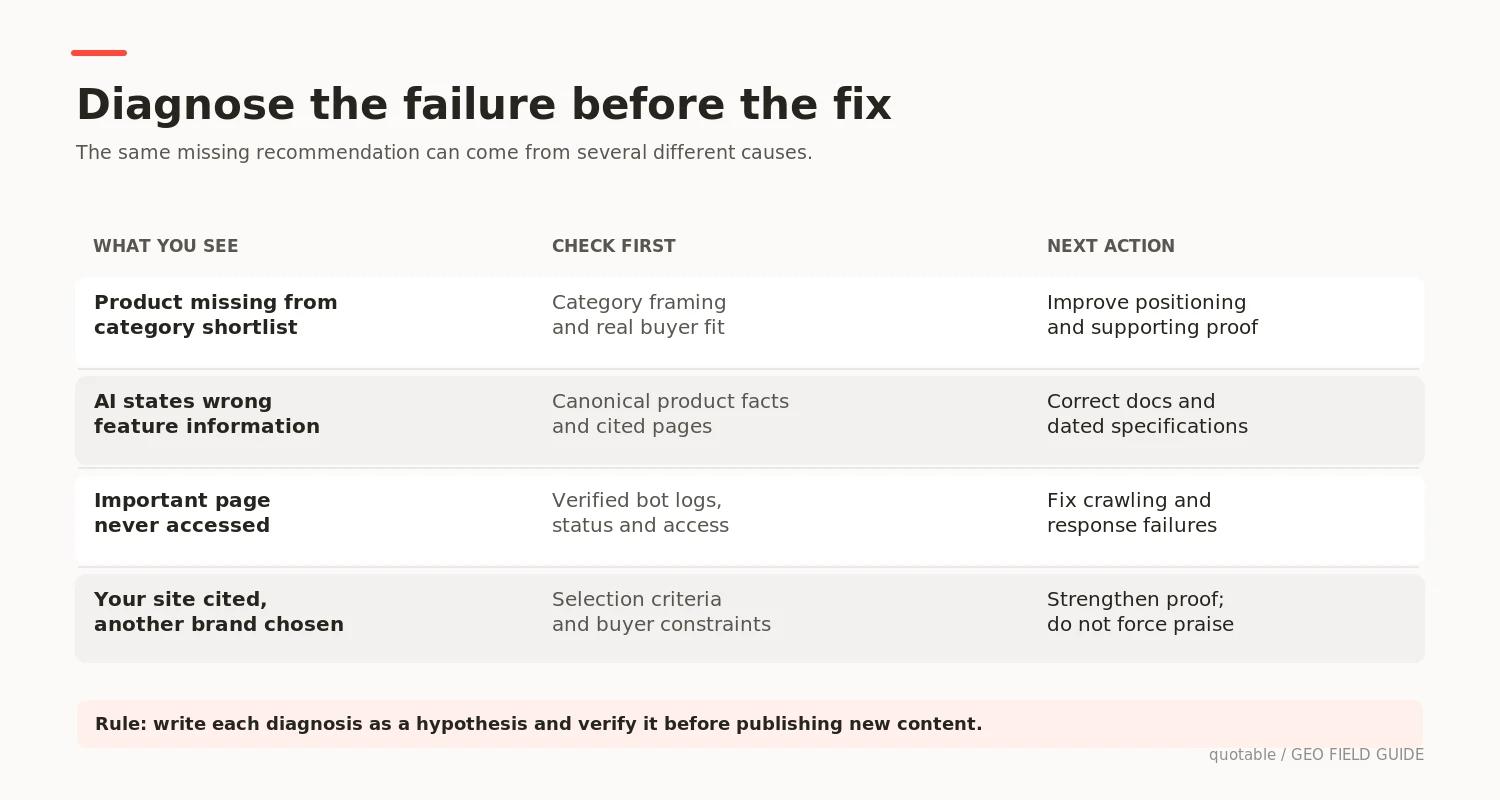
Step 6: diagnose before you prescribe
| What you observe | Plausible issue | Next verification step | Appropriate response if confirmed |
|---|---|---|---|
| Product absent from category shortlists | Weak category association or buyer fit | Test alternate category language and verify product facts | Improve positioning and category-specific evidence |
| Product described incorrectly | Public facts ambiguous, outdated, or absent | Check canonical documentation and relevant cited pages | Fix product documentation and factual consistency |
| Important page unavailable to a verified crawler | Technical access or rendering issue | Check robots directives, response codes, and logs | Fix access and server behavior |
| Documentation exists but doesn’t address buyer constraint | Weak answer-bearing evidence | Compare the specific passage to the buyer’s question | Rewrite for the actual decision and substantiate claims |
| Brand cited but not recommended | Source relevance doesn’t equal product fit | Inspect the assistant’s stated criteria | Address genuine fit or proof gaps; don’t force endorsement |
| Plenty of broad mentions, few in-market recommendations | Portfolio mismatch or weak buyer-specific evidence | Segment by buyer context and constraints | Prioritize high-value use cases and proof |
A missing recommendation doesn’t tell you which stage failed. Write each diagnosis as a hypothesis that could turn out wrong, along with the evidence you have for it.
Improving visibility without hacks
The fix should follow the diagnosis. In practice most of the useful work comes down to making accurate information reachable, making it answer the actual decision, and making independent corroboration easier to find.
Make product information precise
Product pages are usually good at benefits and bad at the details a buyer, or an assistant, needs to make a defensible choice. A typical help desk site says “Connect your favorite ecommerce tools and support customers in any language,” which sounds fine and answers nothing. It doesn’t say whether Shopify orders attach to tickets, which languages are supported, or whether routing rules come with every plan.
A better integration page states the exact integration and the workflows it supports, the preconditions and plan limits, the setup steps, what it does not do, and where to check current documentation. Add a real customer example if you have one, with the measured result and its limits. That helps a human evaluate the product and gives a retrieval system something specific to use, though it still doesn’t guarantee a citation.
Write passages that answer their own heading
A section called “Shopify integration” should answer the Shopify question in its first sentence. Compare these two:
Weak: “Our platform unlocks seamless workflows and next-generation ecommerce experiences.”
Useful: “Our Shopify integration can display order details alongside support tickets when enabled by an administrator. It does not automatically process refunds.”
The sentence structure doesn’t matter; the specificity does.
The right format depends on the question. “What is” wants a definition, “X vs Y” wants comparison criteria, “best X for Y” wants a shortlist with trade-offs, and “how to” wants steps. You don’t need to turn everything into a listicle or cut paragraphs into tiny chunks, and Google’s guide says outright that chunking content for AI isn’t necessary for its features.
Earn the third-party evidence buyers check
Your own site is where product facts should live, but buyers and assistants also lean on earned media, expert reviews, integration marketplaces, directories, community threads, and case studies.
The data points the same way, at least for Google. Ahrefs studied 75,000 brands and found that branded web mentions correlated with visibility in AI Overviews at 0.664, against 0.218 for backlinks (Ahrefs). Kevin Indig’s research found something similar for ChatGPT, where he concluded that “brand search volume is the biggest predictor for visibility.” Both are correlations, and Ahrefs says so itself, but they explain why a case study on someone else’s site can do more for you than another page on your own.
Think of this as earning corroboration. If category articles keep leaving your product out because you have no credible enterprise proof, one verifiable case study will do more than another self-written “best tool” list. If a review gets a fact wrong, ask for a correction, and don’t try to buy or manufacture positive sentiment. Be careful with conclusions here, too: seeing a third-party site cited in one answer doesn’t mean that getting onto that site will reliably earn you recommendations.
Technical GEO is mostly access and reliability
Start with ordinary technical SEO: crawlable HTML, sensible internal links, stable canonical URLs, correct status codes, and content that loads without broken rendering or a login wall. Then check the access rules and request patterns of the AI crawlers that matter to your business.
OpenAI runs three separate agents, and you control each one independently in robots.txt (OpenAI crawler documentation). OAI-SearchBot surfaces sites in ChatGPT’s search features; block it and your pages won’t appear in ChatGPT search answers, though they can still show up as navigational links. GPTBot is the training crawler, so blocking it is a decision about training data and has no bearing on search inclusion. ChatGPT-User fetches pages when a person asks ChatGPT to, and OpenAI notes that robots.txt rules may not apply to it. The common mistake is blocking GPTBot and assuming you’re out of ChatGPT entirely, or blocking all three and then wondering where the citations went.
If you have CDN or server logs, build a small report on verified crawler identities: which URLs they requested, response codes, failures, volume over time, and which priority pages they haven’t requested at all in the window you looked at. Verify bots with each provider’s published methods, such as IP ranges, because user-agent strings are trivial to fake. A bot visit tells you about access and nothing about indexing or recommendations.
Be careful with borrowed crawler statistics, too. Duane Forrester counted Anthropic’s crawl-to-refer ratio reported everywhere from 70,900:1 to 2,237:1, and pointed out that “every one of those figures is attributed to Cloudflare” (Duane Forrester). The number moves with the measurement window, which is one more reason to work from your own logs.
Quotable’s AI crawler analytics can run that report once the logs are connected. Keep it separate from answer visibility either way, since one measures requests and the other measures what assistants said.
Schema, llms.txt, and “AI formatting”
Use structured data where it describes the page accurately and supports normal search features. I wouldn’t sell it to anyone as an AI citation switch, and Google agrees: its guidance says AI Overviews and AI Mode need no special AI markup and no llms.txt file (Google Search Central).
Some agent tools and other software may read machine-readable docs (if you publish an llms.txt, validate it), and that could be worth testing if those tools matter to your business. If you test it, or any other new tactic, write down the hypothesis, the cost, the expected outcome, and how you’ll measure it before you start, because otherwise you’ll end up believing whatever happened next.
A worked example: from missing recommendation to measurable change
Here’s the whole method on one hypothetical case, a help desk vendor we’ll call Northstar. The company, prompts, citations, and outcomes are all invented.
Northstar starts out appearing in 6 of 20 broad category recommendations but only 1 of 10 answers for EU ecommerce teams that need multilingual routing and Shopify. That’s 30% on one panel and 10% on the other. It says nothing about Northstar’s visibility across all AI users, but it tells the team where to look, and the second number is the one tied to revenue.
The first hypothesis is that assistants misread the category. The team runs “customer support platform,” “help desk,” and “shared inbox” with the buyer context held constant, and Northstar appears under two labels but not the third. So wording affects discovery, though the test can’t say which phrase real buyers use most.
The second hypothesis is missing integration evidence, and this is where the useful finding comes from. Several answers describe Northstar as promising but say they can’t verify its Shopify workflows. When the team checks its own site, the integration page turns out to be a grid of logos with no workflow detail, and a comparison article that assistants cite often still lists an outdated feature set. Neither problem would have shown up in a visibility score. Somebody had to read the answers.
The team rewrites the integration page with verified workflows, limits, setup steps, and a dated product reference. It sends the comparison’s publisher factual corrections without asking for a better verdict, and it leaves unrelated pages alone during the observation window so the result stays readable.
Then it tracks the same panel under the same conditions, recording dates and engine versions, and checks three things separately: whether assistants now describe the integration correctly, whether the new page gets cited, and whether recommendations for the target segment change. If accuracy improves and recommendations don’t, the team has still learned something, because knowledge was one problem and buyer fit or third-party proof is probably the next. Publishing ten more pages because the result was disappointing isn’t a next step.
Measuring GEO without fooling yourself
A GEO report can be short as long as every denominator and segment is clear. Mike King of iPullRank argued in October 2026 that generative results change how answers are presented far more than how sources are selected, “so what breaks is measurement” (iPullRank).
| Metric | How to calculate or inspect it | What it cannot prove |
|---|---|---|
| Unbranded recommendation rate | Relevant recommendation answers naming your brand ÷ completed unbranded recommendation answers | Total market share or sales impact |
| Branded factual accuracy | Correct verified claims ÷ verified claims checked in a designated branded panel | Independent discovery |
| Citation incidence | Answers citing your domain ÷ eligible completed answers in the selected panel | That your brand was recommended |
| Buyer-fit performance | Recommendations within a defined high-value buyer segment | Performance across all buyers |
| Source mix | Domains and URLs cited, grouped by source role | An unseen full retrieval path |
| AI referral traffic | Eligible sessions identified from supported referrers and analytics conventions | All influence from zero-click or unattributed AI use |
| Qualified leads and conversion | CRM and analytics outcomes tied to observable sessions or disclosed attribution models | Reliable causal credit for GEO alone |
If your brand is recommended in 14 of 20 general unbranded answers (70%) and 2 of 10 high-value enterprise selections (20%), the 70% is accurate and mostly irrelevant when enterprise is where the money is.
Show counts next to percentages, especially on small panels, report branded and unbranded samples separately, and when you compare periods, change one thing at a time.
If I could keep only one number in a GEO report, it would be the unbranded recommendation rate inside the buyer segment you most want to win. Everything else in the table is context for that number.
Benchmark and exploration panels
Keep a benchmark panel fixed so trends mean something, and put new questions, labels, and experimental buyer conditions in a separate exploration panel. Mixing them breaks the trend line. If your brand appears in 15 of 25 benchmark answers and you add 15 hard prompts where it never shows up, the combined rate drops from 60% to 37.5% with no real change in visibility. Report both panels, log every addition, and version the benchmark when you change it on purpose.
Quotable tracks prompt-level mentions, citations, and sources over time. For business impact you still need analytics and CRM data, and nobody should present a visibility score as revenue.
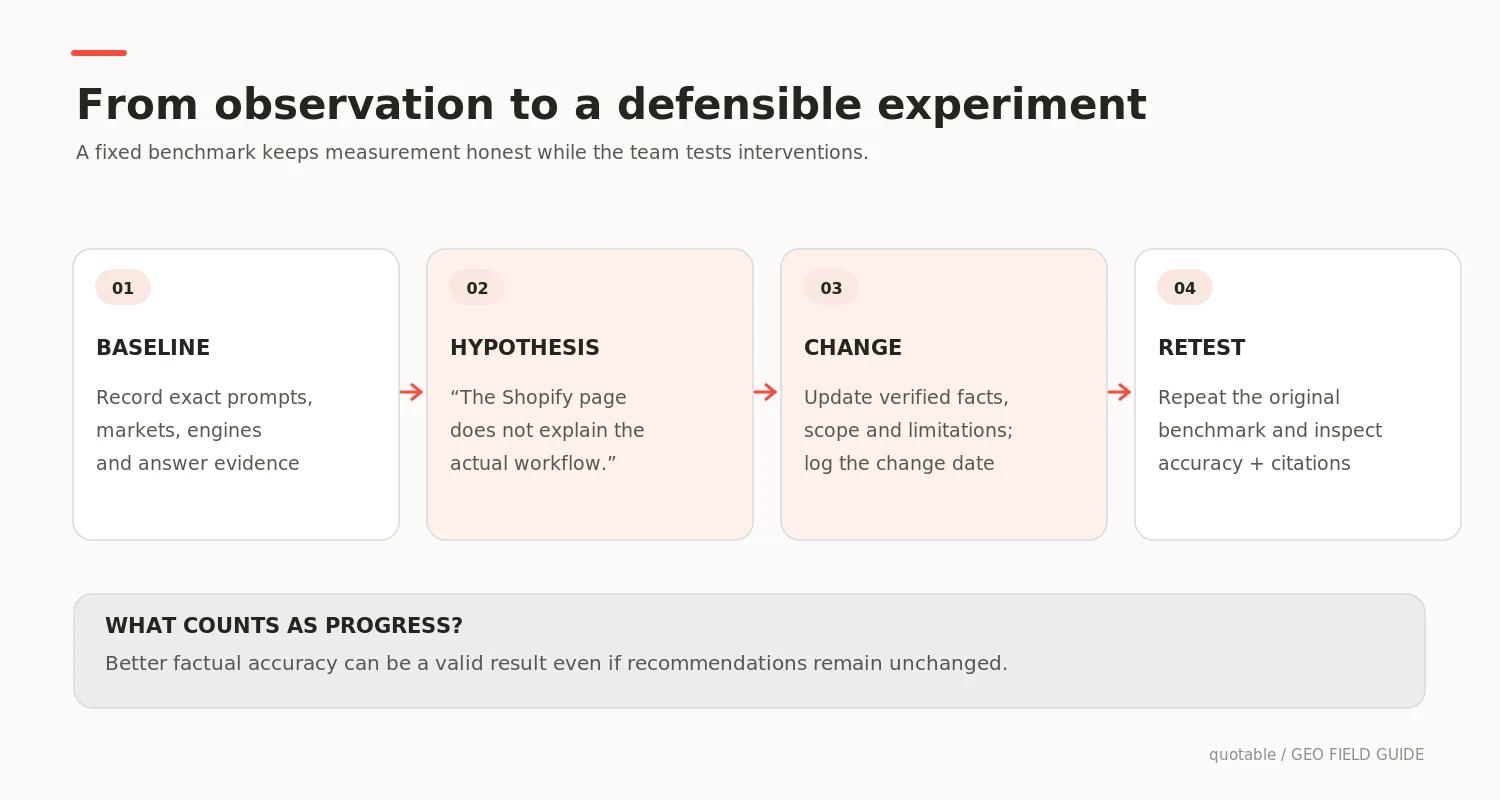
Running a GEO experiment that tells you something
Changing a page and checking ChatGPT the next morning doesn’t tell you much. Answers vary from run to run, and a model update can move results for reasons that have nothing to do with your work.
A test is worth running when you’ve decided five things in advance:
- One hypothesis. “Adding verified Shopify workflow details will improve the accuracy of AI answers about our Shopify integration” can be tested, while “improve GEO” can’t.
- One primary outcome, which here is factual accuracy on the affected prompts.
- A stable comparison: the same prompts, engines, and markets, and ideally a similar page or segment you didn’t touch.
- A record of the intervention, meaning what changed, when, on which URL, and which other campaigns were running at the same time.
- A plan to read the result cautiously, since even several consistent observations may not establish cause.
Results that look like failures often aren’t. If retrieval requests rise and citations don’t, the page may be getting considered without being the strongest final source. If accuracy improves and recommendations stay flat, you fixed misinformation and still have a selection problem. Each of those points to a different next test.
Some teams run open rerankers to compare their passages with competitors’. That’s a reasonable content diagnostic for spotting missing criteria or weak phrasing, as long as nobody mistakes it for a simulation of what ChatGPT or Google do privately.
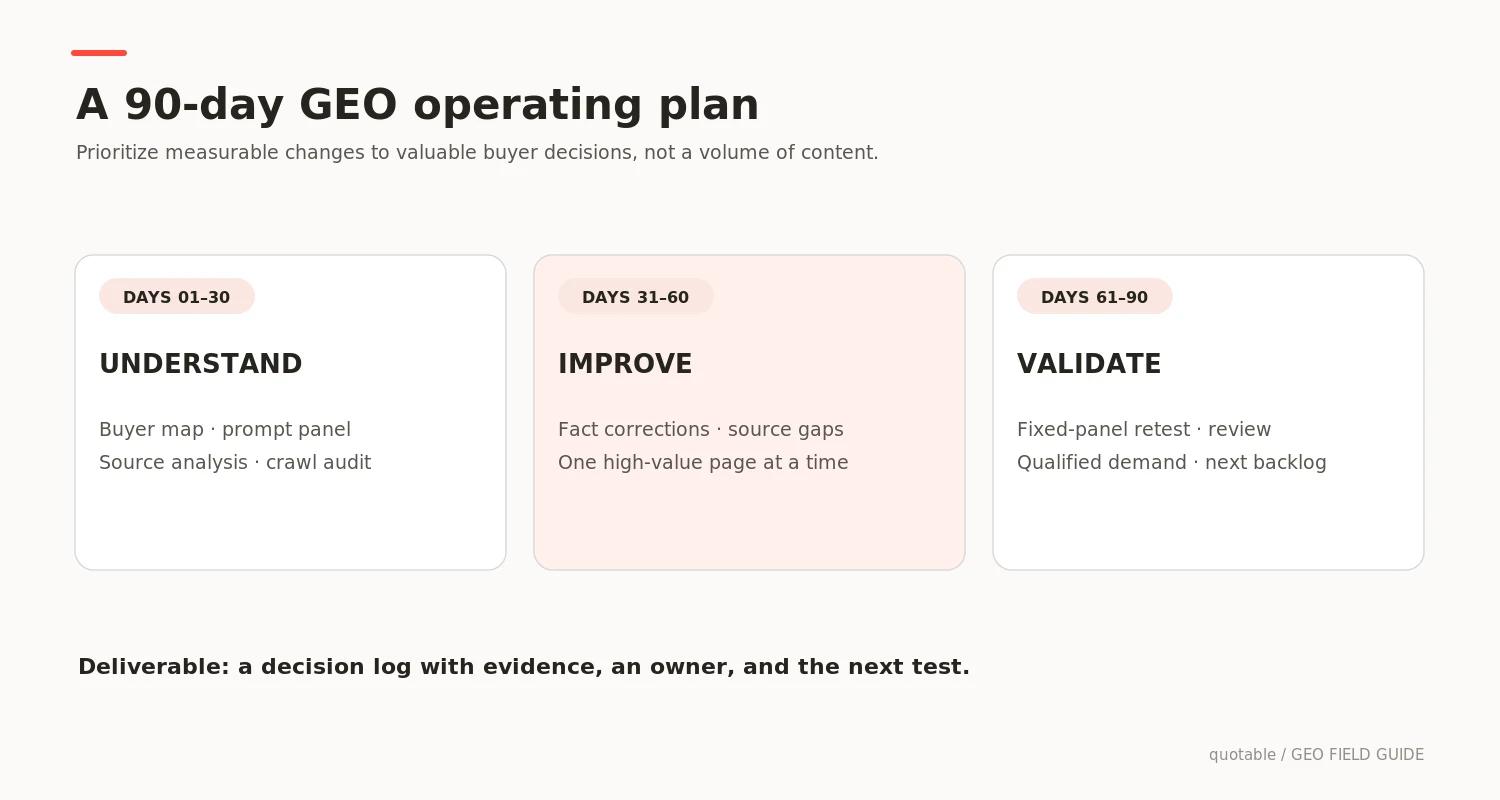
A 90-day plan
A small cross-functional team is enough. Aim for a credible baseline and a few interventions on decisions that matter to revenue.
| Period | Work | Deliverable |
|---|---|---|
| Days 1 to 15 | Select two key buyer segments; document categories, problems, buying constraints, and source-of-truth product claims | Buyer and category map, plus a product fact sheet |
| Days 16 to 30 | Build a 20 to 30 prompt starter panel; capture responses; classify citations, recommendations, and factual errors; review crawl access | GEO audit with observed counts and evidence links |
| Days 31 to 45 | Prioritize three gaps by buyer value, confidence in the diagnosis, and effort | Ranked action backlog with owners |
| Days 46 to 60 | Fix factual documentation and technical access issues; improve one high-value page; pursue justified source corrections | Logged interventions with dated change records |
| Days 61 to 75 | Run a controlled follow-up; inspect changed answers and sources; refine one hypothesis | Comparative results, including failures and uncertainty |
| Days 76 to 90 | Decide what to scale; connect identifiable traffic and lead signals; publish a short internal report | Stable GEO operating cadence and next-quarter roadmap |
Prioritize by buying impact. Wrong product facts and missing evidence for must-have requirements come first, because a false claim about a security requirement can knock you out of a live deal, whereas a high-volume educational prompt mostly makes the dashboard look busy.
If you’re running this across many brands or pages, Quotable’s Tables and agent workflows can process the repetitive tasks, but product claims, customer evidence, and strategic trade-offs still need a person to check them.
Mistakes I’d avoid
The most expensive one is tracking only branded prompts. Naming your brand in the prompt makes a mention far more likely, so a report built on branded prompts mostly measures how well the model can repeat your name back to you. Keep independent discovery in its own column.
Close behind it is blending everything into one visibility number across markets and intents. A gain in branded accuracy can hide a drop in unbranded in-market selection, and you won’t notice until pipeline does.
The rest are smaller but common. People treat every missing citation as a technical bug, when citation choice depends on relevance, evidence, and how the answer was composed. They write a listicle for every category because the format sometimes gets cited. They optimize brainstormed fan-outs as if they were demand data, chop content into fragments even though there’s no verified ideal chunk size, and read a crawler visit as if it were a recommendation. And they declare a win after one model response, when only a like-for-like comparison with the other influences logged can tell them anything.
The bottom line
I’d treat AI answers as evidence about a buyer’s decision and stop treating them as a ranking system to hack. Start from the problems customers bring to an assistant, record what it recommends and cites, check that your information is reachable and correct, fix what’s missing, and retest on the same panel.
One careful audit and one well-supported fix will teach you more than a hundred generic GEO pages. In the worked example, the fix was a single integration page that had never answered the question buyers kept asking.
If you want to make that process repeatable, Quotable puts AI visibility tracking, source analysis, crawler data, and execution workflows in one place, so the hours go into reading answers instead of collecting screenshots.
Frequently asked questions
Can I pay ChatGPT to recommend my brand organically?
No. A website change or a monitoring tool can't buy you a guaranteed organic recommendation. Improve the accuracy and accessibility of your information, earn legitimate outside evidence, and measure whether answers change. Advertising, where it exists, is a separate product.
Does GEO replace SEO?
No. Search-led AI experiences depend on the same discovery and crawl access that SEO covers, and GEO adds questions about synthesized answers, accuracy, citations, and recommendations on top of that.
How long does GEO take to work?
I don't know, and I'd be wary of anyone who quotes you a number of days. Crawl schedules, source changes, and model behavior differ by platform. Set a baseline, log your changes, and look for results that hold across several runs.
Do I need llms.txt?
Not for Google's AI Overviews or AI Mode, since Google says Google Search doesn't use llms.txt files. Some agent tools may read machine-readable docs, which is a separate question and worth testing only if those tools matter to you.
Should I optimize for ChatGPT, Gemini, Perplexity, and AI Mode separately?
Build shared foundations for all of them, which mostly means accurate content and access for their crawlers, then measure each one separately because retrieval and citation behavior differ between them. Start with the engines your buyers use.
How many prompts should I track?
Enough to cover your important buying situations while you can still read every answer. Twenty to thirty works as a start for many small teams, and it isn't a statistically validated minimum. Grow the panel by adding business contexts you're missing; paraphrasing the same question ten times adds nothing.
Is being mentioned better than being cited?
They measure different things. A mention means you made the shortlist, and a citation means your page was used as support. Track both and judge each against what the prompt was built to test.
Written by